
History
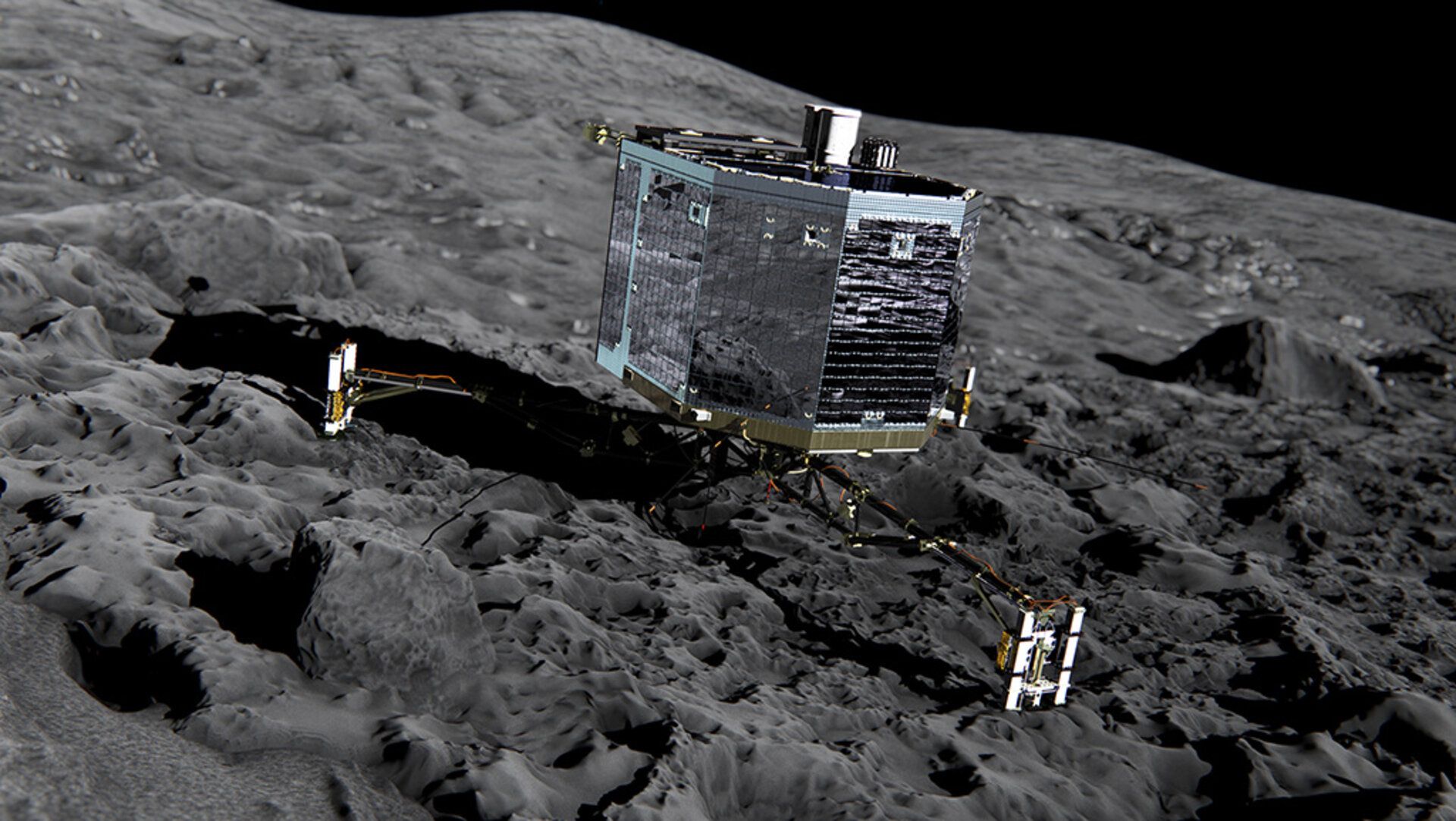
Philae was a European robotic lander carried by the European Space Agency's Rosetta spacecraft to Comet 67P/Churyumov–Gerasimenko. Its purpose was to place scientific instruments directly on a comet nucleus and investigate the surface, subsurface, internal structure, composition and local environment.
The approximately 100 kg lander was provided by a European consortium led by the German Aerospace Center, DLR, with participation from ESA and institutes in Austria, Finland, France, Hungary, Ireland, Italy and the United Kingdom. According to ESA, Philae carried ten scientific instruments and was designed to secure itself after touchdown using landing-leg ice screws and two anchoring harpoons.
Philae travelled attached to Rosetta from the mission's launch in 2004 until its separation in November 2014. It became the first spacecraft to accomplish a soft landing and scientific experiments on the surface of a comet, although failures in its anchoring system caused it to bounce before coming to rest at an unintended site.
Development and cruise
Philae was developed as the surface component of the Rosetta mission. The lander's total spacecraft mass was about 97.6 kg, while its scientific instruments accounted for approximately 27 kg. Including attachment, separation and communications equipment carried on the orbiter, the associated lander hardware totalled about 111 kg.
Rosetta and Philae were launched on 2 March 2004 and travelled for more than ten years before Rosetta reached Comet 67P/Churyumov–Gerasimenko in August 2014. During cruise, Philae remained attached to the orbiter. Some lander instruments were also used during the mission's Mars flyby in February 2007.
Landing site selection
After arrival at 67P, the mission teams evaluated possible landing regions using scientific, engineering and operational criteria. Ten preliminary sites were reduced to five candidates and then to a primary and backup site. Site J, later named Agilkia, was selected for the landing attempt. The planned separation altitude was about 22.5 km, with an estimated descent duration of 6 hours 59 minutes and a planned touchdown velocity of approximately 1 m/s.
Descent and landing
Philae separated from Rosetta on 12 November 2014 at about 08:35 UTC. The release system achieved an ejection speed of approximately 0.1874 m/s. Its tripod legs and deployed instrument components unfolded after separation, and the lander descended without trajectory-correction propulsion while maintaining communication with Rosetta.
Philae first touched the surface at Agilkia at 15:34:04 UTC, about 112 m from the intended target point. The active descent system's cold-gas thruster was already known to be unavailable, and the two anchoring harpoons failed to fire at touchdown. The lander therefore was not secured to the weak-gravity surface and bounced away from Agilkia.
After an approximately two-hour hopping sequence that included additional surface contacts, Philae finally came to rest at 17:31:17 UTC at a site later named Abydos. The final location had poorer solar illumination than Agilkia and left the lander in an unfavorable orientation. A detailed scientific review published by the Royal Society describes the descent, multiple contacts and subsequent surface science program.
Surface science and hibernation
Despite the uncontrolled landing sequence, Philae survived and completed most of its initial scientific program. Its instruments operated during descent, the bouncing phase and at Abydos. The first science sequence continued for about 56 hours 28 minutes. All ten instruments were activated at least once, although unfavorable geometry, limited power and insufficient contact with the surface prevented some planned measurements from producing useful results.
Because the final site received limited sunlight, the primary battery became the main energy source during the initial operations. Philae entered hibernation on 15 November 2014 after its battery was depleted and the solar panels could not provide sufficient continuous power.
Increasing illumination as the comet approached the Sun later allowed the lander to wake. On 13 June 2015, Rosetta received a signal from Philae after 211 days of hibernation. The contact lasted 85 seconds and returned more than 300 telemetry packets. ESA operations reports stated that the lander's subsystems appeared to be functioning nominally and that its solar panels were again generating enough power for intermittent operation. Communication opportunities, however, remained limited and no new scientific data were obtained during the later contact period.
Rediscovery
Philae's exact final location remained uncertain after the landing. Rosetta repeatedly photographed the expected area while continuing its investigation of Comet 67P. On 2 September 2016, close-range images from Rosetta's OSIRIS camera finally showed the lander at Abydos, lying on its side in a shadowed, rocky location. Locating Philae allowed scientists to place its surface measurements into their correct geological context.
Design
Structure and landing system
Philae was a compact, box-shaped spacecraft with a carbon-fiber primary structure. Its dimensions were approximately 0.7 × 0.7 × 0.9 m. Three landing legs formed a tripod with about 2.3 m between the feet.
The spacecraft was a passive lander. It carried no guidance, navigation or propulsion system for correcting its trajectory during the descent. Its landing point was determined primarily by Rosetta's trajectory, orientation, release timing and Philae's separation velocity.
The landing gear was designed to absorb the vertical kinetic energy of touchdown and could safely absorb about 60 J, corresponding to a vertical touchdown speed of approximately 1.1 m/s. Ice screws in the feet were intended to engage the surface. Two harpoons connected to the landing gear were designed to fire automatically and anchor the spacecraft. A cold-gas thruster on the upper structure was intended to push the lander toward the surface during anchoring. The thruster did not operate during the actual landing, and the harpoons also failed to fire.
Power and communications
Solar cells on the exterior supplied electrical power, supplemented by a primary battery for the initial surface operations. The unintended landing position significantly reduced the sunlight available to the panels and prevented sustained operation after the initial battery-powered science sequence.
Philae did not communicate directly with Earth during its comet operations. Radio communications were relayed through Rosetta, reducing the electrical power required by the lander. This architecture also meant that communication depended on the geometry between Philae and the orbiter.
Scientific instruments
Philae carried ten scientific experiments intended to investigate Comet 67P at close range. APXS was intended to determine elemental composition. CIVA provided panoramic and microscopic imaging and sample analysis. CONSERT used radio sounding between Philae and Rosetta to investigate the comet nucleus. COSAC studied molecular composition and possible chirality of samples. MUPUS investigated physical and thermal properties of surface and subsurface material.
PTOLEMY was designed to examine isotopic composition. ROLIS obtained downward-looking images during descent. ROMAP measured magnetic and plasma conditions. SD2 was a drill and sample-transfer system. SESAME combined electrical and acoustic surface sounding with dust-impact monitoring.
Operational history
Philae's first touchdown at Agilkia disturbed a relatively soft surface layer. Analysis of landing dynamics indicated a weak regolith, while the final Abydos site was substantially harder and more rugged. Images from ROLIS and CIVA revealed markedly different terrain at the two locations.
Measurements from CONSERT indicated that the interior of the comet's smaller lobe was highly porous and relatively homogeneous on the scales examined. ROMAP measurements during descent and the bouncing sequence placed a low upper limit on remanent magnetization of the surface material. COSAC and PTOLEMY detected volatile and organic species associated with the cometary environment and material encountered during the landing sequence.
The landing difficulties limited the original long-duration surface program. Nevertheless, eight of the ten instruments produced scientific results used in the later mission analysis. A comprehensive review of the mission concluded that Philae achieved important parts of its objectives concerning surface structure, physical properties, nucleus composition, internal structure and the local plasma environment.
Specifications (Philae lander)
General characteristics
- Type: Robotic comet lander
- Mission: Rosetta
- Target: Comet 67P/Churyumov–Gerasimenko
- Lander mass: approximately 97.6 kg
- Mass including associated orbiter-mounted lander units: approximately 111 kg
- Scientific instrument mass: approximately 27 kg
- Dimensions: approximately 0.7 × 0.7 × 0.9 m
- Landing gear: three-leg tripod, approximately 2.3 m between feet
- Scientific instruments: 10
- Electrical power: primary battery and external solar cells
- Communications: radio relay through the Rosetta orbiter
Landing system
- Descent method: passive ballistic descent without trajectory-correction propulsion
- Release altitude for 2014 landing: approximately 22.5 km above the surface
- Release velocity: approximately 0.1874 m/s
- Planned touchdown velocity: approximately 1 m/s
- Landing-gear energy absorption: up to approximately 60 J
- Surface anchoring: two harpoons and ice screws in the landing feet
- Active descent system: cold-gas thruster intended to push the lander toward the surface during touchdown
Scientific payload
- APXS: elemental composition analysis
- CIVA: panoramic and microscopic imaging and sample analysis
- CONSERT: radio sounding of the comet nucleus
- COSAC: molecular composition analysis
- MUPUS: physical and thermal properties of surface and subsurface material
- PTOLEMY: isotopic composition measurements
- ROLIS: descent and surface imaging
- ROMAP: magnetic-field and plasma measurements
- SD2: drilling, sample acquisition and transfer
- SESAME: electrical and acoustic surface sounding and dust-impact monitoring
 Argentina
 Armenia
 Australia
 Austria
 Austria-Hungary
 Belgium
 Brazil
 United Kingdom
 United States
 Brunei
 Bulgaria
 Canada
 Chile
Chile China
China Colonial America
 Colombia
 Confederate States
 Croatia
 Czech
Czech Denmark
 Egypt
Egypt Finland
 France
 Georgia
 German Imperial
 Greece
 Holland
 Hungary
 India
India Indonesia
 Iran
Iran Iraq
Iraq Ireland
 Israel
 Italy
Italy Japan
Japan Japan (1940)
 Jordan
 Kingdom of Italy
 Malaysia
 Mexico
 Myanmar
 Nazi Germany
 Netherlands
 New Zealand
 North Korea
 Norway
 Pakistan
 Peru
Peru Philippines
 Poland
 Portugal
 Prussia
 Romania
 Russia
 Saudi Arabia
 Serbia
 Singapore
 Slovakia
 Slovenia
 South Africa
 South Korea
 Soviet Union
 Spain
Spain Sweden
 Switzerland
 Syria
Syria Taiwan
 Thailand
 Turkey
 UAE
UAE Ukraine
 Vietnam
 Yugoslavia