
History
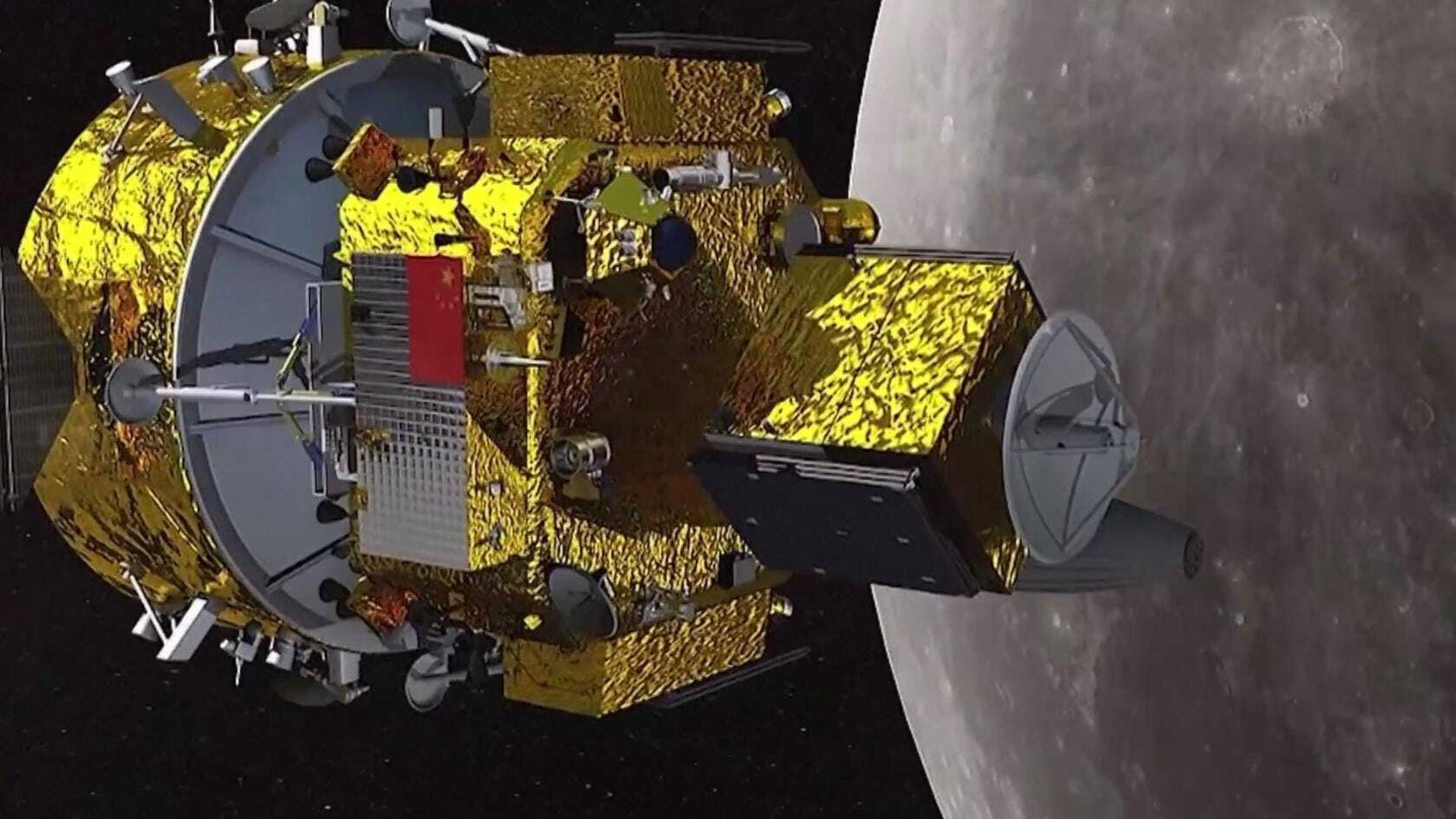
Chang'e 7 is a Chinese robotic lunar exploration mission designed to investigate the Moon's south polar region, with particular emphasis on water ice, volatile materials, surface conditions and local resources. Its architecture combines an orbiter, lander, rover and small hopping probe supported by the Queqiao-2 lunar relay satellite.
The mission represents part of the fourth phase of China's lunar exploration program and is intended to combine orbital remote sensing, precision landing, surface roving and short hopping flights into permanently shadowed terrain. Chang'e 7 is also intended to provide scientific and technical information for later Chinese lunar exploration and the planned International Lunar Research Station.
Chang'e 7 hardware was delivered to the Wenchang launch site in April 2026. The spacecraft and Long March 5 Y14 launch vehicle were rolled out together on 19 August 2026 for a planned 24 August launch, but a subsequent Space.com report stated that bad weather had caused a substantial delay and that launch could slip into 2027.
Development
Chang'e 7 followed China's earlier Chang'e lunar missions, which demonstrated lunar orbiting, surface landing and roving, and robotic sample return. The mission was formally approved in September 2022 according to China in Space. Earlier concepts included a dedicated relay satellite, but this element was removed after the Queqiao-2 relay satellite was launched in 2024 to support China's later lunar missions.
The resulting mission architecture consists of four principal spacecraft: an orbiter, a lander, a rover and a hopper. The complete spacecraft stack has been described as approximately 8,200 kg. The orbiter is to conduct remote sensing and reconnaissance from lunar orbit, while the lander carries the rover and hopper to the south polar surface.
Chang'e 7 and the later Chang'e 8 mission are associated with preparations for China's planned International Lunar Research Station. Chang'e 8 is intended to follow with additional technology demonstrations for future lunar infrastructure.
Landing plan
Mission planning focuses on the lunar south polar region. The rim of Shackleton crater has been identified as a preferred candidate landing area because it combines favorable illumination with access to nearby permanently shadowed terrain. The Planetary Society notes that a final landing area had not been publicly announced and that terrain safety, illumination and scientific potential were factors in site selection.
After reaching lunar orbit, the orbiter is expected to examine potential landing areas before the lander begins its descent. Chang'e 7 is designed for landing accuracy better than 100 m, a major increase in precision compared with earlier Chang'e landing missions. The landing system includes landmark image navigation and hazard avoidance capabilities intended for the difficult terrain of the lunar south pole.
Design
Mission architecture
Chang'e 7 uses an integrated exploration architecture in which the four spacecraft perform complementary tasks. The orbiter surveys the Moon from above and supports landing-site reconnaissance. The lander provides the stationary surface platform and deploys the rover and hopper. The rover travels across accessible terrain, while the hopper is designed to enter locations that cannot readily be reached by a wheeled vehicle.
The mission relies on Queqiao-2 for communications relay rather than carrying a dedicated relay satellite. Removing the originally proposed relay element allowed the later configuration to concentrate mass and payload capacity on the remaining spacecraft, including the hopper.
Orbiter
The orbiter carries instruments for high-resolution imaging, radar observations, mineral mapping, elemental measurements, magnetic-field studies, space-weather observations and Earth radiation measurements. Its High Resolution Stereo Mapping Camera is specified to provide better than 0.5 m surface resolution with an imaging width greater than 18 km from an altitude of 100 km. From 15 km altitude, the stated resolution improves to better than 0.075 m with an imaging width greater than 0.9 km.
A miniature synthetic-aperture radar is intended to image the lunar surface using radar, including terrain where optical observations are difficult. Other Chinese instruments include a wide-band infrared mineral imaging analyzer, a lunar neutron-gamma spectrometer and a lunar orbit magnetometer.
International orbiter payloads include a hyperspectral imager developed jointly by the Egyptian and Bahraini space agencies, a Moon-based Dual-channel Earth Radiation Spectrometer supplied with Swiss participation, and a Thai space-weather particle detector. The hyperspectral instrument is intended to study the composition and distribution of lunar surface materials.
Lander
The lander carries cameras for descent and local topographic observations together with instruments for studying the surface environment and interior of the Moon. A lunar seismograph is intended to record seismic activity, while the Lunar Surface Environment Detection System measures properties of the local particle, electric-field and dust environment.
International equipment on the lander includes an Italian laser corner-reflector array, a Russian lunar dust and electric-field instrument, and the ILO-C wide-field optical telescope developed through cooperation between the International Lunar Observatory Association and the University of Hong Kong's Laboratory for Space Research. The Beijing Institute of Space Mechanics & Electricity built the camera to the ILO-C team's specifications. The instrument is intended to obtain wide-field visible-color astronomical imagery from the lunar surface.
Rover
The Chang'e 7 rover is derived from the Yutu rover family used on Chang'e 3 and Chang'e 4. Its instrument suite includes a panoramic camera, magnetometer, lunar penetrating radar, Raman spectrometer and an in-situ system for measuring volatile substances and isotopes in lunar surface material.
The rover is intended to examine local geology and subsurface structure while searching for evidence of volatile compounds. Its ground-penetrating radar sends radar signals beneath the surface to investigate subsurface layers and structures, while the Raman spectrometer analyzes minerals and other surface materials.
Hopper
The hopper is a small mobile probe designed to make repeated short flights between illuminated terrain and permanently shadowed craters. These dark regions are important targets because extremely low temperatures can preserve water ice and other volatile compounds.
The hopper incorporates active shock absorption for landing on sloped terrain. After entering a shadowed crater, it is intended to move away from terrain disturbed by its landing and use its water-molecule and hydrogen-isotope analysis equipment to examine local material. It must then return toward illuminated terrain to maintain solar-powered operations.
The hopping vehicle gives Chang'e 7 access to steep or permanently shadowed areas that are impractical for the rover. This capability is central to the mission's planned direct search for lunar water ice.
Scientific objectives
Chang'e 7 is designed to investigate the lunar surface environment and search for water ice in the south polar region. Other objectives include high-precision study of lunar morphology, composition and structure; investigation of the Moon's internal structure, magnetic field and thermal characteristics; general characterization of the south polar environment; and Moon-based observations of Earth's magnetotail and plasmasphere.
The mission will use different observing methods across its four spacecraft. The orbiter provides regional mapping and remote sensing, the lander makes long-duration measurements at a fixed site, the rover studies accessible surface and subsurface terrain, and the hopper investigates shadowed areas where volatile deposits may be preserved.
Program status
By April 2026, Chang'e 7 flight hardware had reached the Wenchang launch site. On 19 August 2026, the combined Chang'e 7 spacecraft and Long March 5 Y14 rocket were rolled out at Wenchang in preparation for launch.
The mission had been targeting launch on 24 August 2026. Reporting updated on 23 August stated that bad weather had forced a substantial postponement and that the launch might be delayed until 2027. Consequently, the mission should be regarded as awaiting launch rather than operational.
Once launched, the spacecraft is planned to enter lunar orbit and spend time observing potential landing areas before the surface elements descend. The lander, rover and hopper will then attempt coordinated exploration of the south polar region, while the orbiter remains in lunar orbit for remote-sensing observations.
Components
- Orbiter: Lunar-orbiting spacecraft for mapping, radar observations, mineral and elemental studies, magnetic measurements and international scientific experiments.
- Lander: Stationary surface platform carrying cameras, environmental instruments, a seismograph and several international payloads, while also deploying the rover and hopper.
- Rover: Solar-powered mobile surface vehicle equipped for imaging, mineral analysis, magnetic measurements, subsurface radar observations and volatile studies.
- Hopper: Short-range flying probe designed to enter permanently shadowed terrain and directly investigate water ice and other volatile materials.
Specifications (Chang'e 7 mission architecture)
General characteristics
- Type: Robotic lunar south-pole exploration mission
- Principal spacecraft: Orbiter, lander, rover and hopper
- Approximate spacecraft mass: 8,200 kg
- Launch vehicle: Long March 5 Y14
- Launch site: Wenchang Space Launch Site, China
- Communications support: Queqiao-2 lunar relay satellite
- Target region: Lunar south pole
- Preferred landing area: Region near the rim of Shackleton crater
Landing and exploration
- Planned landing accuracy: Better than 100 m
- Exploration modes: Orbital observation, landing, surface roving and hopping
- Primary resource target: Water ice and other volatile compounds in south polar terrain
Orbiter imaging performance
- Stereo camera resolution at 100 km altitude: Better than 0.5 m
- Stereo camera imaging width at 100 km altitude: Greater than 18 km
- Stereo camera resolution at 15 km altitude: Better than 0.075 m
- Stereo camera imaging width at 15 km altitude: Greater than 0.9 km
Related equipment
- Queqiao-2: Lunar relay satellite supporting communications for Chang'e 7 and other Chinese lunar missions.
- Chang'e 6: Earlier fourth-phase Chinese lunar mission that returned samples from the Moon's far side in 2024.
- Chang'e 8: Planned follow-on lunar mission intended to test technologies relevant to future lunar infrastructure and the International Lunar Research Station.
 Argentina
 Armenia
 Australia
 Austria
 Austria-Hungary
 Belgium
 Brazil
 United Kingdom
 United States
 Brunei
 Bulgaria
 Canada
 Chile
Chile Colonial America
 Colombia
 Confederate States
 Croatia
 Czech
Czech Denmark
 Egypt
Egypt Finland
 France
 Georgia
 Germany
 German Imperial
 Greece
 Holland
 Hungary
 India
India Indonesia
 Iran
Iran Iraq
Iraq Ireland
 Israel
 Italy
Italy Japan
Japan Japan (1940)
 Jordan
 Kingdom of Italy
 Malaysia
 Mexico
 Myanmar
 Nazi Germany
 Netherlands
 New Zealand
 North Korea
 Norway
 Pakistan
 Peru
Peru Philippines
 Poland
 Portugal
 Prussia
 Romania
 Russia
 Saudi Arabia
 Serbia
 Singapore
 Slovakia
 Slovenia
 South Africa
 South Korea
 Soviet Union
 Spain
Spain Sweden
 Switzerland
 Syria
Syria Taiwan
 Thailand
 Turkey
 UAE
UAE Ukraine
 Vietnam
 Yugoslavia