
History
CAST Chang'e 8 is a planned China National Space Administration robotic mission to the lunar south-polar region. The mission is scheduled for launch around 2029 and is intended to land on the Leibnitz-Beta Plateau near the lunar south pole. It will combine a lander, rover and surface robot with Chinese and international scientific and technology payloads.
Chang'e 8 is designed to follow Chang'e 7 and extend China's investigation of the south-polar environment. Its program combines scientific measurements with in-situ resource utilization experiments intended to support later International Lunar Research Station activities.
The mission also carries a substantial international cooperation element. CNSA announced 200 kg of payload resources for foreign partners, and in April 2025 selected ten collaborative projects involving partners from 11 countries and regions and one international organization. The selected payloads include the Africa2Moon Bounced African Low Lunar Sphere radio-astronomy demonstrator.
Development and international cooperation
CNSA opened international cooperation opportunities for Chang'e 8 in October 2023. The available research describes three cooperation levels: independent partner spacecraft working with Chang'e 8, system-level contributions such as rovers or robots transported by the lander, and instruments mounted on the lander. For system- and instrument-level contributions, the mission offers 200 kg of combined payload capacity. An individual payload may weigh up to 100 kg. The combined electrical-power allocation is 200 W, with an individual payload limited to 50 W.
On 24 April 2025, CNSA announced the selected international projects and stated that Chang'e 8 would launch around 2029. The mission was assigned to the Leibnitz-Beta Plateau near the lunar south pole, where it is expected to work with Chang'e 7 on scientific exploration and resource-utilization experiments. The announcement is available through the Chinese government report.
The selected projects include a multi-functional surface robot from Hong Kong researchers, a Pakistani lunar rover, two small exploration robots developed through Turkish-Chinese cooperation, a South African-Peruvian radio-astronomy project, Italian laser retroreflectors, Russian plasma and energetic-particle instruments, a Thai neutron analyzer, a Bahrain-Egypt imaging system and an Iranian lunar-potential monitor.
By April 2026, structural and functional models of the Africa2Moon spherical probes had been assembled in South Africa for delivery to the Chang'e 8 team for testing. These payload models were manufactured with participation from Petrawell in Cape Town, the Aerospace Systems Research Institute at the University of KwaZulu-Natal and the Electronic Systems Laboratory at Stellenbosch University.
Design
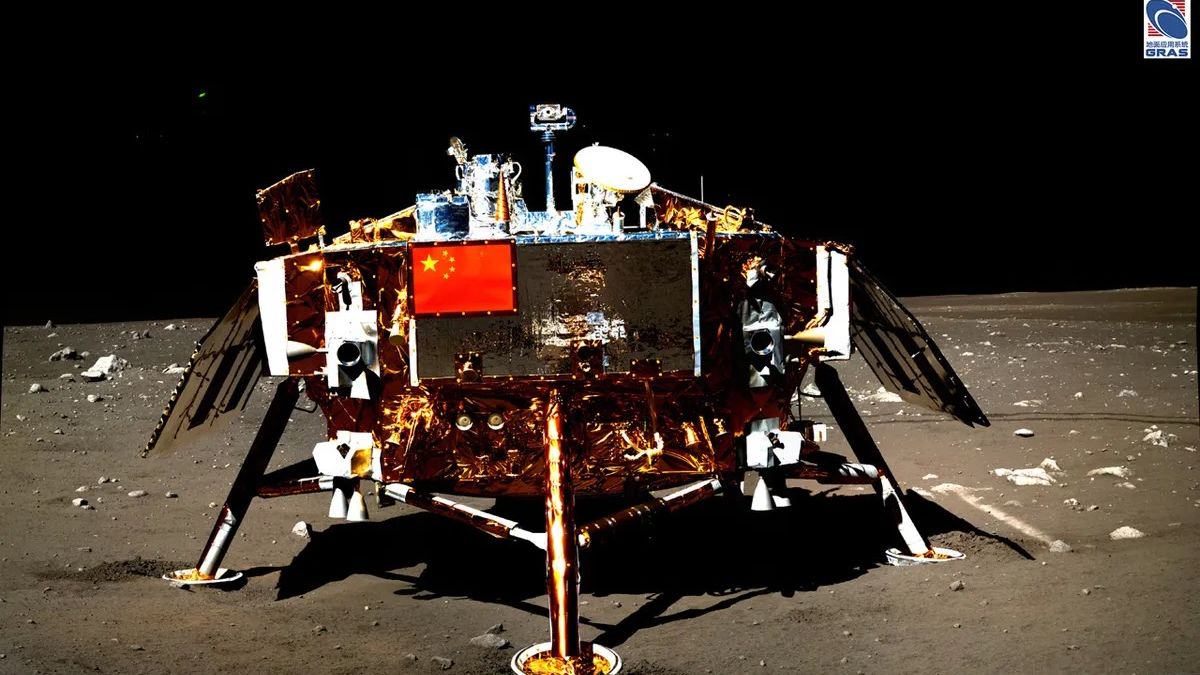
Chang'e 8 is planned as a multi-element lunar surface mission. The core Chinese configuration consists of a lander, a rover and a mobile surface robot. The lander is derived from the Chang'e 3 bus but is described as having two main engines and additional attitude-control thrusters intended to provide greater propulsion redundancy for a precision south-polar landing.
Because sunlight reaches the lunar south-polar region at a very low angle, the lander is described as using a vertically deployed, rotatable mast carrying two solar-panel sections rather than relying only on side-mounted panels. Transponders at the top of the mast are intended to support local communications with surface robots.
Rover and surface robot
The rover is described as similar in general arrangement to Yutu-2, but with a vertical two-section solar array at the rear. Its planned work includes techniques for collecting, separating and storing noble gases from lunar material. The separate six-wheeled surface robot is intended to collect regolith with rotating brushes, transport material to the lander and deploy sensors around the landing area. Available descriptions also state that the robot is planned to use a nuclear-based hybrid power system rather than solar panels.
Scientific payloads
The planned Chinese lander payload includes landing and terrain cameras, a seismometer, a low-frequency electromagnetic-field detector, a regolith heat-flow instrument, Earth-observation radiometry and multispectral imaging instruments, a soft X-ray telescope, a miniature terrestrial-ecosystem experiment and an in-situ resource-utilization device. The rover payload is planned to include a panoramic camera, ground-penetrating radar, an infrared mineral analyzer and an in-situ lunar-sample analysis and storage device.
The resource-utilization work is intended to test techniques for using local lunar material, including experiments associated with producing brick-like construction material from regolith. These experiments are technology demonstrations and should not be treated as operational lunar construction capability.
Africa2Moon BALLS payload
The Africa2Moon Bounced African Low Lunar Sphere, or BALLS, payload consists of three spherical probes intended to form a low-frequency radio-astronomy array on the lunar surface. Each probe uses a spherical frame of interlocking rings around two large triangular solar-panel arrays arranged in opposite directions. The spheres carry low-frequency radio antennas.
The array is intended to observe frequencies below 20 MHz that cannot be effectively observed from Earth's surface because of ionospheric distortion and terrestrial radio interference. After deployment, the three probes are intended to operate as a spaced array, with their data sent to the Chang'e 8 lander for relay to Earth. A detailed description of the payload and its 2026 test hardware is available in the Space.com report.
The three-probe BALLS payload is a technology demonstrator and pathfinder. Africa2Moon separately proposes a later array of 55 antennas on the lunar far side. That larger array is not part of the Chang'e 8 mission.
Program status
Chang'e 8 remains a planned mission. CNSA stated in April 2025 that launch is scheduled for around 2029. The mission is expected to use a Long March 5 launch vehicle from Wenchang and to target the Leibnitz-Beta Plateau near the lunar south pole. The final surface campaign is intended to complement Chang'e 7 and provide scientific and engineering data relevant to the planned International Lunar Research Station.
The Africa2Moon BALLS hardware had progressed to structural and functional models by April 2026, but the payload still required integration and testing with the Chang'e 8 program. The mission and its payloads should therefore be described as under development rather than operational.
Operators
- China National Space Administration (CNSA): planned mission operator for Chang'e 8.
Specifications (Chang'e 8 mission)
Mission characteristics
- Mission type: robotic lunar lander, rover and surface-robot mission
- Operator: China National Space Administration
- Manufacturer: China Academy of Space Technology (CAST)
- Planned launch: around 2029
- Launch vehicle: Long March 5
- Launch site: Wenchang
- Target region: Leibnitz-Beta Plateau near the lunar south pole
- International payload allocation: 200 kg combined
- Maximum individual international payload mass: 100 kg
- International payload power allocation: 200 W combined; up to 50 W for an individual payload
Africa2Moon BALLS payload
- Number of probes: three spherical units
- Primary role: low-frequency radio-astronomy technology demonstrator
- Observation band: below 20 MHz
- Communications concept: probe data relayed through the Chang'e 8 lander to Earth
Related equipment
- Chang'e 7: preceding Chinese lunar south-pole mission intended to survey the region and work in sequence with Chang'e 8.
- International Lunar Research Station: planned lunar research infrastructure for which Chang'e 7 and Chang'e 8 are intended to provide scientific and technology-demonstration groundwork.
 Argentina
 Armenia
 Australia
 Austria
 Austria-Hungary
 Belgium
 Brazil
 United Kingdom
 United States
 Brunei
 Bulgaria
 Canada
 Chile
Chile Colonial America
 Colombia
 Confederate States
 Croatia
 Czech
Czech Denmark
 Egypt
Egypt Finland
 France
 Georgia
 Germany
 German Imperial
 Greece
 Holland
 Hungary
 India
India Indonesia
 Iran
Iran Iraq
Iraq Ireland
 Israel
 Italy
Italy Japan
Japan Japan (1940)
 Jordan
 Kingdom of Italy
 Malaysia
 Mexico
 Myanmar
 Nazi Germany
 Netherlands
 New Zealand
 North Korea
 Norway
 Pakistan
 Peru
Peru Philippines
 Poland
 Portugal
 Prussia
 Romania
 Russia
 Saudi Arabia
 Serbia
 Singapore
 Slovakia
 Slovenia
 South Africa
 South Korea
 Soviet Union
 Spain
Spain Sweden
 Switzerland
 Syria
Syria Taiwan
 Thailand
 Turkey
 UAE
UAE Ukraine
 Vietnam
 Yugoslavia