
History
NPO Lavochkin Luna 24 was a Soviet robotic lunar sample-return spacecraft and the final Soviet mission to the Moon. Launched on August 9, 1976, it landed in Mare Crisium, drilled into the lunar regolith, and returned 170.1 g of material to Earth.
Luna 24 was the third successful Soviet robotic lunar sample-return mission, following Luna 16 and Luna 20. It used the upgraded E8-5M spacecraft design and a new LB-09 rotary-percussion drill intended to recover a deeper core while preserving the relative order of soil layers.
The mission concluded the Soviet Luna program's first era of lunar exploration. Its returned core became an important international research sample and provided detailed information about the geology and composition of Mare Crisium.
Development
Luna 24 belonged to the E8-5M series, an improved version of the earlier E8-5 robotic sample-return spacecraft. The E8-5M design incorporated a redesigned drilling system and several spacecraft changes. The thermal-control system used less water than the earlier design, and the Kvant low-altitude altimeter was removed.
The principal improvement was the LB-09 lunar drill developed by the Tashkent branch of the KBOM design bureau for NPO Lavochkin. Unlike the sampling equipment carried by Luna 16 and Luna 20, the LB-09 was designed to preserve the stratigraphic order of the extracted regolith. It could also vary its drilling action according to soil resistance.
The first E8-5M mission was Luna 23, launched in 1974. Luna 23 reached Mare Crisium but was damaged during landing and could not return a sample. Its drill was nevertheless tested while the spacecraft lay in an abnormal position. A second E8-5M launch attempt in October 1975 failed when the Proton-K upper stage did not place the spacecraft into its planned initial orbit. Luna 24, spacecraft E8-5M No. 413, was prepared as the next attempt.
Launch and lunar arrival
Luna 24 launched from Site 81 at Baikonur on August 9, 1976, at 15:04:12 UTC aboard a Proton-K rocket with a Block D upper stage. The spacecraft first entered Earth orbit before being dispatched toward the Moon. A trajectory correction was conducted on August 11.
The spacecraft entered an approximately circular 115 km lunar orbit in mid-August with an inclination of 120 degrees and an orbital period of about 1 hour 59 minutes. Additional maneuvers lowered the orbit to approximately 12 by 120 km before the final descent.
On August 18, Luna 24 performed its braking maneuver and landed successfully in the southeastern part of Mare Crisium at about 12.7 degrees north and 62.2 degrees east. The landing site was only a short distance from the disabled Luna 23 spacecraft.
Design
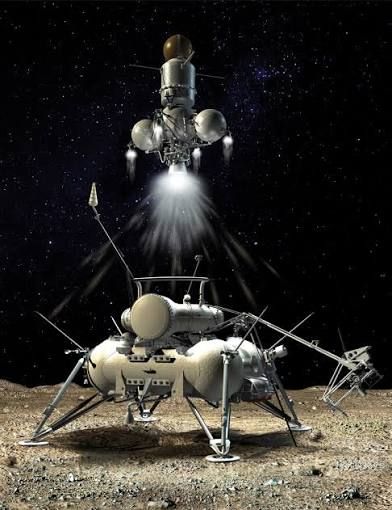
Luna 24 used the E8-5M architecture developed for automated lunar sample return. The spacecraft combined a landing and propulsion section, a lunar ascent vehicle, an Earth-return capsule, and the soil-sampling system. The descent stage provided propulsion for lunar-orbit maneuvers and the powered landing, while the ascent stage carried the sealed sample container away from the Moon.
Sampling system
The LB-09 system consisted of a drill head, drilling shaft, sample cartridge, drive mechanism, retrieval mechanism, transfer equipment, and sample-storage container. The drill initially operated in rotary mode. At greater depth it could switch to a combined percussion and rotary mode.
During the Luna 24 mission, the drill penetrated approximately 225 cm along a path inclined about 30 degrees from the local vertical, corresponding to roughly 2 m of vertical depth. Lunar material entered a flexible tube inside the drill. After drilling, the tube was withdrawn and coiled onto a drum so that it could fit inside the compact return capsule.
The recovered sample formed a core approximately 160 cm long and had a total mass of 170.1 g. The system preserved much of the relative layering of the soil, making it possible to examine changes in the regolith with depth. Detailed information on the returned core is available from the Lunar Sample Compendium.
Return system
After the sample container had been transferred and sealed, the lunar ascent vehicle used the descent stage as its launch platform. The ascent vehicle was accelerated onto a direct trajectory toward Earth rather than entering a separate lunar parking orbit.
Near Earth, the reentry capsule separated from the return vehicle and entered the atmosphere. The capsule used parachutes for its final descent and carried the lunar sample in a sealed container.
Operational history
After landing on August 18, 1976, ground controllers checked the spacecraft and commanded the LB-09 drill to begin sampling. Telemetry reported the progress of drilling and transfer of the regolith into the return system.
The ascent vehicle departed the lunar surface on August 19 after Luna 24 had spent less than one day at its landing site. The spacecraft then made a direct return flight to Earth. The reentry capsule landed in Western Siberia about 200 km southeast of Surgut on August 22, completing the sample-return mission.
The 170.1 g sample was taken to the Vernadsky Institute of Geochemistry and Analytical Chemistry for study. Portions were later shared with research institutions in other countries, including the United States, Britain, India, and Czechoslovakia. Soviet scientists also exchanged Luna 24 material for samples returned by NASA's Apollo missions.
Analysis showed that the Mare Crisium core contained multiple layers with different colors, textures, and compositions. Much of the material consisted of mare basalt, including very-low-titanium basalt. Researchers also identified small amounts of highland material. Scientific studies of Luna 24 material became an important source of information about the geological development of Mare Crisium.
Luna 24 was the third successful Soviet automated lunar sample-return mission and the last Soviet spacecraft to make a soft landing on the Moon. It also remained the Soviet Union's final lunar mission. A detailed mission chronology and engineering history is available from RussianSpaceWeb.
Specifications (Luna 24 E8-5M No. 413)
General characteristics
- Manufacturer: NPO Lavochkin
- Spacecraft designation: E8-5M No. 413
- Mission: Robotic lunar sample return
- Launch mass: approximately 5,795 kg
- Descent module dry mass: 1,640.5 kg
- Descent-stage propellant mass: 3,539 kg
- Lunar ascent vehicle mass: 514.8 kg
- Earth-return capsule mass: 34 kg
- Power-system battery capacity: 574 Ah
- Launch vehicle: Proton-K with Block D upper stage
- Launch site: Baikonur Cosmodrome, Site 81
Lunar mission
- Launch date: August 9, 1976
- Initial lunar orbit altitude: approximately 115 km
- Initial lunar orbit inclination: 120 degrees
- Initial lunar orbital period: approximately 1 hour 59 minutes
- Lunar landing date: August 18, 1976
- Landing region: Mare Crisium
- Lunar ascent date: August 19, 1976
- Earth return date: August 22, 1976
- Returned sample mass: 170.1 g
- Returned core length: approximately 160 cm
- Drill penetration: approximately 225 cm along the drilling path
LB-09 drill
- External diameter: 15 mm
- Internal diameter: 8 mm
- Length: 3,157 mm
- Maximum drilling range: 2,575 mm
- Operating modes: Rotary and percussion-rotary drilling
Related equipment
- Luna 16: Earlier Soviet robotic lunar sample-return spacecraft and the first successful mission of its type.
- Luna 20: Second successful Soviet robotic lunar sample-return mission.
- Luna 23: Earlier E8-5M spacecraft that landed in Mare Crisium but was damaged and could not return a sample.
 Argentina
 Armenia
 Australia
 Austria
 Austria-Hungary
 Belgium
 Brazil
 United Kingdom
 United States
 Brunei
 Bulgaria
 Canada
 Chile
Chile China
China Colonial America
 Colombia
 Confederate States
 Croatia
 Czech
Czech Denmark
 Egypt
Egypt Finland
 France
 Georgia
 Germany
 German Imperial
 Greece
 Holland
 Hungary
 India
India Indonesia
 Iran
Iran Iraq
Iraq Ireland
 Israel
 Italy
Italy Japan
Japan Japan (1940)
 Jordan
 Kingdom of Italy
 Malaysia
 Mexico
 Myanmar
 Nazi Germany
 Netherlands
 New Zealand
 North Korea
 Norway
 Pakistan
 Peru
Peru Philippines
 Poland
 Portugal
 Prussia
 Romania
 Russia
 Saudi Arabia
 Serbia
 Singapore
 Slovakia
 Slovenia
 South Africa
 South Korea
 Spain
Spain Sweden
 Switzerland
 Syria
Syria Taiwan
 Thailand
 Turkey
 UAE
UAE Ukraine
 Vietnam
 Yugoslavia