
History
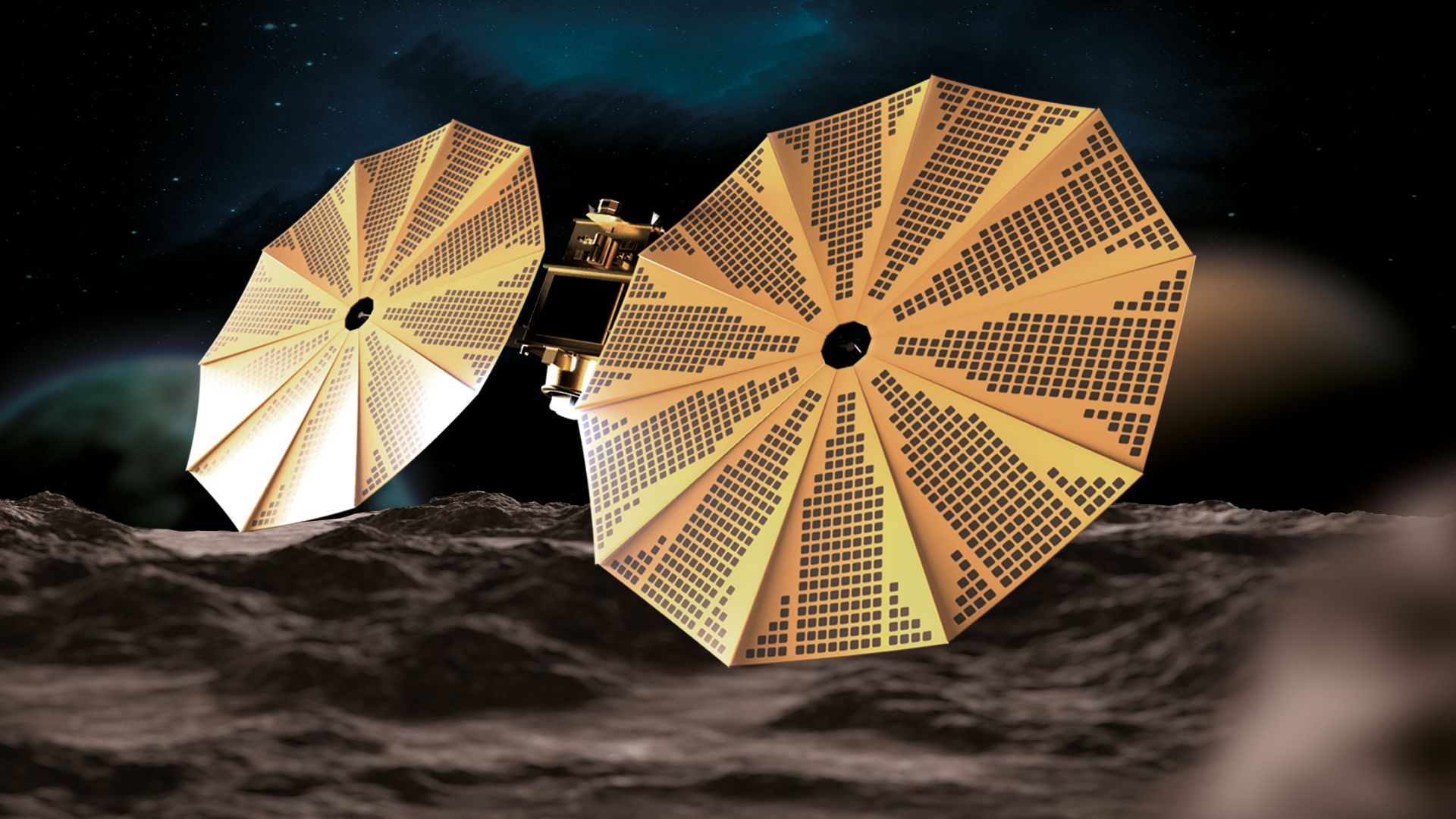
The Emirates Mission to the Asteroid Belt (EMA) was announced by the UAE Space Agency in May 2023 as the United Arab Emirates' second interplanetary mission, following the Hope Mars orbiter. The lander for the mission was designed, built, and tested by the Technology Innovation Institute (TII) in Abu Dhabi by a team of approximately 50 engineers and scientists, many of whom had begun their careers as entry-level technicians on the Hope Mars mission. Development of the lander was completed in under two years.
A half-scale model of the lander was unveiled at a press conference in Abu Dhabi on 1 October 2026. The flight-ready lander is held in a vacuum chamber in the UAE and is to be transported to Colorado, United States, for integration with the main spacecraft MBR Explorer, which was developed by the UAE Space Agency.
The mission is scheduled to launch from Tanegashima Space Center, Japan, during a three-week window opening in early March 2028 aboard an H3 launch vehicle. The MBR Explorer will conduct high-speed flybys of six asteroids before reaching its final target, 269 Justitia. The mission team's briefing places the rendezvous with 269 Justitia in 2036, while the Wikipedia article on MBR Explorer gives 2034. The lander deployment will follow the main spacecraft's roughly seven-month orbital survey of the asteroid.
Specifications
The UAE Asteroid Lander is a fully autonomous spacecraft that will operate without receiving commands from Earth or from MBR Explorer after deployment. It carries two onboard cameras and an attitude-control system to counteract any spin acquired during separation. An onboard artificial intelligence system decides when to capture images and filters and ranks the most valuable data; the lander takes images throughout the cruise and transmits its best selections to Earth approximately every six months.
The lander is designed to descend onto the surface of 269 Justitia at 15 to 27 m/s with no meaningful means of deceleration. The descent is expected to last two to three hours, depending on the asteroid's precise gravity, which remains unknown. The team does not expect the probe to survive the surface encounter. Should it remain functional, its battery is rated for 20 to 50 minutes of operation. The impact is expected to excavate a small crater on the asteroid's surface, potentially exposing subsurface material that cannot be imaged from orbit.
 Argentina
 Armenia
 Australia
 Austria
 Austria-Hungary
 Belgium
 Brazil
 United Kingdom
 United States
 Brunei
 Bulgaria
 Canada
 Chile
Chile China
China Colonial America
 Colombia
 Confederate States
 Croatia
 Czech
Czech Denmark
 Egypt
Egypt Finland
 France
 Georgia
 Germany
 German Imperial
 Greece
 Holland
 Hungary
 India
India Indonesia
 Iran
Iran Iraq
Iraq Ireland
 Israel
 Italy
Italy Japan
Japan Japan (1940)
 Jordan
 Kingdom of Italy
 Malaysia
 Mexico
 Myanmar
 Nazi Germany
 Netherlands
 New Zealand
 North Korea
 Norway
 Pakistan
 Peru
Peru Philippines
 Poland
 Portugal
 Prussia
 Romania
 Russia
 Saudi Arabia
 Serbia
 Singapore
 Slovakia
 Slovenia
 South Africa
 South Korea
 Soviet Union
 Spain
Spain Sweden
 Switzerland
 Syria
Syria Taiwan
 Thailand
 Turkey
 Ukraine
 Vietnam
 Yugoslavia