
History
The JAXA Martian Moons eXploration spacecraft, commonly known as MMX, is a Japanese robotic spacecraft designed to explore the Martian moons Phobos and Deimos and return material from Phobos to Earth. The mission is led by the Japan Aerospace Exploration Agency (JAXA), with contributions from NASA, the French space agency CNES, the German Aerospace Center DLR, and the European Space Agency.
MMX combines orbital observation, low-gravity landing, surface sampling, rover deployment, and an interplanetary return flight. Its principal scientific objective is to help determine whether Phobos and Deimos are captured asteroids or formed from debris produced by a major impact on early Mars.
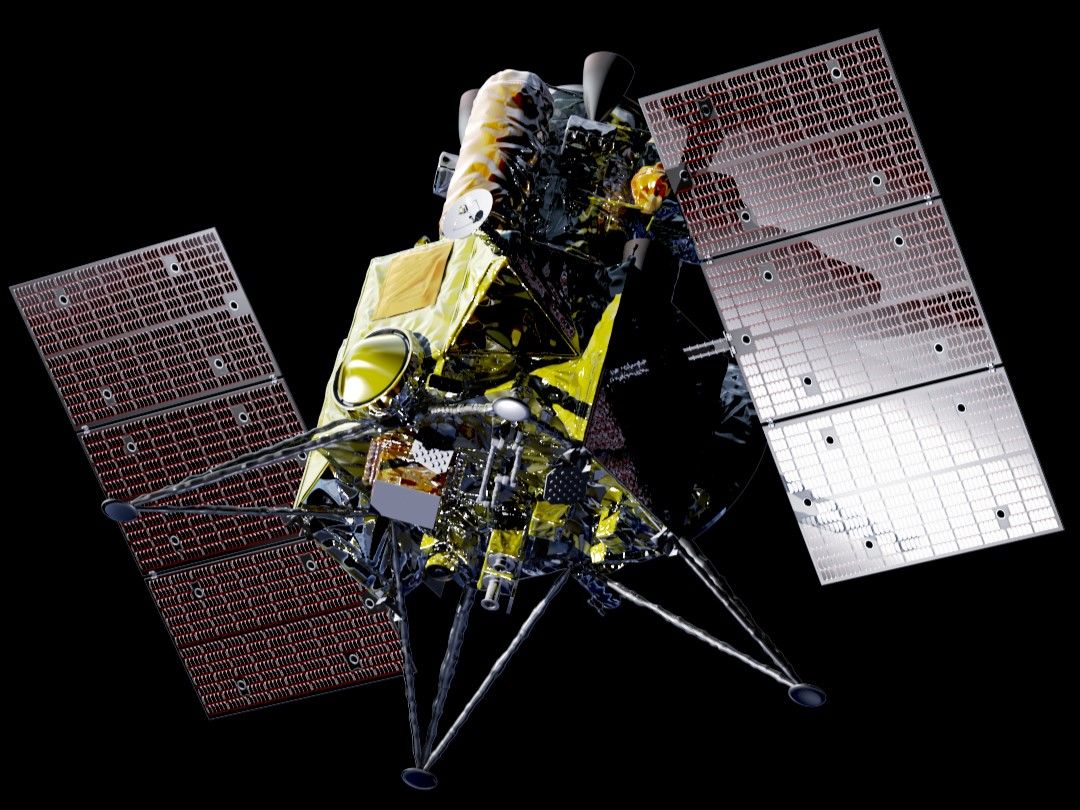
The spacecraft consists of three major elements: a propulsion module, an exploration module, and a return module. The complete flight spacecraft was publicly unveiled at Tanegashima Space Center on 13 August 2026 ahead of its planned launch toward Mars in October 2026.
Development
JAXA announced the Martian Moons eXploration mission in 2015. The project was approved to proceed into development in February 2020. According to the JAXA Institute of Space and Astronautical Science, the mission was developed to observe both Martian moons, collect material from Phobos, and return those samples to Earth while advancing technologies for planetary exploration, sampling, communications, and travel between Mars and Earth.
An earlier mission schedule called for launch in 2024. This plan was abandoned because of problems affecting Japan's H3 launch vehicle. Since suitable Earth-Mars launch opportunities occur approximately every 26 months, the delay moved the mission to the 2026 launch window. Earlier schedule information retained by independent references such as Gunter's Space Page therefore differs from the current 2026 mission plan.
Integration and launch preparations
MMX reached Tanegashima Space Center by March 2026 and underwent final launch preparations there. On 13 August 2026, Japan publicly displayed the propulsion module together with the exploration and return modules. JAXA subsequently announced a planned liftoff at 04:41 Japan time on 20 October 2026, corresponding to 19 October at 19:41 GMT. The announced launch window extends through 7 November.
The spacecraft is planned to launch aboard an H3 rocket from Tanegashima. The ESA MMX factsheet states that the complete spacecraft has a mass of about 4,200 kg including fuel.
Design
MMX uses a modular architecture intended to support the different phases of the round trip between Earth, Mars, Phobos, and Earth again. The spacecraft comprises a propulsion module for the outbound transfer and major orbital manoeuvres, an exploration module that carries the landing and sampling equipment, and a return module that conducts the later return phase and carries the sample-return capsule.
Propulsion module
The propulsion module uses chemical propulsion to transport MMX toward Mars and support major acceleration and deceleration manoeuvres. It also houses guidance, navigation, and control equipment used to determine spacecraft position and control orientation.
Return module
The return module carries a high-gain dish antenna for communications with Earth and receives electrical power from two solar-panel wings. According to ESA, it has its own propulsion system with a 500 N-class orbital manoeuvring engine and a 20 N-class reaction-control system. The module also carries the Sample Return Capsule that will eventually deliver material from Phobos to Earth.
Exploration module
The exploration module is the part of MMX intended to make contact with Phobos. It has four landing legs, scientific instruments, a robotic sampling arrangement, and two separate sample-collection systems. The spacecraft will also deploy the 25 kg Franco-German Idefix rover before the main MMX landing attempt.
Because the gravity of Phobos is extremely weak, conventional satellite orbits around the moon are impractical. MMX is therefore designed to conduct observations from quasi-satellite trajectories that remain close to Phobos while being dynamically governed by the Mars system.
Sampling system
MMX carries two complementary sampling devices. The C-SMP corer is designed to obtain material from depths greater than 2 cm below the Phobos surface. The P-SMP pneumatic sampler uses pressurized gas to lift loose surface material into a collection container. The mission requirement is to return at least 10 g of Phobos material.
After collection, the samples are transferred to the Sample Return Capsule. ESA describes the capsule as approximately 60 cm in diameter and fitted with a heat shield for atmospheric re-entry at Earth. The capsule is planned to land in Australia before being transferred to JAXA's Institute of Space and Astronautical Science for sample extraction and scientific distribution.
Scientific instruments
The main MMX spacecraft carries instruments for imaging, spectroscopy, laser ranging, particle and dust measurements, radiation monitoring, and environmental studies. These include the TENGOO telescopic camera, OROCHI multispectral wide-angle camera, LIDAR laser altimeter, MIRS near-infrared spectrometer, NASA-provided MEGANE gamma-ray and neutron spectrometer, MSA ion mass spectrometer, CMDM dust monitor, IREM radiation monitor, and Super Hi-Vision cameras. A detailed instrument and mission breakdown is also provided by the German Aerospace Center.
The MIRS instrument is being developed with French participation, while NASA contributes MEGANE. ESA supplies deep-space communications equipment, including a transponder and power amplifier, and plans to support mission communications through its Estrack ground-station network.
Idefix rover
MMX carries the Idefix rover, jointly developed by CNES and DLR. The rover has a mass of 25 kg and is intended to operate on the surface of Phobos before the main spacecraft lands. Its instruments include cameras, the RAX Raman spectrometer, and the miniRAD radiometer. The rover will investigate surface composition, temperature, texture, and the mechanical behaviour of the regolith while also demonstrating wheeled locomotion in extremely low gravity.
Program status
As of August 2026, MMX has been assembled and unveiled but has not yet launched. The mission is scheduled to depart from Tanegashima in October 2026 and spend about a year travelling to Mars.
After arrival in the Mars system, MMX is planned to observe Phobos and Deimos and operate near Phobos for an extended scientific campaign. The spacecraft will deploy Idefix, select and approach a sampling site, land on Phobos, and collect at least 10 g of material. DLR's current mission timeline places rover deployment and spacecraft sampling in 2029.
After completing its Phobos operations, MMX is planned to make observations of Deimos and begin the return journey in 2030. The samples are scheduled to reach Earth in 2031. If successful, MMX will be the first mission to return material from the Mars system to Earth.
Operators
- Japan Aerospace Exploration Agency: Lead agency and operator of the MMX spacecraft and sample-return mission.
Specifications (MMX spacecraft)
General characteristics
- Type: Robotic Mars-moon exploration and sample-return spacecraft
- Launch mass: Approximately 4,200 kg including fuel
- Configuration: Propulsion module, exploration module, and return module
- Power: Two solar-panel wings
- Launch vehicle: H3 rocket
- Launch site: Tanegashima Space Center, Japan
- Planned launch: 20 October 2026 Japan time
- Planned Earth return: 2031
Propulsion
- Outbound propulsion: Chemical propulsion system
- Return-module main engine: 500 N class
- Return-module reaction control: 20 N class
Sampling and return equipment
- C-SMP: Corer sampler for material deeper than 2 cm
- P-SMP: Pneumatic sampler for loose surface material
- Minimum planned returned sample: 10 g from Phobos
- Sample Return Capsule diameter: Approximately 60 cm
Scientific payload
- TENGOO: Telescopic imaging camera
- OROCHI: Multispectral wide-angle imaging system
- LIDAR: Laser ranging and surface-altitude instrument
- MIRS: Near-infrared spectrometer
- MEGANE: Gamma-ray and neutron spectrometer
- MSA: Ion mass spectrometer
- CMDM: Circum-Martian dust monitor
- IREM: Radiation monitor
- SHV cameras: 4K and 8K Super Hi-Vision cameras
Related equipment
- Hayabusa: Earlier JAXA asteroid sample-return mission that returned material from Itokawa in 2010.
- Hayabusa2: JAXA asteroid mission that returned samples from Ryugu in 2020 and provided experience relevant to small-body operations and sample return.
- Phobos-Grunt: Russian Phobos sample-return mission launched in 2011 that failed shortly after launch.
 Argentina
 Armenia
 Australia
 Austria
 Austria-Hungary
 Belgium
 Brazil
 United Kingdom
 United States
 Brunei
 Bulgaria
 Canada
 Chile
Chile China
China Colonial America
 Colombia
 Confederate States
 Croatia
 Czech
Czech Denmark
 Egypt
Egypt Finland
 France
 Georgia
 Germany
 German Imperial
 Greece
 Holland
 Hungary
 India
India Indonesia
 Iran
Iran Iraq
Iraq Ireland
 Israel
 Italy
Italy Japan (1940)
 Jordan
 Kingdom of Italy
 Malaysia
 Mexico
 Myanmar
 Nazi Germany
 Netherlands
 New Zealand
 North Korea
 Norway
 Pakistan
 Peru
Peru Philippines
 Poland
 Portugal
 Prussia
 Romania
 Russia
 Saudi Arabia
 Serbia
 Singapore
 Slovakia
 Slovenia
 South Africa
 South Korea
 Soviet Union
 Spain
Spain Sweden
 Switzerland
 Syria
Syria Taiwan
 Thailand
 Turkey
 UAE
UAE Ukraine
 Vietnam
 Yugoslavia