
History
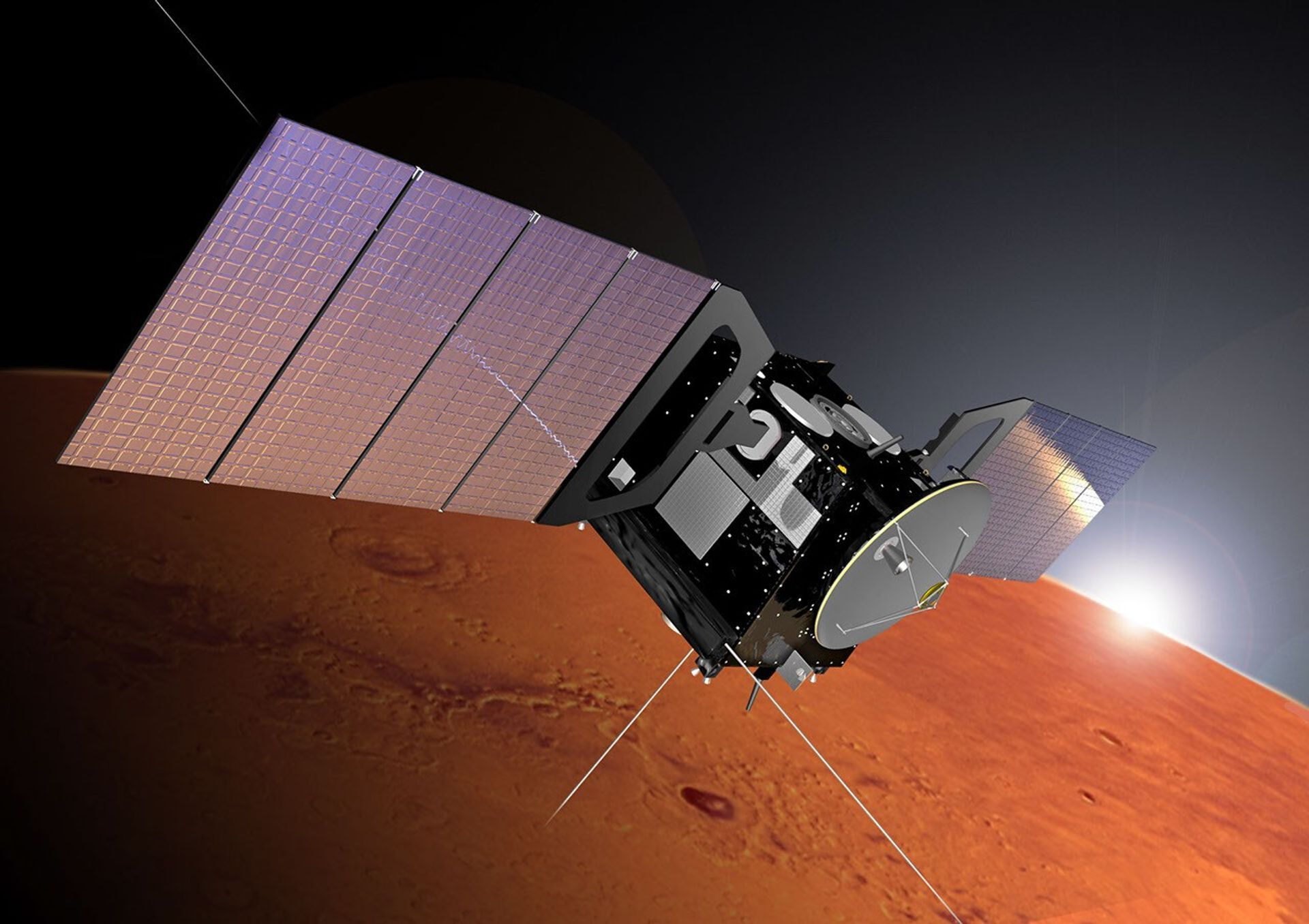
Mars Express is a European Space Agency Mars orbiter launched in 2003 to investigate the planet's surface, subsurface, atmosphere, climate and interaction with the space environment. It was Europe's first mission to Mars and was designed as a relatively rapid, lower-cost planetary mission using experience and hardware heritage from earlier European projects.
The orbiter carries instruments for high-resolution stereo imaging, mineralogical mapping, atmospheric studies, plasma measurements, radio science and radar sounding of the Martian subsurface. It has remained in operation around Mars for more than two decades and has also provided communications relay support for other Mars missions.
In 2026, imagery from the High Resolution Stereo Camera was used to produce a detailed flyover of parts of the Martian Southern Highlands and Schiaparelli Crater. The camera observes the surface from multiple viewing angles and in several spectral channels, allowing three-dimensional colour representations of large areas to be constructed.
Development
A European mission to Mars was included among the priorities of ESA's Horizon 2000 Plus planning in 1995. Mars Express was conceived partly as a successor to the unsuccessful Russian Mars 96 mission and inherited scientific concepts and instrument heritage from that programme. In 1997, it became an ESA fast and flexible planetary mission project scheduled for launch in 2003.
The spacecraft was built on a fast-track programme. Its design reused equipment and engineering experience developed for ESA's Rosetta mission, helping reduce development time and cost. Astrium SAS in Toulouse, France, served as prime contractor and led a consortium of 24 companies from 15 European countries and the United States. The mission therefore represented a broad international European programme despite its French prime contractor.
Mars Express was designed as an orbiter-and-lander mission. The orbiter carried the British Beagle 2 lander, which was intended to investigate geology, mineralogy, geochemistry, meteorology and possible signatures of life at its landing site.
Launch and arrival at Mars
Mars Express was launched from Baikonur Cosmodrome in Kazakhstan on 2 June 2003 aboard a Soyuz-Fregat launch vehicle. After separation from the launcher, the spacecraft began an interplanetary cruise of approximately seven months toward Mars.
Beagle 2 separated from Mars Express on 19 December 2003. Six days later, on 25 December, Mars Express successfully entered orbit around Mars. No communication was received from Beagle 2 after its descent, and the lander was declared lost in February 2004. Images obtained years later by NASA's Mars Reconnaissance Orbiter showed Beagle 2 on the Martian surface with indications that its deployment had remained incomplete.
After orbital adjustment, Mars Express operated in a highly elliptical, near-polar orbit that brought it to a few hundred kilometres above the surface at its closest point and roughly 10,000 km away near the far end of the orbit. This geometry supports both detailed surface observations and broader investigations of Mars and its environment.
Long-duration mission
Science operations began after arrival and commissioning. The mission was repeatedly extended as the spacecraft continued to return useful scientific data. ESA's Mars Express overview lists the spacecraft as operational around Mars and describes its continuing global investigation of Mars, Phobos and Deimos.
The spacecraft has undergone several operational adaptations during its long service. MARSIS radar antenna deployment was delayed until 2005 while engineers evaluated the risk posed by the long booms. The antenna system was subsequently deployed successfully and the radar became operational. In 2011, problems affecting the solid-state mass memory temporarily interrupted normal operations, but full science operations were restored in 2012.
Later software and operational changes extended the useful life of spacecraft systems. A gyroless attitude-estimation capability introduced in 2018 reduced dependence on the spacecraft's laser gyroscopes, and later updates further supported continued operation.
Design
Spacecraft structure
Mars Express uses a compact, approximately box-shaped spacecraft bus with two solar-array wings extending from opposite sides. Published spacecraft data describe a main body about 1.5 m by 1.8 m by 1.4 m, constructed with an aluminium honeycomb structure and aluminium skin. The solar arrays span approximately 12 m from tip to tip.
The spacecraft was designed around a main propulsion system used for Mars orbit insertion and subsequent orbital corrections. The propulsion system includes a 400 N bipropellant main engine and eight smaller thrusters used for trajectory and attitude-related manoeuvres. Helium pressurization is used to feed propellant to the engine.
Power and thermal control
Electrical power is generated by solar panels mounted on rotating mechanisms that allow their orientation to be adjusted toward the Sun. Lithium-ion batteries supply power when Mars Express passes through eclipse and direct sunlight is unavailable.
Thermal control combines radiators, multilayer insulation and heaters. Most spacecraft equipment is maintained near room temperature, while instruments with infrared detectors require much colder operating conditions and are thermally isolated so that excess heat can be radiated into space.
Attitude control and data handling
Mars Express is three-axis stabilized. Its attitude-control system uses inertial measurement equipment, star cameras, Sun sensors, accelerometers and reaction wheels to maintain the precise pointing required by its scientific instruments.
Spacecraft control and scientific data handling are performed by redundant control and data-management systems. The onboard solid-state memory stores scientific observations and housekeeping information before transmission to Earth. Mission planners later introduced the MEXAR2 artificial-intelligence scheduling tool to improve allocation of onboard storage, ground-station access and communications opportunities.
Communications
The communications system includes a 1.6 m high-gain parabolic antenna for normal communications with Earth and omnidirectional low-gain antennas for launch, early operations and contingencies. Mars Express communicates with Earth using X-band and S-band links.
The spacecraft also carries UHF equipment for communications with spacecraft on the Martian surface. Its relay function was originally associated with Beagle 2 but has subsequently supported several international Mars missions. Mars Express has therefore served both as a science platform and as part of the communications infrastructure around Mars.
Scientific payload
ESA describes Mars Express as carrying eight principal scientific investigations covering the surface, subsurface, atmosphere, plasma environment and radio science. Together they allow the mission to study the geological and climatic history of Mars and the processes that continue to affect the planet.
- HRSC: The High Resolution Stereo Camera produces high-resolution colour and stereoscopic images of the Martian surface. ESA's mission objectives include imaging the global surface at about 10 m per pixel and selected regions at resolutions down to about 2 m per pixel.
- OMEGA: The Visible and Infrared Mineralogical Mapping Spectrometer maps minerals on the Martian surface and also contributes to atmospheric investigations.
- MARSIS: The Mars Advanced Radar for Subsurface and Ionosphere Sounding uses long antennas to investigate subsurface structures to depths of several kilometres and to study plasma around Mars.
- PFS: The Planetary Fourier Spectrometer measures properties of the Martian atmosphere, including temperature and composition.
- SPICAM: The ultraviolet and infrared atmospheric spectrometer studies atmospheric composition and structure.
- ASPERA: The plasma and energetic-particle instrument investigates interactions between the upper Martian atmosphere and the solar wind.
- MaRS: The Mars Radio Science Experiment uses the spacecraft's radio system to investigate the atmosphere, ionosphere, gravity field, surface properties and solar corona.
- VMC: The Visual Monitoring Camera was originally included to observe Beagle 2 separation and was later developed into a useful wide-angle scientific imaging instrument.
High Resolution Stereo Camera
The HRSC is one of the mission's principal mapping instruments. It observes the Martian surface from several viewing directions during the same orbital pass. Combining these observations permits stereo reconstruction of terrain and the production of digital elevation information and three-dimensional visualizations.
In 2026, HRSC data were used to illustrate terrain across Mars' Southern Highlands and Schiaparelli Crater. Schiaparelli is an impact structure approximately 460 km across. The region preserves geological features associated with a period when liquid water influenced the Martian surface billions of years ago. Sediments, volcanic material, wind activity and impact debris have modified and partly filled the crater over geological time.
Scientific and operational history
Mars Express began returning major scientific results soon after reaching Mars. Early observations detected water ice at the southern polar region and contributed to mapping hydrated minerals and other surface materials associated with the planet's history of water.
HRSC observations have produced extensive three-dimensional mapping of volcanoes, valleys, impact craters, polar terrain and other geological formations. These data have contributed to reconstruction of the volcanic, fluvial and impact history of Mars and to increasingly detailed global terrain models.
OMEGA observations have mapped minerals formed or altered in the presence of water. Long-duration observations by SPICAM and PFS have provided records of atmospheric temperature, minor gases, clouds, dust and seasonal variation covering many Martian years.
MARSIS has investigated the structure of the subsurface and polar deposits. Radar observations reported in 2018 were interpreted as evidence for liquid water beneath the southern polar ice cap. Later research considered alternative interpretations, including highly saline brines or other materials capable of producing similar radar reflections, so the physical nature of the detected regions remains subject to scientific analysis.
The mission has also extensively observed Phobos and, to a lesser degree, Deimos. Close flybys have been used to investigate Phobos' surface, plasma environment, gravity and subsurface properties. Mars Express has additionally participated in radio-science experiments with ESA's ExoMars Trace Gas Orbiter.
During its long operational life, Mars Express has supported other spacecraft around and on Mars through communications relay and coordinated observations. Its relay work has included assistance associated with NASA surface missions and tests with China's Zhurong rover.
More than twenty years of observations have allowed Mars Express to study processes that are difficult to characterize during short missions, including seasonal atmospheric cycles, dust activity, clouds, changes in polar deposits and transient geological or atmospheric phenomena. A 2025 review of the mission described Mars Express as continuing its scientific operations after more than two decades at Mars and highlighted the value of its long time series for studying planetary evolution.
Program status
Mars Express remained operational in 2026. Its continuing mission combines scientific observations of Mars and its moons with communications and coordinated investigations involving other spacecraft. ESA has repeatedly extended the mission as spacecraft condition, scientific value and available resources have permitted.
In April 2026, ESA released HRSC imagery of Utopia Planitia documenting surface differences compared with Viking-era observations. In May 2026, Mars Express coordinated observations with NASA's Psyche spacecraft during Psyche's Mars gravity-assist encounter.
Specifications (Mars Express orbiter)
General characteristics
- Type: Mars planetary orbiter
- Operator: European Space Agency
- Prime contractor: Astrium SAS, Toulouse, France
- Launch date: 2 June 2003
- Launch vehicle: Soyuz-Fregat
- Launch site: Baikonur Cosmodrome, Kazakhstan
- Mars orbit insertion: 25 December 2003
- Main body dimensions: approximately 1.5 m × 1.8 m × 1.4 m
- Solar-array span: approximately 12 m
- Launch mass: approximately 1,123 kg
- Dry mass: approximately 666 kg
- Main engine thrust: 400 N
- Electrical power: approximately 460 W available after a reduction caused by a faulty connection
- Data storage: 12 Gbit solid-state mass memory
Orbit
- Orbit type: Highly elliptical, near-polar Mars orbit
- Periareion altitude: approximately 298 km
- Apoareion altitude: approximately 10,107 km
- Inclination: approximately 86.3 degrees
Scientific equipment
- HRSC: High Resolution Stereo Camera
- OMEGA: Visible and Infrared Mineralogical Mapping Spectrometer
- MARSIS: Subsurface sounding radar and ionospheric investigation
- PFS: Planetary Fourier Spectrometer
- SPICAM: Ultraviolet and infrared atmospheric spectrometer
- ASPERA: Plasma and energetic neutral atom investigation
- MaRS: Mars Radio Science Experiment
- VMC: Visual Monitoring Camera
 Argentina
 Armenia
 Australia
 Austria
 Austria-Hungary
 Belgium
 Brazil
 United Kingdom
 United States
 Brunei
 Bulgaria
 Canada
 Chile
Chile China
China Colonial America
 Colombia
 Confederate States
 Croatia
 Czech
Czech Denmark
 Egypt
Egypt Finland
 Georgia
 Germany
 German Imperial
 Greece
 Holland
 Hungary
 India
India Indonesia
 Iran
Iran Iraq
Iraq Ireland
 Israel
 Italy
Italy Japan
Japan Japan (1940)
 Jordan
 Kingdom of Italy
 Malaysia
 Mexico
 Myanmar
 Nazi Germany
 Netherlands
 New Zealand
 North Korea
 Norway
 Pakistan
 Peru
Peru Philippines
 Poland
 Portugal
 Prussia
 Romania
 Russia
 Saudi Arabia
 Serbia
 Singapore
 Slovakia
 Slovenia
 South Africa
 South Korea
 Soviet Union
 Spain
Spain Sweden
 Switzerland
 Syria
Syria Taiwan
 Thailand
 Turkey
 UAE
UAE Ukraine
 Vietnam
 Yugoslavia