
History
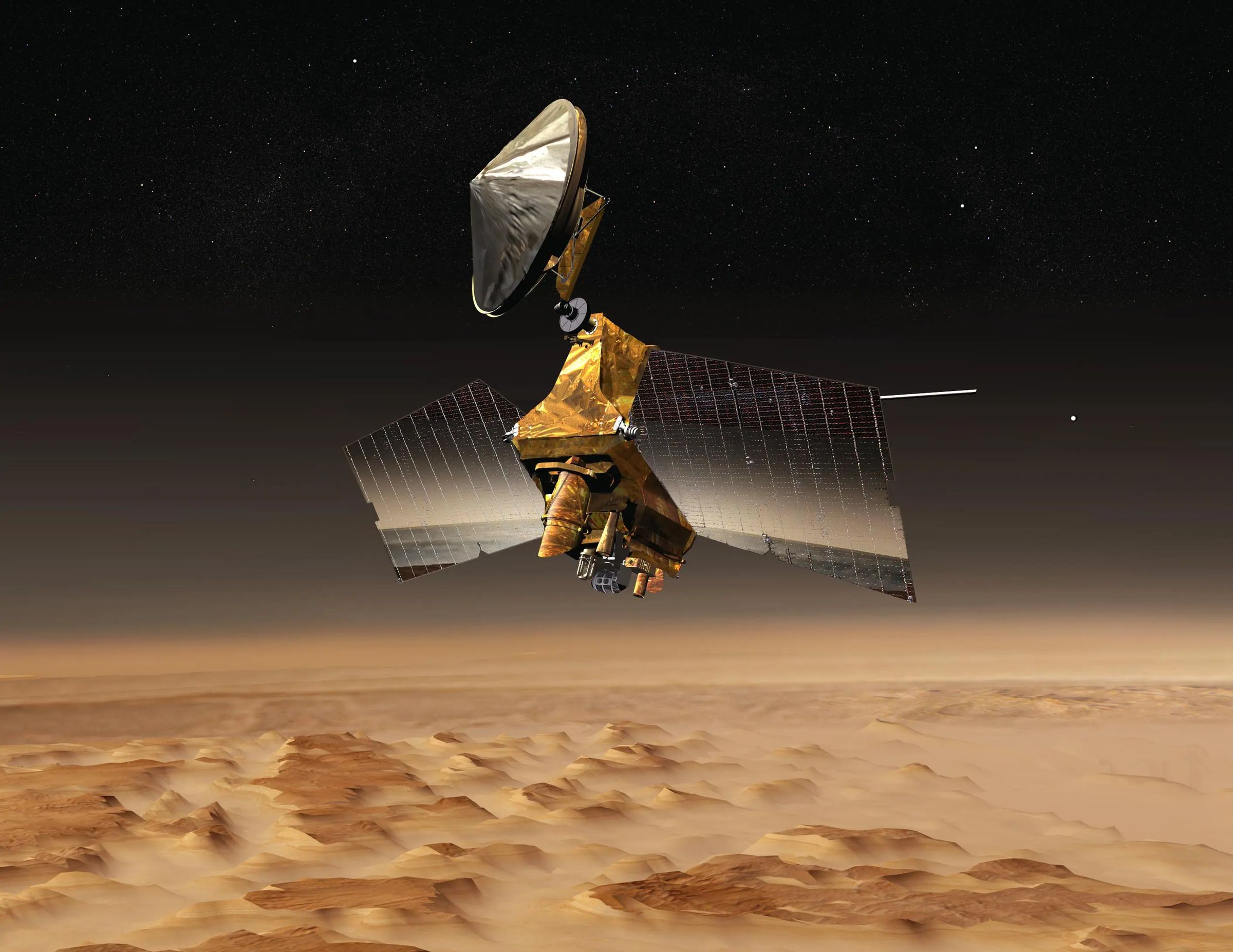
The Lockheed Martin-built Mars Reconnaissance Orbiter (MRO) is a NASA robotic spacecraft designed to study the surface, subsurface, atmosphere, and climate of Mars while also serving as a communications relay for landed missions. Its central scientific theme is the history and distribution of water on Mars. NASA continues to describe MRO as an active mission in its mission overview.
MRO launched on 12 August 2005 aboard an Atlas V 401 from Space Launch Complex 41 at Cape Canaveral Air Force Station, Florida. It reached Mars on 10 March 2006, entered an initial highly elliptical orbit, and then used months of aerobraking to establish a low, near-polar science orbit.
The spacecraft combines very-high-resolution imaging, mineral spectroscopy, atmospheric sounding, subsurface radar, gravity and upper-atmosphere investigations, and high-rate telecommunications. Its Electra UHF relay package also allows MRO to pass commands and data between Mars surface missions and Earth.
Development
NASA reorganized its Mars Exploration Program after the 1999 losses of Mars Climate Orbiter and Mars Polar Lander, with a stronger emphasis on the theme of following the history of water. A science definition team formed in 2000 developed requirements for a new Mars orbiter planned for the 2005 launch opportunity.
NASA issued an announcement of opportunity for MRO instruments in June 2001. In September 2001, the Jet Propulsion Laboratory selected Lockheed Martin Astronautics, later Lockheed Martin Space Systems, as prime contractor for the spacecraft. By late 2001 the principal science investigations had been selected, including HiRISE, CRISM, CTX, MARCI, MCS, and the Italian-provided SHARAD radar. NASA formally established the mission's science objectives in 2002.
Launch and Mars arrival
MRO lifted off at 11:43 UTC on 12 August 2005. The cruise to Mars lasted about seven months and included spacecraft checkout, instrument calibration, navigation, and trajectory correction maneuvers. On 10 March 2006, MRO fired its main engines for about 27 minutes to slow by roughly 1 km/s and enter Mars orbit.
The initial capture orbit was highly elliptical, with a period of about 35 hours. MRO began aerobraking later in March 2006, repeatedly passing through the upper Martian atmosphere so that aerodynamic drag reduced the orbit without consuming the amount of propellant that a fully propulsive maneuver would have required. Aerobraking ended on 30 August 2006, after which additional maneuvers established the primary science orbit.
The SHARAD antenna was deployed in September 2006. Normal science data collection began on 7 November 2006 after solar conjunction. The primary science phase was planned for one Martian year, followed by a relay phase and a series of extended missions.
Design
Structure and power
MRO uses a main spacecraft bus built from titanium, carbon-composite structures, and aluminum-honeycomb panels. A large titanium propellant tank occupies much of the central structure. Two solar-array wings extend from opposite sides of the bus, while a steerable 3 m high-gain antenna provides the primary communications link with Earth.
The spacecraft had a launch mass of about 2,180 kg and an unfueled mass of about 1,031 kg. Its overall span is about 13.6 m. The two solar arrays each provide roughly 10 m² of collecting area and together generate about 1,000 W at Mars under representative conditions. Two rechargeable nickel-hydrogen batteries, each rated at 50 Ah and 32 V, provide stored electrical power.
Propulsion and attitude control
The pressure-fed hydrazine propulsion system uses a single main propellant tank. MRO carries 20 thrusters: six main engines for Mars orbit insertion, six medium thrusters for trajectory corrections and support during major maneuvers, and eight small thrusters for fine attitude control and backup pointing. Reaction wheels provide precise routine pointing for high-resolution observations.
Spacecraft orientation is determined with Sun sensors, star trackers, and inertial measurement units. The pointing system was designed to provide the stability required by HiRISE and the other imaging instruments while allowing targeted observations away from nadir.
Computing and communications
The spacecraft computer is based on a radiation-hardened 133 MHz RAD750 processor. Data storage uses about 160 Gbit of flash memory. MRO communicates with the Deep Space Network primarily through X-band using its 3 m high-gain antenna, with Ka-band equipment carried as a technology demonstration and backup capability. Maximum downlink rates from Mars can reach about 6 Mbit/s under favorable conditions.
The Electra UHF Communications and Navigation Package provides relay links for spacecraft approaching, landing on, or operating on Mars. It can forward commands to surface missions, receive their science and engineering data, and return Doppler information useful for navigation and surface-location determination.
Science payload
NASA lists six primary science instruments, three engineering instruments, and two additional science-facility experiments on MRO. Detailed instrument descriptions and specifications are available from the NASA science-instruments page.
- HiRISE: The High Resolution Imaging Science Experiment is a large visible and near-infrared telescopic camera. From roughly 300 km altitude it can obtain pixels about 30 cm across and resolve surface features of about 1 m. Its red-channel swath is about 6 km wide, with programmable image lengths up to roughly 60 km.
- CTX: The Context Camera provides broad grayscale coverage around higher-resolution targets. From about 300 km altitude it produces images at approximately 6 m per pixel over a swath about 30 km wide.
- MARCI: The Mars Color Imager uses five visible and two ultraviolet bands to build repeated global weather maps and monitor clouds, dust storms, ozone, and seasonal changes.
- CRISM: The Compact Reconnaissance Imaging Spectrometer for Mars mapped minerals across visible and near-infrared wavelengths, with targeted observations at about 18 m per pixel. Its principal role was to identify minerals associated with past interaction between water and rock. The instrument was retired in 2023 after its cryogenic system had reached the end of its useful life.
- MCS: The Mars Climate Sounder uses visible and infrared channels to measure atmospheric temperature, dust, and water-related properties in vertical profiles, supporting studies of Martian weather and climate.
- SHARAD: The Shallow Radar transmits in the 15-25 MHz band to probe subsurface layering and search for water ice. Its roughly 10 m antenna can investigate the upper hundreds of meters of the Martian crust, with deeper penetration possible in favorable material.
The three engineering instruments are Electra, the Optical Navigation Camera, and the Ka-band Telecommunications Experiment Package. The Gravity Field Investigation uses Doppler tracking of the spacecraft, while the Atmospheric Structure Investigation used accelerometer measurements during aerobraking to determine upper-atmosphere density.
Operational history
After science operations began in November 2006, MRO conducted global mapping, regional surveys, and targeted observations. HiRISE, CTX, and CRISM were also used to characterize candidate landing sites and terrain hazards for later Mars missions. MRO's combination of fine imaging and repeated orbital coverage made it particularly valuable for detecting surface changes such as new impact craters, moving dunes, avalanches, dust storms, and seasonal frost.
The orbiter also became a major communications node at Mars. Its Electra package relayed data for surface spacecraft and provided support during arrival, entry, descent, and landing events. HiRISE photographed the Phoenix lander descending under parachute in 2008 and the Curiosity rover during its 2012 descent. MRO also supported landing-site reconnaissance for Curiosity and later Mars missions.
MRO's instruments have produced evidence relevant to the history of Martian water, including mineral deposits formed in aqueous environments and subsurface ice detected by radar and imaging. HiRISE has returned imagery at a scale fine enough to monitor geologic and seasonal changes over time, while MARCI and MCS have provided repeated observations of the atmosphere and climate.
Long-duration operations required changes as individual components aged. CRISM's cryocoolers reached the end of their life, limiting the instrument before its formal retirement in April 2023. Other spacecraft systems continued operating, and NASA still listed MRO as active in 2026, more than 20 years after launch.
Operators
- United States: NASA operates the Mars Reconnaissance Orbiter as part of the Mars Exploration Program, with the Jet Propulsion Laboratory responsible for mission management and spacecraft operations.
Specifications (Mars Reconnaissance Orbiter)
General characteristics
- Type: Robotic Mars reconnaissance and science orbiter
- Prime spacecraft contractor: Lockheed Martin
- Operator: NASA / Jet Propulsion Laboratory
- Launch mass: 2,180 kg
- Dry mass: 1,031 kg
- Payload mass: about 139 kg
- Overall span: about 13.6 m
- High-gain antenna diameter: 3 m
- Electrical power: two solar arrays, about 1,000 W at Mars under representative conditions
- Energy storage: two 50 Ah, 32 V nickel-hydrogen batteries
- Main computer: 133 MHz RAD750 radiation-hardened processor
- Data storage: about 160 Gbit flash memory
Propulsion
- Propellant: hydrazine monopropellant
- Propellant load: about 1,187 kg at launch
- Thrusters: 20 total; six main, six medium, and eight small attitude-control thrusters
- Main-engine thrust: six engines at about 170 N each
- Medium-thruster thrust: six thrusters at about 22 N each
- Small-thruster thrust: eight thrusters at about 0.9 N each
Orbit and communications
- Target body: Mars
- Primary science orbit: near-polar, near-circular, approximately 250 x 315 km
- Inclination: about 92.65 degrees
- Orbital period: about 112 minutes
- Local solar time: approximately 3 p.m. on the dayside ascending-node crossing
- Earth communications: X-band through 3 m high-gain antenna, with Ka-band equipment also carried
- Maximum downlink rate: up to about 6 Mbit/s
- Mars relay: Electra UHF Communications and Navigation Package
Science instruments
- HiRISE: high-resolution visible and near-infrared imaging camera
- CTX: context imaging camera
- MARCI: seven-band global weather and color imager
- CRISM: visible and near-infrared imaging spectrometer; retired in 2023
- MCS: atmospheric radiometer and climate sounder
- SHARAD: 15-25 MHz shallow subsurface radar
 Argentina
 Armenia
 Australia
 Austria
 Austria-Hungary
 Belgium
 Brazil
 United Kingdom
 Brunei
 Bulgaria
 Canada
 Chile
Chile China
China Colonial America
 Colombia
 Confederate States
 Croatia
 Czech
Czech Denmark
 Egypt
Egypt Finland
 France
 Georgia
 Germany
 German Imperial
 Greece
 Holland
 Hungary
 India
India Indonesia
 Iran
Iran Iraq
Iraq Ireland
 Israel
 Italy
Italy Japan
Japan Japan (1940)
 Jordan
 Kingdom of Italy
 Malaysia
 Mexico
 Myanmar
 Nazi Germany
 Netherlands
 New Zealand
 North Korea
 Norway
 Pakistan
 Peru
Peru Philippines
 Poland
 Portugal
 Prussia
 Romania
 Russia
 Saudi Arabia
 Serbia
 Singapore
 Slovakia
 Slovenia
 South Africa
 South Korea
 Soviet Union
 Spain
Spain Sweden
 Switzerland
 Syria
Syria Taiwan
 Thailand
 Turkey
 UAE
UAE Ukraine
 Vietnam
 Yugoslavia