
History
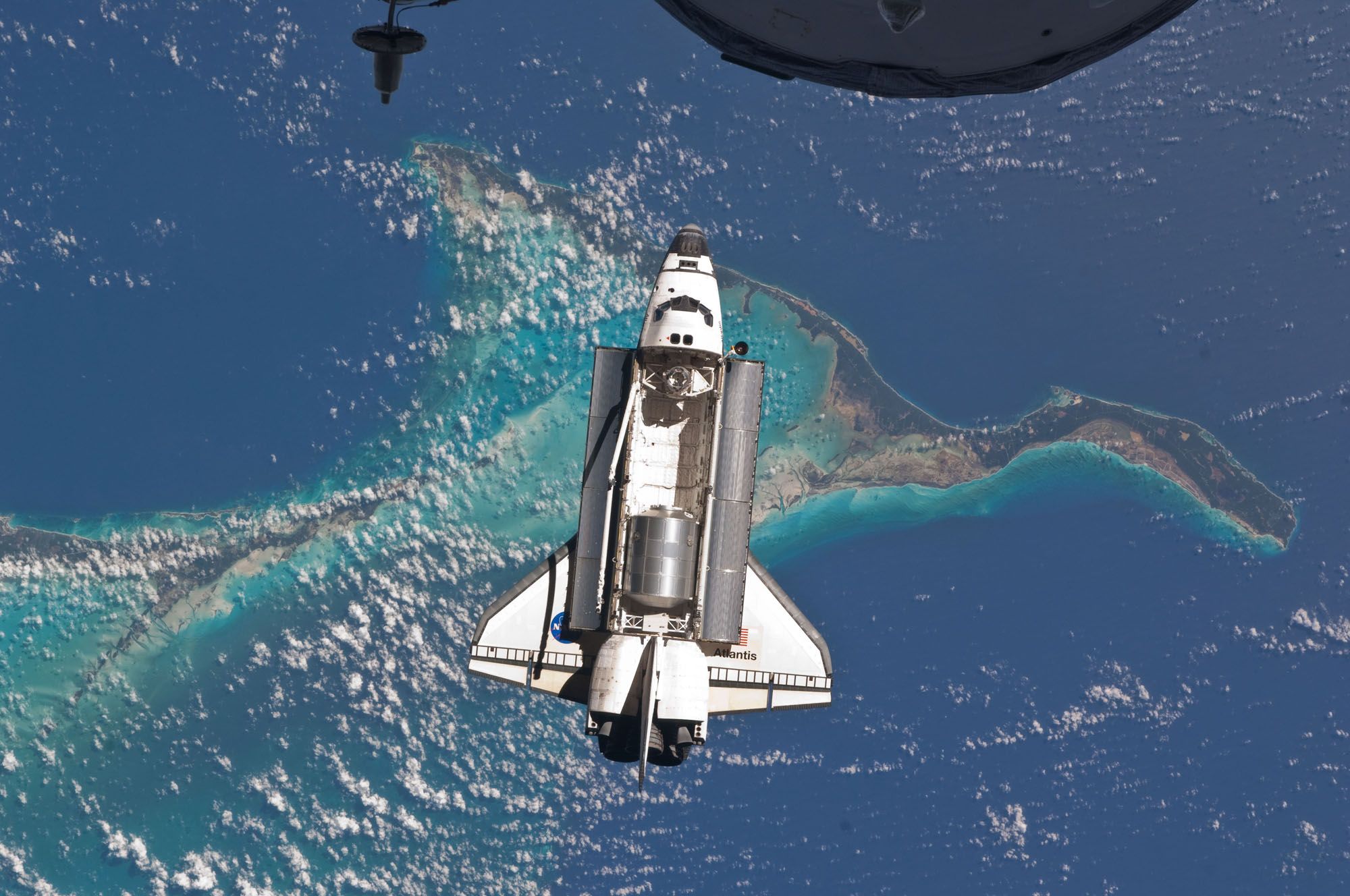
Space Shuttle Atlantis (orbiter vehicle designation OV-104) was manufactured by Rockwell International in Southern California and delivered to the Kennedy Space Center in Florida in April 1985. It was the fourth operational Space Shuttle orbiter and the second-to-last built. Atlantis is named after RV Atlantis, a two-masted sailing ship that served as the primary research vessel for the Woods Hole Oceanographic Institution from 1930 to 1966. The orbiter was completed in about half the time it took to build Space Shuttle Columbia and was nearly 3.2 t lighter than Columbia at rollout.
Atlantis made its maiden flight on STS-51-J from October 3 to 7, 1985, a dedicated Department of Defense mission. Over its career Atlantis flew 33 missions, carrying 207 crew members and orbiting Earth 4,848 times, traveling a total distance of approximately 203,000,000 km. Key missions included the deployment of the Magellan planetary probe to Venus on STS-30 (1989), making Atlantis the first Space Shuttle to launch an interplanetary probe; the 100th U.S. crewed space flight and first U.S. Shuttle–Mir docking on STS-71 (1995); delivery of the Destiny module to the ISS on STS-98 (February 2001); the first post-Columbia disaster mission, STS-115 (September 2006), which carried the P3/P4 truss segments and solar arrays; the longest Atlantis mission, STS-117 (June 2007), which lasted almost 14 days and delivered the S3/S4 truss; delivery of the Columbus laboratory on STS-122 (February 2008); and Hubble Space Telescope Servicing Mission 4 on STS-125 (May 2009), during which the crew completed five spacewalks totaling 37 hours.
Atlantis launched on its 33rd and final mission, STS-135, on July 8, 2011, which was also the final mission of the Space Shuttle program. Atlantis landed at the Kennedy Space Center on July 21, 2011. NASA Administrator Charles Bolden announced on April 12, 2011, that Atlantis would be displayed at the Kennedy Space Center Visitor Complex. The exhibit, which opened on June 29, 2013, mounts the orbiter at a 43.21° angle with payload bay doors open to give the appearance of orbit, in a 5,900 m² indoor facility.
STS-112
On October 7, 2002, Atlantis launched from Kennedy Space Center Launch Complex 39B on the 11-day STS-112 mission to the International Space Station. The primary objective was to deliver the 28,000-pound (12,572 kg) Starboard 1 (S1) integrated truss segment, a 45-foot (13.7 m) aluminum structure containing an ammonia-cooled radiator and carrying power and cooling lines between truss segments. The S1 truss was attached to the right side of the station's central S0 truss, part of the 360-foot (110 m) truss backbone. The mission also delivered the Crew and Equipment Translation Aid (CETA) Cart A, the first of two human-powered carts for the ISS railway.
The crew consisted of Commander Jeffrey Ashby, Pilot Pamela Melroy, Mission Specialists Sandra Magnus, David Wolf, and Piers Sellers, and Russian cosmonaut Fyodor Yurchikhin. The astronauts performed three spacewalks totaling 19 hours and 41 minutes to install the S1 truss, connect plumbing lines for its radiators, and install the CETA cart on the truss rail system. The mission also delivered approximately 1,800 kg of cargo to the station and returned a similar amount to Earth.
During ascent, a chunk of insulating foam shed from the external tank and struck the bottom of the left solid rocket booster, leaving a dent approximately 4 inches (10 cm) wide and 3 inches (7.6 cm) deep in the SRB-ET Attach Ring. The launch had been delayed from its original October 2 date due to Hurricane Lili threatening Johnson Space Center, and had previously been affected by tiny cracks discovered on June 17, 2002, in metal flow liners within the orbiter's main liquid hydrogen fuel lines, which temporarily grounded the entire shuttle fleet. Atlantis landed on October 18, 2002, at the Kennedy Space Center Shuttle Landing Facility, having traveled 4.5 million miles (approximately 7.2 million km). The orbit had an inclination of 51.6°, an apoapsis of 405 km, and a periapsis of 273 km, with an orbital period of 91.2 minutes.
Specifications
- Weight (with three shuttle main engines): 68,635 kg (151,314 lb)
- Length: 37.2 m (122 ft)
- Height: 17.2 m (56 ft)
- Wingspan: 23.7 m (78 ft)
 Argentina
 Armenia
 Australia
 Austria
 Austria-Hungary
 Belgium
 Brazil
 United Kingdom
 Brunei
 Bulgaria
 Canada
 Chile
 China
 Colonial America
 Colombia
 Confederate States
 Croatia
 Czech
 Denmark
 Egypt
 Finland
 France
 Georgia
 Germany
 German Imperial
 Greece
 Holland
 Hungary
 India
 Indonesia
 Iran
 Iraq
 Ireland
 Israel
 Italy
 Japan
 Japan (1940)
 Jordan
 Kingdom of Italy
 Malaysia
 Mexico
 Myanmar
 Nazi Germany
 Netherlands
 New Zealand
 North Korea
 Norway
 Pakistan
 Peru
 Philippines
 Poland
 Portugal
 Prussia
 Romania

 Russia
 Saudi Arabia
 Serbia
 Singapore
 Slovakia
 Slovenia
 South Africa
 South Korea
 Soviet Union
 Spain
 Sweden
 Switzerland
 Syria
 Taiwan
 Thailand
 Turkey
 UAE
 Ukraine
 Vietnam
 Yugoslavia