
History
The Pioneer Venus Orbiter (Pioneer 12) was the first American spacecraft to enter orbit around Venus. It launched on May 20, 1978, aboard an Atlas Centaur rocket from Launch Complex 36A at Cape Canaveral, Florida, and was inserted into an elliptical orbit around Venus on December 4, 1978. The mission was part of a two-probe campaign; a second probe, Pioneer Venus 2, launched in August 1978.
After entering orbit, the spacecraft returned global maps of Venus's clouds, atmosphere, and ionosphere, measurements of the atmosphere–solar wind interaction, and radar maps of 93 percent of the planet's surface. Its instruments mapped most of the surface between latitudes 73° north and 63° south at a resolution of 75 km, revealing a planet with a highest point—Maxwell Montes—rising 10.8 km above the mean surface. Cameras detected almost continuous lightning in the atmosphere, and the spacecraft confirmed that Venus has little if any intrinsic magnetic field. By March 19, 1981, the probe had mapped 93 percent of the area within sight of its instruments, and NASA switched the mapping radar off.
While in Venus orbit, the probe observed Halley's Comet, as well as comets Encke (1984), Giacobini–Zinner (1985), Wilson (1987), NTT (1987), and McNaught (1987). In 1991, NASA reactivated the mapping radar to investigate previously inaccessible southern portions of the planet. In May 1992, the spacecraft entered the final phase of its mission. With a planned primary mission duration of only eight months, the probe operated for 14 years before burning up in Venus's atmosphere on October 8, 1992, after its propellant was exhausted and its orbit decayed.
Design
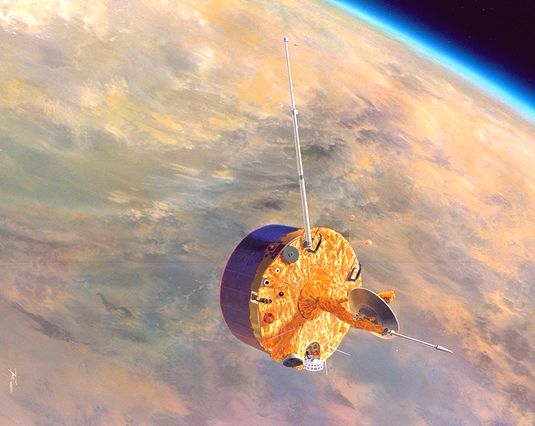
Manufactured by Hughes Aircraft Company, the Pioneer Venus Orbiter was based on the HS-507 bus. The spacecraft was a flat cylinder 2.5 m in diameter and 1.2 m high. All instruments and spacecraft subsystems were mounted on the forward end of the cylinder, except the magnetometer, which was at the end of a deployable boom (listed as 4.7 m in one reference and 4.8 m in another). A solar array extended around the circumference of the cylinder. A 1.09 m despun dish antenna provided S- and X-band communication with Earth, supplemented by low-gain omnidirectional antennas for emergency communication. The spacecraft was spin-stabilized at approximately 15 rpm, with attitude determination by sun sensors and star sensors. Nutation damping was performed with a partially filled tube of liquid Freon. Four 10 W traveling-wave tube amplifiers powered the radar, and an X-band transmitter was incorporated for occultation measurements.
Specifications
The spacecraft mass is given as 517 kg in one reference, while another lists a gross mass of 582 kg. The orbiter carried 17 experiments with a total instrument mass of 45 kg (one NASA overview cited 16 instruments). Body-mounted solar panels provided 312 W of electrical power, recharging two 7.5 Ah nickel–cadmium batteries. The hydrazine propulsion system used seven thrusters for attitude control and orbit adjustment, and a Star 24 solid rocket motor provided 18 kN of thrust for Venus orbit insertion.
From Venus orbit insertion to July 1980, the periapsis was held between 142 and 253 km (at 17° north latitude) with an apoapsis of 66,900 km in a 24-hour orbit. Thereafter, the periapsis was allowed to rise to 2,290 km at maximum and then fall, to conserve fuel. In the final phase beginning in May 1992, the periapsis was held between 150 and 250 km until the spacecraft re-entered Venus's atmosphere.
Instruments
- Cloud photopolarimeter – vertical distribution of clouds
- Surface radar mapper – topography and surface characteristics
- Infrared radiometer – IR emissions from the Venusian atmosphere
- Air-glow ultraviolet spectrometer – scattered and emitted UV radiation
- Neutral mass spectrometer – upper atmosphere composition
- Solar wind plasma analyzer – solar wind properties
- Magnetometer – Venus's magnetic field
- Electric field detector – solar wind interactions with the atmosphere
- Electron temperature probe – ionospheric thermal properties
- Ion mass spectrometer – ionospheric ion population
- Charged particle retarding potential analyzer – ionospheric particles
- Two radio science experiments – gravity field mapping
- Radio occultation experiment – atmospheric characterization
- Atmospheric drag experiment – upper atmosphere density
- Radio science atmospheric and solar wind turbulence experiment
- Gamma-ray burst detector
 Argentina
 Armenia
 Australia
 Austria
 Austria-Hungary
 Belgium
 Brazil
 United Kingdom
 Brunei
 Bulgaria
 Canada
 Chile
 China
 Colonial America
 Colombia
 Confederate States
 Croatia
 Czech
 Denmark
 Egypt
 Finland
 France
 Georgia
 Germany
 German Imperial
 Greece
 Holland
 Hungary
 India
 Indonesia
 Iran
 Iraq
 Ireland
 Israel
 Italy
 Japan
 Japan (1940)
 Jordan
 Kingdom of Italy
 Malaysia
 Mexico
 Myanmar
 Nazi Germany
 Netherlands
 New Zealand
 North Korea
 Norway
 Pakistan
 Peru
 Philippines
 Poland
 Portugal
 Prussia
 Romania

 Russia
 Saudi Arabia
 Serbia
 Singapore
 Slovakia
 Slovenia
 South Africa
 South Korea
 Soviet Union
 Spain
 Sweden
 Switzerland
 Syria
 Taiwan
 Thailand
 Turkey
 UAE
 Ukraine
 Vietnam
 Yugoslavia