
History
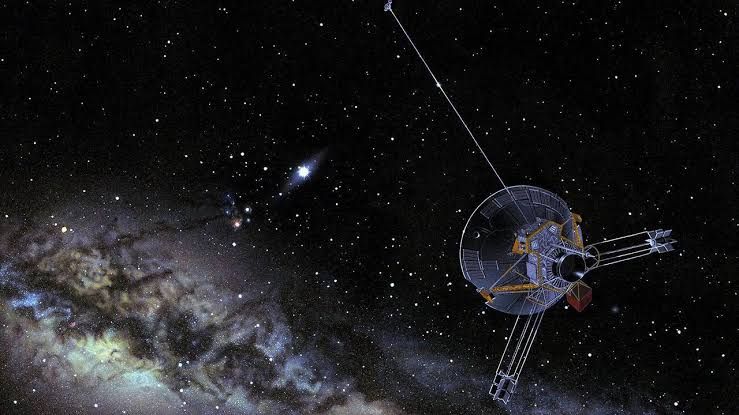
Pioneer 11 was a NASA robotic deep-space probe developed to investigate the asteroid belt, Jupiter, Saturn, the solar wind, cosmic rays, and the environments surrounding the outer planets. It was the sister spacecraft of Pioneer 10 and became the first spacecraft to encounter Saturn.
NASA's mission record lists the launch as April 6, 1973 at 02:11 UT from Cape Canaveral. Other supplied records list April 5, 1973, but this article follows NASA's UTC mission chronology. Pioneer 11 reached Jupiter in December 1974 and used the planet's gravity to redirect its trajectory toward Saturn.
On September 1, 1979, Pioneer 11 completed the first close spacecraft encounter with Saturn. The probe continued operating in deep space for more than two decades, with NASA Ames Research Center making its last contact on September 30, 1995 and scientists receiving the last good engineering data on November 24, 1995.
Launch and asteroid-belt passage
Pioneer 11 was launched aboard an Atlas Centaur launch vehicle. After boost by the TE-M-364-4 engine, the spacecraft departed Earth at about 51,800 km/h (32,000 mph). During the outbound journey, the mission experienced several technical problems, including the momentary failure of an RTG boom to deploy, a problem with an attitude-control thruster, and partial failure of the asteroidal dust detector. None of these problems ended the mission.
The spacecraft passed through the asteroid belt without damage by mid-March 1974. A midcourse correction on April 26, 1974 directed Pioneer 11 toward a much closer Jupiter encounter than Pioneer 10 and established the geometry required for a polar flyby.
Jupiter encounter
Pioneer 11 entered Jupiter's bow-shock region on November 25, 1974. NASA records the spacecraft's closest approach to Jupiter at 05:22 UT on December 3, 1974, about 42,500 km (26,400 miles) above the planet's cloud tops. The supplied secondary article gives December 2, but NASA's mission chronology is used here.
At closest approach, Pioneer 11 was moving at more than 171,000 km/h (106,000 mph). Its high speed reduced the amount of time spent inside Jupiter's intense radiation belts despite passing closer to the planet than Pioneer 10. Pioneer 11 repeatedly crossed Jupiter's bow shock, providing evidence that the boundary of the Jovian magnetosphere changed in response to the solar wind.
The spacecraft returned images of Jupiter, including improved views of the Great Red Spot and the first pictures of the planet's polar regions. It also took about 200 images of Jupiter's moons. The encounter then used Jupiter's gravity to redirect Pioneer 11 across the solar system toward Saturn.
On April 16, 1975, the micrometeoroid detector was switched off because it was issuing spurious commands that interfered with other instruments. Additional trajectory corrections on May 26, 1976 and July 13, 1978 refined the approach to Saturn.
Saturn encounter
Pioneer 11 detected Saturn's bow shock on August 31, 1979 at a distance of about 1.5 million km (932,000 miles), providing the first conclusive evidence of Saturn's magnetic field. The spacecraft crossed Saturn's ring plane beyond the outer ring at 14:36 UT on September 1 and reached closest approach at 16:31 UT.
The sources give slightly different closest-approach figures. NASA reports about 20,900 km (13,000 miles) from Saturn's cloud tops, while the Pioneer Saturn archive gives 21,400 km. The encounter distance can therefore be described as approximately 21,000 km above the cloud tops. Pioneer 11 was moving at about 114,000 km/h (71,000 mph) relative to Saturn at closest approach.
The spacecraft returned 440 images of the Saturn system. About 20 had resolutions of approximately 90 km. Images of Titan, with a resolution of about 180 km, showed the moon as a largely featureless orange object. A brief data transmission indicated an average global temperature of about -193 degrees Celsius (-315 degrees Fahrenheit).
Pioneer 11 detected a narrow ring outside Saturn's A ring that was later identified as the F ring. NASA's current mission history also credits the spacecraft with discovering a new satellite about 200 km in diameter. The supplied secondary account states that two new moons were discovered; because the sources differ, this article follows NASA's mission summary. Measurements refined knowledge of Saturn's gravity field, oblateness, atmospheric structure, magnetic environment, and balance between emitted and absorbed energy.
Data analysis indicated that Saturn was primarily composed of liquid hydrogen. The spacecraft measured an overall planetary temperature of about -180 degrees Celsius (-292 degrees Fahrenheit), and its images showed an atmosphere that appeared less visually structured than Jupiter's. Pioneer 11 continued observing Saturn as it departed, with final Saturn observations made in October 1979.
Extended mission
After the Saturn encounter, Pioneer 11 continued outward on a solar-system escape trajectory. It crossed the orbit of Neptune on February 23, 1990, becoming the fourth spacecraft after Pioneer 10, Voyager 1, and Voyager 2 to cross that distance from the Sun.
By 1995, two scientific instruments were still operating. NASA Ames Research Center made its last routine contact with Pioneer 11 on September 30, 1995, when the spacecraft was 44.1 astronomical units from Earth. Scientists received a few minutes of good engineering data on November 24, 1995, but communication was not re-established afterward.
Design
Pioneer 11 was a lightweight, spin-stabilized spacecraft. Its design was closely related to Pioneer 10 and was intended for long-duration operation far from the Sun, where conventional solar power was impractical for the mission profile.
Power and communications
The spacecraft was powered by SNAP-19 radioisotope thermoelectric generators. Electrical power from the RTGs supported the scientific instruments, communications equipment, and spacecraft systems during the long mission beyond Jupiter.
Pioneer 11 used a 2.74 m high-gain antenna for communications with Earth. It carried two S-band radio transmitters, each rated at 8 W transmitted power.
Scientific payload
Pioneer 11 carried 12 scientific instruments for imaging, magnetic-field measurement, plasma studies, radiation research, ultraviolet and infrared observations, cosmic-ray measurement, and the detection of dust and meteoroids.
- Imaging Photopolarimeter: imaging and photometric observations of planetary targets.
- Helium Vector Magnetometer: magnetic-field measurements.
- Infrared Radiometer: infrared measurements of planetary thermal properties.
- Quadrispherical Plasma Analyzer: measurements of charged plasma particles.
- Ultraviolet Photometer: ultraviolet observations.
- Charged Particle Instrument: measurement of energetic charged particles.
- Cosmic Ray Telescope: cosmic-ray observations.
- Geiger Tube Telescope: energetic-particle measurements.
- Sisyphus Asteroid/Meteoroid Detector: detection of asteroid-belt and meteoroid particles.
- Meteoroid Detectors: measurements of meteoroid impacts.
- Trapped Radiation Detector: investigation of radiation environments around the planets.
- Triaxial Fluxgate Magnetometer: additional magnetic-field measurements.
Pioneer plaque
Pioneer 11 carried a gold-anodized aluminum plaque intended to communicate information about the spacecraft's origin if it were ever encountered by an intelligent extraterrestrial civilization. The plaque used human figures and astronomical symbols to indicate information about humanity and Earth's location. Pioneer 10 carried the same type of plaque.
Mission status
The Pioneer 11 mission is complete. Routine communication ended in September 1995, followed by the final good engineering data in November 1995. The spacecraft remains on an escape trajectory away from the Sun and no longer communicates with Earth.
Specifications (Pioneer 11 / Pioneer-G)
General characteristics
- Type: robotic planetary flyby spacecraft
- Spacecraft designation: Pioneer-G
- Launch mass: 258.5 kg (570 lb)
- Stabilization: spin-stabilized
- Power source: SNAP-19 radioisotope thermoelectric generators
- High-gain antenna: 2.74 m diameter
- Radio system: two S-band transmitters
- Transmitter output: 8 W each
- Scientific instruments: 12
Mission profile
- Launch vehicle: Atlas Centaur AC-30, using Atlas 3D no. 5011D and Centaur D-1A stages
- Launch site: Cape Canaveral, Launch Complex 36B
- NASA launch date and time: April 6, 1973 at 02:11 UT
- Primary planetary targets: Jupiter and Saturn
- Initial outbound speed: about 51,800 km/h (32,000 mph)
- Jupiter closest approach: about 42,500 km (26,400 miles) above the cloud tops
- Saturn closest approach: approximately 21,000 km (13,000 miles) above the cloud tops
- Saturn closest-approach speed: about 114,000 km/h (71,000 mph)
Related equipment
- Pioneer 10: sister spacecraft whose asteroid-belt and Jupiter mission preceded Pioneer 11 and demonstrated the basic spacecraft design in the outer solar system.
- Voyager 1 and Voyager 2: later NASA outer-planet probes. Pioneer 11's Saturn observations and trajectory testing provided information useful for planning subsequent Voyager encounters.
 Argentina
 Armenia
 Australia
 Austria
 Austria-Hungary
 Belgium
 Brazil
 United Kingdom
 Brunei
 Bulgaria
 Canada
 Chile
Chile China
China Colonial America
 Colombia
 Confederate States
 Croatia
 Czech
Czech Denmark
 Egypt
Egypt Finland
 France
 Georgia
 Germany
 German Imperial
 Greece
 Holland
 Hungary
 India
India Indonesia
 Iran
Iran Iraq
Iraq Ireland
 Israel
 Italy
Italy Japan
Japan Japan (1940)
 Jordan
 Kingdom of Italy
 Malaysia
 Mexico
 Myanmar
 Nazi Germany
 Netherlands
 New Zealand
 North Korea
 Norway
 Pakistan
 Peru
Peru Philippines
 Poland
 Portugal
 Prussia
 Romania
 Russia
 Saudi Arabia
 Serbia
 Singapore
 Slovakia
 Slovenia
 South Africa
 South Korea
 Soviet Union
 Spain
Spain Sweden
 Switzerland
 Syria
Syria Taiwan
 Thailand
 Turkey
 UAE
UAE Ukraine
 Vietnam
 Yugoslavia