
History
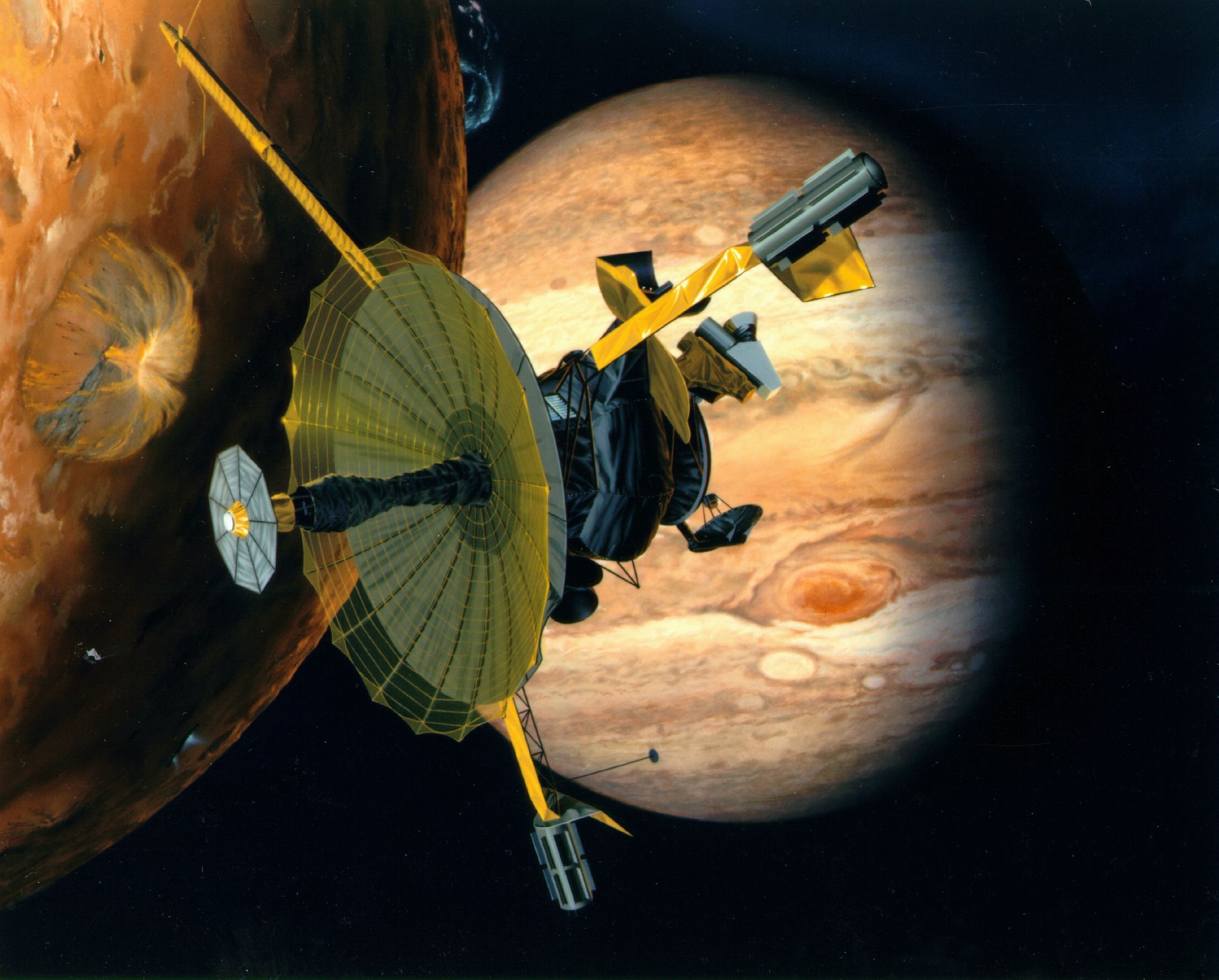
Galileo was a NASA robotic planetary spacecraft developed to study Jupiter, its moons, the Jovian magnetosphere, and selected small bodies encountered during its journey. The mission consisted of a Jupiter orbiter and an atmospheric entry probe, with the Jet Propulsion Laboratory building the main spacecraft and managing the mission for NASA.
Launched aboard Space Shuttle Atlantis on October 18, 1989, Galileo followed a Venus-Earth-Earth gravity-assist trajectory before reaching Jupiter on December 7, 1995. During the cruise it became the first spacecraft to visit an asteroid when it passed Gaspra in 1991, and its 1993 encounter with Ida led to the discovery of the asteroid's moon Dactyl.
Galileo operated around Jupiter for nearly eight years and completed 34 Jovian orbits. The mission ended on September 21, 2003, when the orbiter was deliberately directed into Jupiter.
Development
NASA assigned the Jet Propulsion Laboratory as the lead center for the project that became Galileo. The mission was originally developed as the Jupiter Orbiter Probe program and was officially given the Galileo name in February 1978, honoring Galileo Galilei and his observations of Jupiter's major moons.
The Jet Propulsion Laboratory built the Galileo spacecraft and managed the mission for NASA. West Germany's Messerschmitt-Bölkow-Blohm supplied the propulsion module, while NASA's Ames Research Center managed development of the atmospheric probe, which was built by Hughes Aircraft Company. The completed spacecraft left JPL for Kennedy Space Center on December 19, 1985. Its launch was subsequently delayed following the Space Shuttle Challenger accident.
Launch and interplanetary cruise
Galileo was launched aboard Atlantis on mission STS-34 on October 18, 1989. After deployment from the shuttle and separation from its Inertial Upper Stage, the spacecraft began the indirect trajectory required to reach Jupiter. The mission used gravitational assists at Venus on February 10, 1990, Earth on December 8, 1990, and Earth again on December 8, 1992. An official mission chronology is available from the Galileo Orbiter Archive.
On October 29, 1991, Galileo passed asteroid Gaspra at about 1,601 km, making the first spacecraft encounter with an asteroid. On August 28, 1993, it passed asteroid 243 Ida at about 2,400 km while continuing toward Jupiter. The spacecraft was traveling at almost 28,000 mph during the encounter.
Images returned from the Ida flyby revealed a small natural satellite. Galileo imaging-team member Ann Harch identified the moon in the recorded data on February 17, 1994. The satellite was later named Dactyl. Its discovery provided the first confirmed observation of a moon orbiting an asteroid.
During the cruise, the mission also observed the July 1994 impacts of fragments of comet Shoemaker-Levy 9 into Jupiter. The atmospheric probe was released from the orbiter on July 12, 1995, several months before arrival at the planet.
Jupiter mission
Galileo arrived at Jupiter and entered orbit on December 7, 1995. On the same day, its atmospheric probe entered Jupiter's atmosphere and transmitted measurements to the orbiter for relay to Earth. Galileo became the first spacecraft to orbit an outer planet.
The primary mission continued through December 1997 and was followed by three extended missions that kept Galileo operating until 2003. According to the mission archive, the spacecraft completed 34 Jupiter orbits and conducted repeated close encounters with the Galilean satellites. The recorded flybys included seven of Io, eleven of Europa, eight of Ganymede, eight of Callisto, and one of Amalthea.
End of mission
By the end of the mission, Galileo lacked sufficient propellant to escape the Jovian system. NASA deliberately directed the spacecraft into Jupiter on September 21, 2003. The disposal prevented the uncontrolled spacecraft from eventually contaminating Europa or another Jovian moon considered potentially significant for studies of habitability.
Design
Galileo combined a spinning section with a despun section. The rotor turned at approximately three revolutions per minute to provide stabilization and supported most engineering systems together with instruments designed to measure fields and particles. The stator maintained a fixed orientation for remote-sensing instruments that needed stable pointing. A spin-bearing assembly connected the two sections and transferred electrical power and data across the rotating interface.
Structure and scientific payload
At launch, the orbiter and atmospheric probe together had a mass of 2,562 kg and the assembled spacecraft stood 6.15 m tall. Scientific equipment included a solid-state imaging camera, near-infrared mapping spectrometer, ultraviolet instruments, a photopolarimeter-radiometer, magnetometer, plasma detector, plasma-wave subsystem, energetic-particle detector, dust detector, Heavy Ion Counter, and radio-science equipment. The magnetometer sensors were placed on an 11 m boom to reduce interference from the spacecraft.
The despun section carried remote-sensing instruments, including the imaging system and spectrometers. Instruments designed to sample fields and particles were primarily mounted on the rotating section. A broader technical description is also provided in the Galileo spacecraft overview.
Power
Electrical power was supplied by two radioisotope thermoelectric generators using plutonium-238 heat sources. Each generator contained 18 heat-source modules and was mounted on a 5 m boom. Together the generators produced about 570 W at launch. Their output gradually declined and was about 493 W when Galileo reached Jupiter.
Propulsion
The propulsion system used one 400 N main engine and twelve 10 N thrusters. The spacecraft carried 925 kg of monomethylhydrazine and nitrogen tetroxide propellants, with separate tanks holding about 7 kg of helium for pressurization. The propulsion module was developed and supplied by Messerschmitt-Bölkow-Blohm as West Germany's major contribution to the project.
Telecommunications
Galileo was designed with a 4.8 m high-gain antenna and two low-gain antennas. The communications system was intended to transmit data at S-band and X-band frequencies at rates ranging from 10 bit/s to a maximum of 134 kbit/s. The high-gain antenna failed to deploy as planned, forcing the mission team to use the low-gain antennas and substantially reducing the available data rate from Jupiter. Mission plans and spacecraft operations were extensively modified to compensate for this limitation.
Atmospheric probe
The Galileo atmospheric probe was built by Hughes Aircraft Company under management by NASA's Ames Research Center. It weighed 339 kg and was 86 cm tall. The probe separated from the orbiter in July 1995 and entered Jupiter's atmosphere on December 7, transmitting its measurements to the orbiter during descent.
Program status
The Galileo mission is complete. The spacecraft was destroyed during its intentional atmospheric entry into Jupiter on September 21, 2003. Scientific data from the mission remain archived for continuing study, including observations of Jupiter, its atmosphere and magnetosphere, the Galilean satellites, Gaspra, Ida, and Dactyl.
Specifications (Galileo spacecraft at launch)
General characteristics
- Type: Robotic planetary spacecraft with Jupiter orbiter and atmospheric probe
- Launch mass: 2,562 kg for the orbiter and probe together
- Overall height: 6.15 m
- Atmospheric probe mass: 339 kg
- Atmospheric probe height: 0.86 m
- Attitude stabilization: Dual-spin configuration
- Rotor speed: Approximately 3 rpm
- High-gain antenna diameter: 4.8 m
- Magnetometer boom length: 11 m
Power
- Power source: Two radioisotope thermoelectric generators
- Electrical output at launch: Approximately 570 W
- Electrical output at Jupiter arrival: Approximately 493 W
Propulsion
- Main engine thrust: 400 N
- Attitude and maneuvering thrusters: Twelve 10 N thrusters
- Propellant: 925 kg of monomethylhydrazine and nitrogen tetroxide
- Pressurant: Approximately 7 kg of helium
Communications
- Frequencies: S-band and X-band
- Designed data rate: 10 bit/s to 134 kbit/s
- Antennas: One 4.8 m high-gain antenna and two low-gain antennas
 Argentina
 Armenia
 Australia
 Austria
 Austria-Hungary
 Belgium
 Brazil
 United Kingdom
 Brunei
 Bulgaria
 Canada
 Chile
Chile China
China Colonial America
 Colombia
 Confederate States
 Croatia
 Czech
Czech Denmark
 Egypt
Egypt Finland
 France
 Georgia
 Germany
 German Imperial
 Greece
 Holland
 Hungary
 India
India Indonesia
 Iran
Iran Iraq
Iraq Ireland
 Israel
 Italy
Italy Japan
Japan Japan (1940)
 Jordan
 Kingdom of Italy
 Malaysia
 Mexico
 Myanmar
 Nazi Germany
 Netherlands
 New Zealand
 North Korea
 Norway
 Pakistan
 Peru
Peru Philippines
 Poland
 Portugal
 Prussia
 Romania
 Russia
 Saudi Arabia
 Serbia
 Singapore
 Slovakia
 Slovenia
 South Africa
 South Korea
 Soviet Union
 Spain
Spain Sweden
 Switzerland
 Syria
Syria Taiwan
 Thailand
 Turkey
 UAE
UAE Ukraine
 Vietnam
 Yugoslavia