History
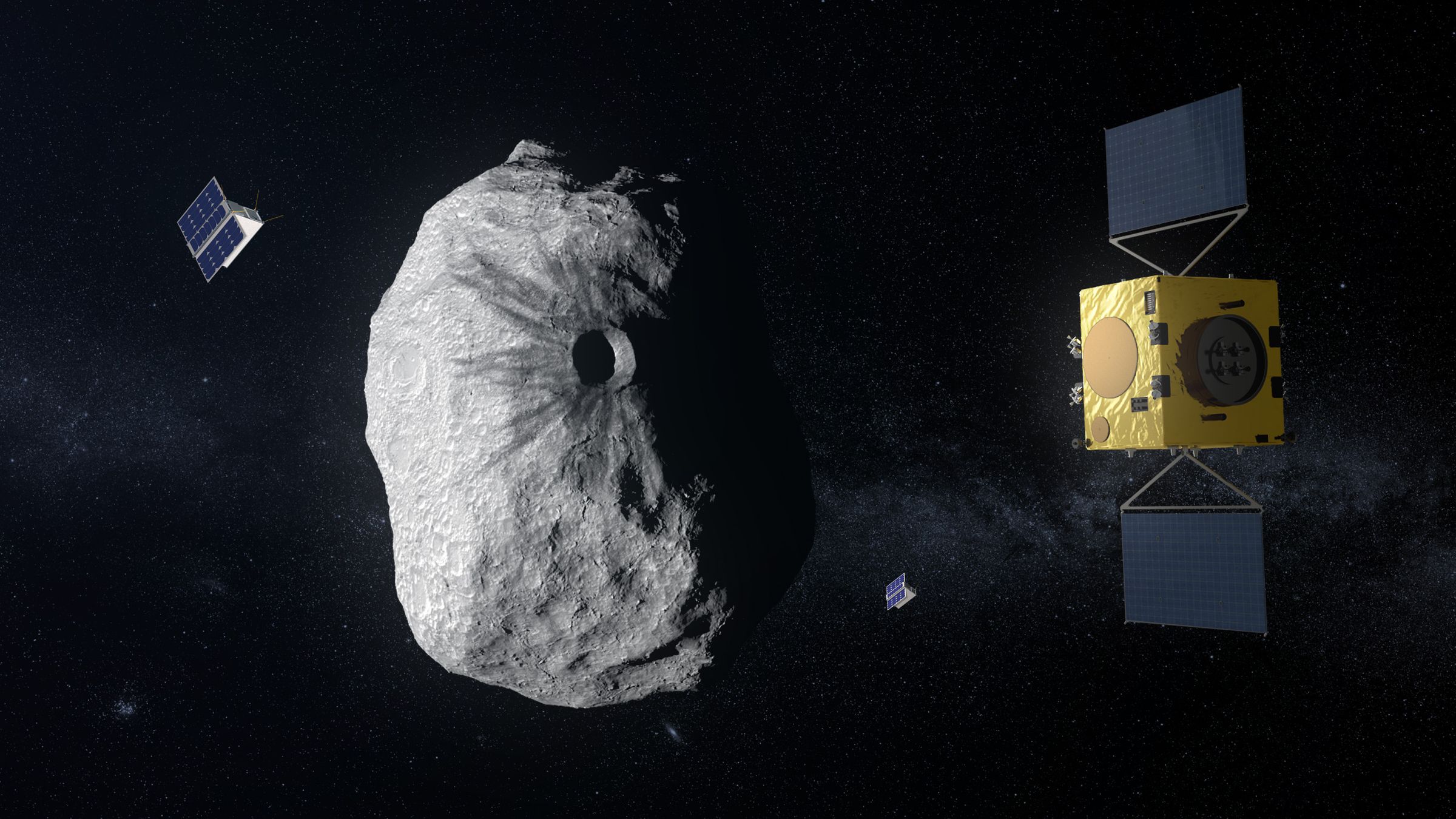
Hera is the first planetary defence spacecraft developed by the European Space Agency (ESA) and the first mission of its Space Safety Programme. Its primary objective is to study the (65803) Didymos binary asteroid system following the impact of NASA's DART spacecraft on the smaller body, Dimorphos, on 26 September 2022, in order to validate the kinetic impact method for deflecting potentially hazardous asteroids from Earth.
In September 2020, ESA awarded a €129.4 million contract to a consortium led by prime contractor OHB System AG in Bremen for the spacecraft's detailed design, manufacturing, and testing. Industry in 17 ESA member states contributes to the mission. The spacecraft is operated from ESA's European Space Operations Centre (ESOC) in Darmstadt, Germany.
Hera launched on 7 October 2024 aboard a SpaceX Falcon 9 rocket. During its two-year cruise to the Didymos system, the spacecraft performed a deep-space manoeuvre in late October 2024, a Mars swingby with a Deimos flyby in March 2025, and a second deep-space manoeuvre in February 2026 that changed its velocity by 367 m/s using 123 kg of hydrazine. Braking manoeuvres in October 2026 slowed the approach in preparation for rendezvous with the binary system.
On 18 October 2026, Hera acquired its first image resolving both bodies separately from a distance of 1,280 km (795 mi). Project scientist Michael Küppers confirmed that Dimorphos, previously indistinguishable from its parent, became visible for the first time as a separate point. On 5 November 2026, the spacecraft acquired its first close-up image from 60 km, revealing the hemisphere of Didymos opposite the face photographed by DART before impact. ESA mission manager Ian Carnelli announced that the first detailed images of Dimorphos — the first object in the Solar System to have its orbit measurably shifted by human action — would be released on 25 November 2026.
The 580 kg DART impactor struck Dimorphos at a velocity of approximately 6.1 km/s in the mission's scientific documentation, while ESA's operations overview gives a figure of around 6.6 km/s. The impact shortened Dimorphos's orbital period around its 780 m parent by 33 minutes ± 1 minute, a change larger than initially predicted. Hera's post-impact survey will measure the crater, determine Dimorphos's mass and internal structure, and quantify momentum transfer efficiency, transforming the one-off experiment into a repeatable planetary defence technique. After completing its primary science objectives, the spacecraft is planned to serve as a deep-space software test platform from mid-2027 at a distance of approximately 150 million km from Earth.
Specifications
Hera's main bus is a 1.6 × 1.6 × 1.7 m box-shaped structure. Two solar panel wings extend to a deployed span of 11.4 m, giving total deployed dimensions of 2.2 × 11.4 × 2.2 m. The solar arrays cover approximately 13 m² and generate 712 W at the nominal 2.4 AU heliocentric distance. The spacecraft is designed to operate between −100 °C and +140 °C.
Mass values differ across ESA documents: 1,128 kg in the mission overview, approximately 1,214 kg (total launch mass) with a 696 kg dry mass in the technical description, and about 1,150 kg fully fuelled in the operations overview.
Propulsion is provided by a bi-propellant (hydrazine) system comprising 16 reaction control thrusters and 6 orbit control thrusters, all 10-N motors, providing a total available delta-V of approximately 1,300 m/s.
Ground communications use X-band (approximately 8.4 GHz) via a high-gain dish antenna and two low-gain antennas. S-band (approximately 2.2 GHz) patch antennas handle inter-satellite links with the two CubeSats at a range of 60 km. Contact is maintained through ESA's three 35 m-diameter Deep Space Antennas at Cebreros (Spain), Malargüe (Argentina), and New Norcia (Australia), with additional coverage from NASA's Deep Space Network during the launch phase.
Attitude is maintained by four reaction wheels, gyroscopes, star trackers, and solar sensors, with guidance provided by the Planetary Altimeter (PALT) and two Asteroid Framing Cameras (AFC). At the Didymos system, surface gravity is estimated at roughly 40,000 times weaker than Earth's for Didymos and approximately 200,000 times weaker for Dimorphos (151 m in diameter; ESA's operations page gives 160 m), requiring the spacecraft to maintain a typical relative velocity of about 12 cm/s around the system barycentre. The planned orbit consists of hyperbolic-arc flybys bringing Hera within 20–30 km of Dimorphos's surface on a weekly cycle.
Hera carries 12 scientific payloads in total, including instruments aboard the two CubeSats.
CubeSats
Hera carries two 6U-XL CubeSats, each with a mass of approximately 12 kg including propellant. Both are 3-axis stabilised with cold-gas propulsion systems and communicate with the mother ship via S-band. The Doppler shift of the radio link is used to measure the gravitational field of the binary system. Both CubeSats carry a visible-light camera and star trackers for determining the dynamic variations of Didymos, and accelerometers for recording surface-impact dynamics if they land on Dimorphos.
Juventas, developed by GomSpace under Luxembourgish leadership, will enter an orbit around Didymos perpendicular to Dimorphos's orbital plane, aligned with the terminator. Its primary mission involves radar soundings of Dimorphos using an updated version of the radar system flown on ESA's Rosetta comet mission. After gathering sufficient radar and radio science data, Juventas will transition to an orbit around Dimorphos, descend to image the surface and the DART impact site at the highest resolution, and land. Its GRASS gravimeter — the first to operate from an asteroid surface — will measure local gravity, with a goal of remaining operational for one Earth day (approximately two Dimorphos orbits) to study temporal changes.
Milani, developed by Tyvak International under Italian leadership and named after the late asteroid scientist Andrea Milani, will operate at lower altitudes than Hera, starting at 10 km and approaching as close as 2 km from Dimorphos's surface. It will carry out spectral surface observations using its ASPECT imager and attempt a landing on Dimorphos, with its VISTA instrument measuring surface dust properties. Onboard gyros and accelerometers will record the dynamics of the landing event and any subsequent low-gravity bounces. The two CubeSats are operated by dedicated teams at ESA's European Space Security and Education Centre at Redu, Belgium, with Hera serving as a communications relay.
 Argentina
 Armenia
 Australia
 Austria
 Austria-Hungary
 Belgium
 Brazil
 United Kingdom
 United States
 Brunei
 Bulgaria
 Canada
 Chile
 China
 Colonial America
 Colombia
 Confederate States
 Croatia
 Czech
 Denmark
 Egypt
 Finland
 France
 Georgia
 Germany
 German Imperial
 Greece
 Holland
 Hungary
 India
 Indonesia
 Iran
 Iraq
 Ireland
 Israel
 Italy
 Japan
 Japan (1940)
 Jordan
 Kingdom of Italy
 Malaysia
 Mexico
 Myanmar
 Nazi Germany
 Netherlands
 New Zealand
 North Korea
 Norway
 Pakistan
 Peru
 Philippines
 Poland
 Portugal
 Prussia
 Romania

 Russia
 Saudi Arabia
 Serbia
 Singapore
 Slovakia
 Slovenia
 South Africa
 South Korea
 Soviet Union
 Spain
 Sweden
 Switzerland
 Syria
 Taiwan
 Thailand
 Turkey
 UAE
 Ukraine
 Vietnam
 Yugoslavia