
History
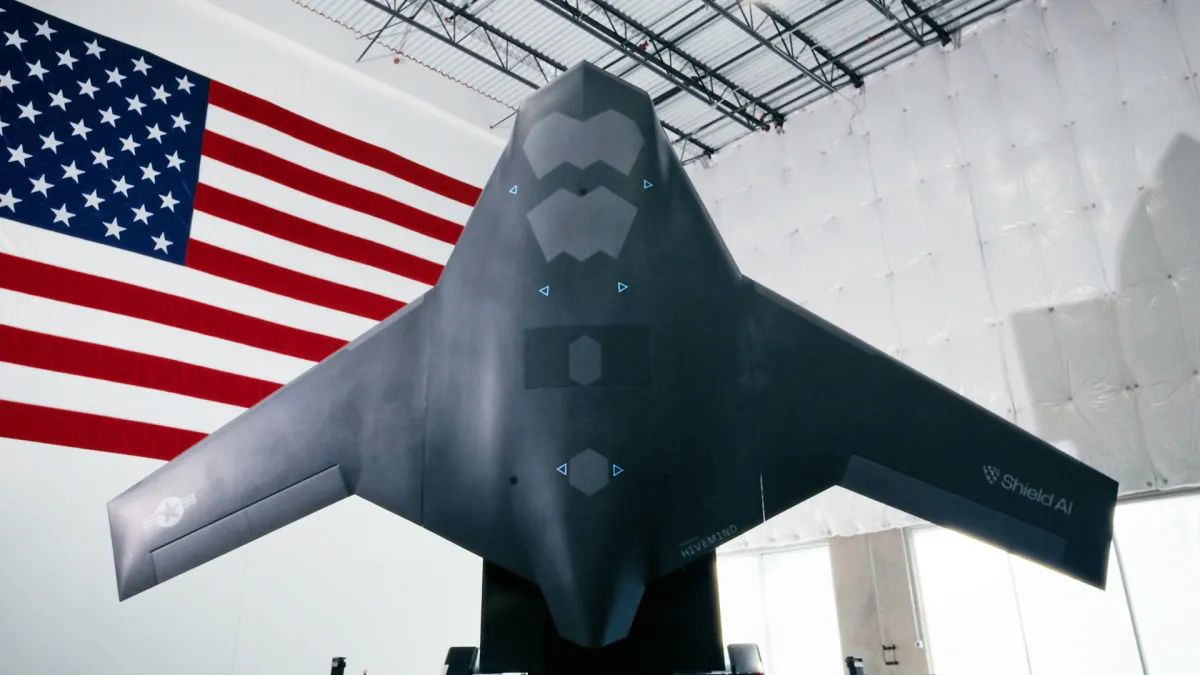
The Shield AI X-BAT is an uncrewed combat aircraft under development in the United States. It is designed to take off and land vertically, allowing it to operate without conventional runways.
The aircraft is intended for strike, counter-air, electronic warfare, intelligence, surveillance, and reconnaissance missions. Shield AI also plans for it to operate independently or alongside crewed aircraft.
X-BAT remains a development program and has no confirmed operators. Its performance figures and mission capabilities are therefore design targets rather than demonstrated operational characteristics.
Development
Shield AI unveiled X-BAT in Washington, D.C., on 21 October 2025. The initial concept used a cranked-kite planform and combined a tail-sitting vertical-takeoff arrangement with a fighter-class turbofan engine.
On 5 November 2025, Shield AI and GE Aerospace announced a propulsion agreement. They selected the F110-GE-129 engine and an Axisymmetric Vectoring Exhaust Nozzle, or AVEN. The nozzle was originally developed and flight-tested on an experimental thrust-vectoring F-16 during the 1990s. GE Aerospace agreed to provide propulsion development and testing support through the X-BAT propulsion program.
By April 2026, the design had changed to an arrowhead-shaped planform with a straight, highly swept leading edge. Shield AI said that test data informed the redesign. A roughly half-scale model representing this configuration was displayed at the Sea-Air-Space exposition near Washington, D.C.
Shield AI planned to construct the prototype at its facility in Frisco, Texas, during the summer of 2026. The development sequence called for ground operation of the propulsion system, horizontal and vertical tests while attached to the launch-and-recovery trailer, and subsequent free-flight testing.
On 16 June 2026, Polish Prime Minister Donald Tusk said that Shield AI had offered Poland an opportunity to participate in the program. The proposal could include X-BAT manufacturing work in Poland. The announcement did not constitute an aircraft order or make Poland an operator.
In July 2026, GE Aerospace and Shield AI completed integration, actuation, and engine light-off testing of the refurbished AVEN with an F110-GE-129E engine at Peebles, Ohio. The test verified coordinated operation of the engine, nozzle hardware, controls, and actuation system. The companies described it as preparation for installation in the prototype and planned flight testing later in 2026. An integrated demonstration remained targeted for 2028.
Design
Airframe and recovery system
X-BAT is a tailless, uncrewed jet aircraft designed to stand vertically on a dedicated launch-and-recovery trailer. The current arrowhead planform is intended to combine high-speed flight with reduced observability. Published dimensions place it in approximately the same size class as a small fighter aircraft.
The aircraft does not require conventional landing gear. It also omits an onboard auxiliary power unit and instead uses an external lithium-ion battery pack to start the engine. Moving support equipment to the trailer reduces equipment carried by the aircraft.
For recovery, X-BAT is intended to approach the trailer from the side, contact it, and power into a securing latch. The aircraft leans into the incoming airflow during this procedure to help supply clean air to the engine. A trailer-mounted blast deflector directs the exhaust away from the aircraft during launch and reduces exhaust recirculation and debris hazards.
Powerplant
The prototype propulsion system combines one GE Aerospace F110-GE-129E afterburning turbofan with an AVEN multi-axis thrust-vectoring nozzle. X-BAT is designed to use afterburner during vertical takeoff and non-afterburning military power during vertical landing.
The AVEN directs engine thrust for vertical launch, transition, and recovery. It may also provide thrust-vectoring control during forward flight if required by a future customer. The prototype nozzle does not have low-observable features, although the developers plan to address this after prototype testing.
An auxiliary inlet on the upper surface opens during vertical-flight phases. The intake arrangement and operating procedures are intended to limit exhaust-gas ingestion and provide clean airflow while the aircraft transitions between vertical and horizontal flight. The integrated AVEN system completed engine light-off testing in July 2026, as reported by GE Aerospace.
Autonomy and mission systems
X-BAT is designed around Shield AI's Hivemind autonomy software. The system is intended to navigate, conduct missions, and coordinate tactics in environments where GPS or communications are unavailable, degraded, or restricted. Planned employment includes standalone operations and collaborative missions with crewed aircraft.
The aircraft uses an open system architecture intended to support replacement or upgrading of radio-frequency, infrared, radar, electronic-warfare, and reconnaissance equipment. Shield AI states that the aircraft will generate 80 kilowatts of electrical power for mission systems. This capacity is intended to support active and passive radar functions, intelligence and surveillance payloads, and electronic attack equipment.
Payload and armament
X-BAT has two internal payload bays described as comparable in size to the internal bays of the F-35. Each is intended to accommodate weapons in the 907 kg (2,000 lb) class. The aircraft also has two external hardpoints.
Planned missions include air-to-air combat, air-to-ground strike, maritime strike, electronic warfare, and reconnaissance. Illustrations have shown several possible weapons, but no operational armament configuration has been confirmed.
The external hardpoints are connected to the internal fuel system and could carry hose-and-drogue refueling pods. This would allow a proposed tanker configuration, although Shield AI does not describe aerial refueling as a primary X-BAT mission.
Program status
As of July 2026, X-BAT remained in prototype development. Engine and thrust-vectoring nozzle tests had been completed, but the aircraft had not yet conducted a confirmed first flight. Flight testing was planned for later in 2026, followed by an integrated demonstration targeted for 2028.
No military service had ordered or operated X-BAT. Shield AI was conducting discussions with potential customers and industrial partners. Poland was considering participation and possible domestic manufacturing, but no production agreement or procurement commitment had been announced.
Specifications (planned X-BAT configuration)
General characteristics
- Crew: None; AI-piloted uncrewed aircraft
- Length: 7.9 m (26 ft)
- Wingspan: 11.9 m (39 ft)
- Powerplant: One GE Aerospace F110-GE-129E afterburning turbofan
- Thrust control: Axisymmetric Vectoring Exhaust Nozzle
- Takeoff and landing: Vertical, using a trailer-mounted launch-and-recovery system
- Electrical generation: 80 kW
Performance
- Maximum speed: Supersonic capability planned; exact speed not disclosed
- Service ceiling: Approximately 15,240 m (50,000 ft)
- Maximum range: More than 3,704 km (2,000 nmi), claimed
- Combat radius: Approximately 1,852 km (1,000 nmi), planned
Armament and payload
- Internal stations: Two internal payload bays
- Internal weapon capacity: Weapons in the 907 kg (2,000 lb) class in each bay
- External stations: Two hardpoints capable of carrying weapons or refueling pods
 Argentina
 Armenia
 Australia
 Austria
 Austria-Hungary
 Belgium
 Brazil
 United Kingdom
 Brunei
 Bulgaria
 Canada
 Chile
Chile China
China Colonial America
 Colombia
 Confederate States
 Croatia
 Czech
Czech Denmark
 Egypt
Egypt Finland
 France
 Georgia
 Germany
 German Imperial
 Greece
 Holland
 Hungary
 India
India Indonesia
 Iran
Iran Iraq
Iraq Ireland
 Israel
 Italy
Italy Japan
Japan Japan (1940)
 Jordan
 Kingdom of Italy
 Malaysia
 Mexico
 Myanmar
 Nazi Germany
 Netherlands
 New Zealand
 North Korea
 Norway
 Pakistan
 Peru
Peru Philippines
 Poland
 Portugal
 Prussia
 Romania
 Russia
 Saudi Arabia
 Serbia
 Singapore
 Slovakia
 Slovenia
 South Africa
 South Korea
 Soviet Union
 Spain
Spain Sweden
 Switzerland
 Syria
Syria Taiwan
 Thailand
 Turkey
 UAE
UAE Ukraine
 Vietnam
 Yugoslavia