
History
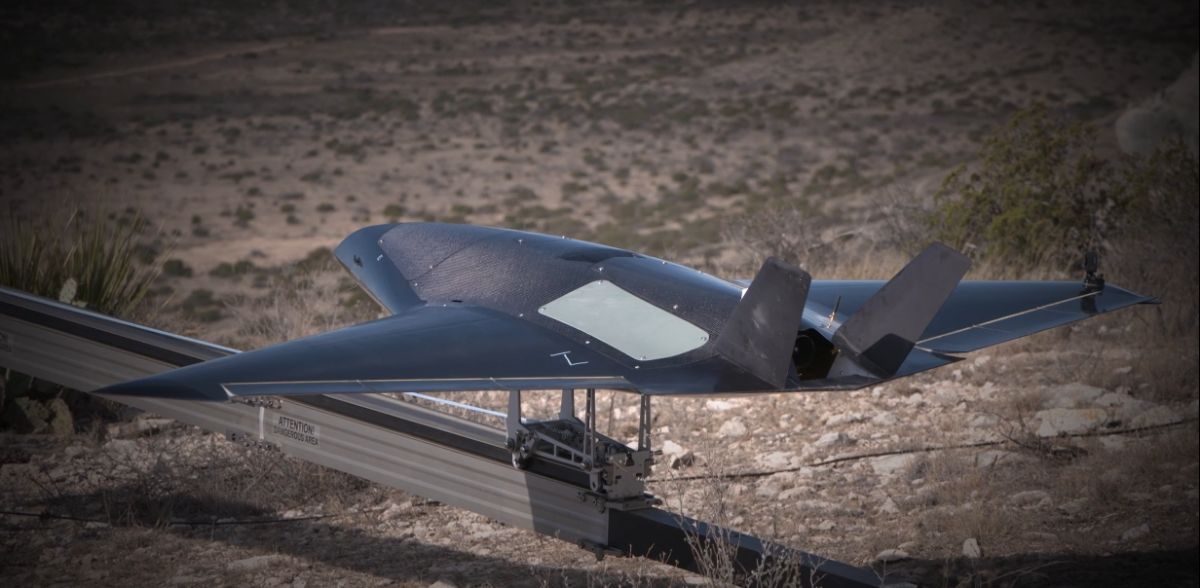
The Callen-Lenz Nyan is a British jet-powered one-way-effect unmanned aircraft designed for precision strikes in contested environments. It can also carry non-kinetic payloads or serve as a decoy and training target.
The aircraft is launched by pneumatic catapult and combines a 2.9 m wingspan with a manufacturer-stated range exceeding 250 km. It has entered British Army service and has reportedly been used operationally by Ukraine.
Callen-Lenz, part of the BAE Systems FalconWorks organization, began developing Nyan in 2022. The program was intended to provide a comparatively low-cost deep-strike system that could be deployed from unprepared ground.
A Nyan matching the production design was recovered in Russia in late June 2024. It was initially described as a previously unknown Ukrainian attack drone before its British origin was identified. This provides the earliest supported evidence of a physically recognizable Nyan airframe.
In February 2026, the United Kingdom Ministry of Defence awarded Callen-Lenz a £4.99 million contract for Nyan one-way-effector systems. The acquisition supported the rapid expansion of British deep-fire capabilities. Nyan was selected as a production system already listed in the United Kingdom Military Aviation Register.
The British Army tested Nyan during Exercise Spring Storm in Estonia in May 2026. The system was subsequently adopted by the 26th Regiment Royal Artillery, part of the British Army's 3rd Division. A report on the British trials is available from EDR Magazine.
In June 2026, the Royal Navy, British Army, and Royal Air Force conducted Exercise Neptune Reach under Project Vantage. A Nyan was launched from the experimental vessel XV Patrick Blackett while the ship was underway. The deck-mounted launcher accelerated the aircraft to as much as 55 m/s. The trial examined how one-way-effect aircraft could contribute to the Royal Navy's planned combination of crewed and uncrewed systems. Further testing aboard HMS Queen Elizabeth was identified as a possibility, but had not been confirmed as an operational deployment. The maritime test was also covered by Naval Technology and The War Zone.
By July 2026, Callen-Lenz stated that more than 1,000 aircraft had been produced. The manufacturer also indicated a unit price below £100,000, although contract configuration and payload could affect the complete system cost.
In August 2026, media reports stated that Ukrainian forces had employed Nyan aircraft against oil-refining facilities in Volgograd and Yaroslavl, Russia. The reports did not disclose launch locations, mission configurations, or the number of aircraft involved.
Design
Airframe and launch system
Nyan is a fixed-wing uncrewed aircraft with a 2.9 m wingspan and a maximum takeoff mass exceeding 75 kg. The airframe is constructed primarily from carbon-fibre material. Its shaping, small size, and exhaust arrangement are intended to reduce radar and infrared signatures.
A pneumatic catapult launches the aircraft, removing the need for a prepared runway. The system can be deployed from unprepared ground. Testing aboard XV Patrick Blackett also demonstrated launch from a moving surface vessel.
Powerplant and performance
A single small gas-turbine engine powers Nyan. The stated cruise speed is 120 knots, approximately 222 km/h. The Callen-Lenz specifications give a range of more than 250 km, depending on fuel load and mission profile. Some secondary reporting has cited a range above 150 km, but the manufacturer's current figure is the more authoritative specification.
Mission systems
Nyan uses an integrated mission-control system and can autonomously follow a programmed mission. During the naval trial, operators entered a designated target before launch and the aircraft flew toward it while the ship remained underway.
The manufacturer states that Nyan can operate in environments where Global Navigation Satellite System signals are unavailable or denied. It does not publicly describe the complete navigation architecture. A Russian media report claimed that digital maps allow operation without GPS or external control, but those additional technical details have not been confirmed by the manufacturer.
Payload
The modular payload bay accepts kinetic or non-kinetic payloads weighing less than 20 kg. In its one-way-effect configuration, Nyan delivers a payload by flying into the assigned target. Callen-Lenz also identifies deep strike, attritable decoy missions, activation of hostile air-defence and electronic-warfare systems, and counter-UAS adversary training as possible applications.
The modular architecture is intended to support later payload and system upgrades. Callen-Lenz has also discussed possible adaptation for greater range or endurance, but no separate production variant has been identified.
Operational history
Ukraine was the first publicly reported combat operator. Nyan aircraft were reportedly in Ukrainian service by 2024, and later reporting connected the type with long-range attacks on Russian industrial targets.
The British Army employed Nyan during Exercise Spring Storm in Estonia in May 2026 and adopted it for service with the 26th Regiment Royal Artillery. The unit uses the aircraft as a deep-fire weapon complementing its artillery capabilities.
The June 2026 launch from XV Patrick Blackett demonstrated that the same air vehicle and catapult concept could operate from a naval platform. The Royal Navy was evaluating the trial results, and the test did not establish Nyan as a fleet-wide operational naval weapon.
Operators
- Ukraine: Reportedly employed Nyan in combat, including long-range attacks against targets in Russia.
- United Kingdom: Operated by the British Army's 26th Regiment Royal Artillery. The Royal Navy has conducted experimental shipboard launches in cooperation with the British Army and Royal Air Force.
Specifications (Nyan OWE)
General characteristics
- Type: One-way-effect uncrewed aircraft
- Wingspan: 2.9 m
- Maximum takeoff mass: More than 75 kg
- Construction: Primarily carbon-fibre material
- Powerplant: One gas-turbine engine
- Launch method: Pneumatic catapult
- NATO stock number: 1550-99-493-1359
Performance
- Cruise speed: 222 km/h (120 knots)
- Range: More than 250 km, depending on fuel load and mission profile
Payload
- Payload capacity: Less than 20 kg
- Payload types: Modular kinetic or non-kinetic payloads
 Argentina
 Armenia
 Australia
 Austria
 Austria-Hungary
 Belgium
 Brazil
 United States
 Brunei
 Bulgaria
 Canada
 Chile
Chile China
China Colonial America
 Colombia
 Confederate States
 Croatia
 Czech
Czech Denmark
 Egypt
Egypt Finland
 France
 Georgia
 Germany
 German Imperial
 Greece
 Holland
 Hungary
 India
India Indonesia
 Iran
Iran Iraq
Iraq Ireland
 Israel
 Italy
Italy Japan
Japan Japan (1940)
 Jordan
 Kingdom of Italy
 Malaysia
 Mexico
 Myanmar
 Nazi Germany
 Netherlands
 New Zealand
 North Korea
 Norway
 Pakistan
 Peru
Peru Philippines
 Poland
 Portugal
 Prussia
 Romania
 Russia
 Saudi Arabia
 Serbia
 Singapore
 Slovakia
 Slovenia
 South Africa
 South Korea
 Soviet Union
 Spain
Spain Sweden
 Switzerland
 Syria
Syria Taiwan
 Thailand
 Turkey
 UAE
UAE Ukraine
 Vietnam
 Yugoslavia