
History
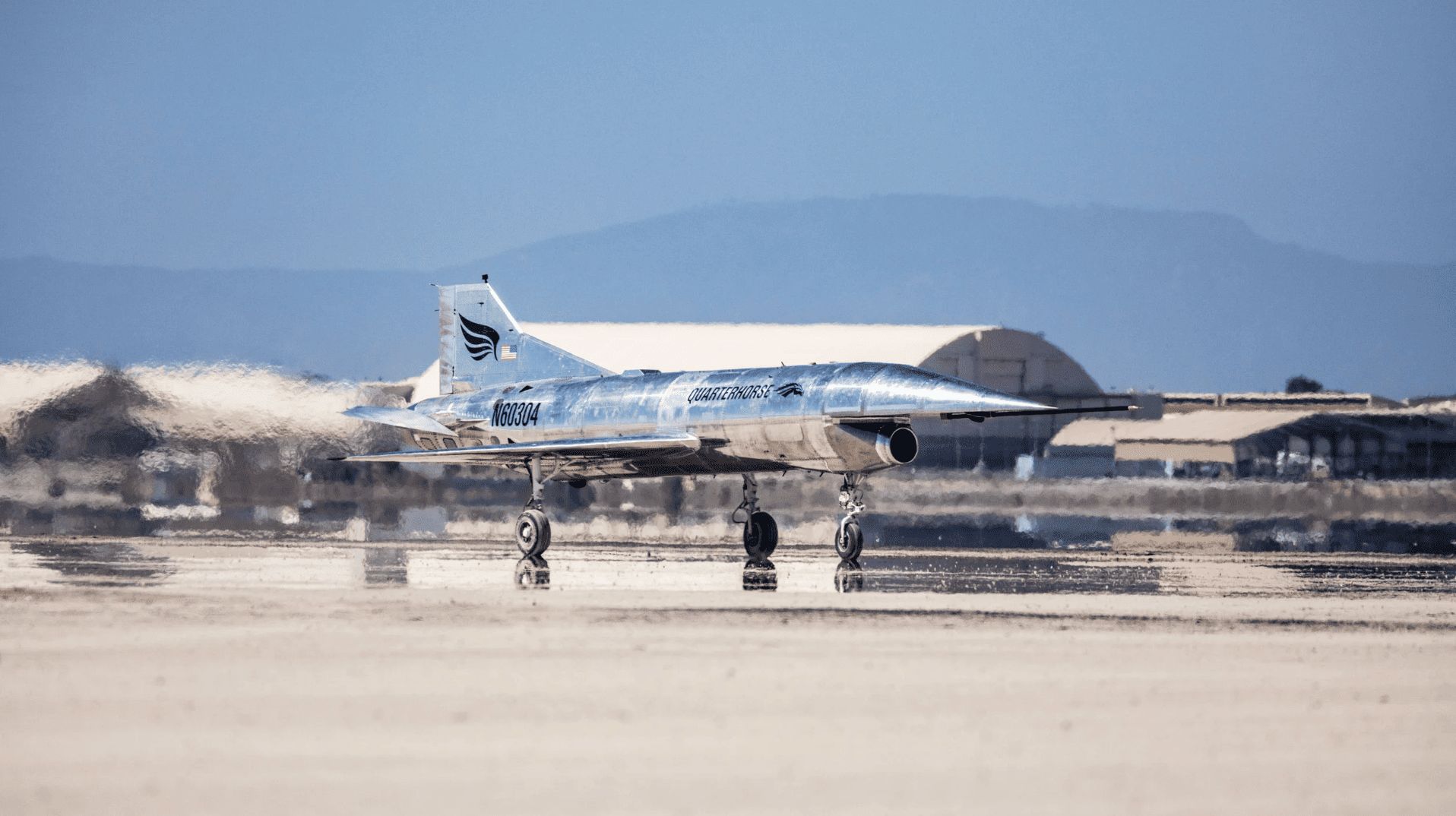
The Hermeus Quarterhorse is an American uncrewed aircraft family developed to test reusable high-speed flight technologies. Its successive demonstrators support rapid flight experimentation and the collection of data for future military aircraft programs.
Quarterhorse initially served as a flight-research platform rather than an operational weapon. Under the U.S. Defense Innovation Unit's Hypersonic and High-Cadence Airborne Testing Capabilities program, it has also begun testing payload integration and separation procedures relevant to future military applications.
The aircraft family follows an iterative development method. Hermeus uses a sequence of progressively more capable vehicles to validate takeoff and landing, supersonic performance, propulsion components, thermal management, mission systems, and high-Mach flight.
Development
Hermeus was founded in 2018 to develop high-speed aircraft for military and commercial applications. In 2020, the U.S. Air Force innovation organization AFWERX awarded the company a $1.5 million contract to study concepts for a future hypersonic presidential transport. A $60 million follow-on contract was awarded in 2021.
In 2023, the Defense Innovation Unit selected Quarterhorse for the HyCAT program and awarded Hermeus $23 million. The work covered propulsion, thermal management, power generation, and mission-system technologies that could support future U.S. Department of Defense programs.
The first flying demonstrator, Quarterhorse Mk 1, made its debut in 2025 at Edwards Air Force Base in California. Powered by a General Electric J85 turbojet, it was used to demonstrate high-speed takeoff and landing operations. It followed an earlier non-flying test article.
Quarterhorse Mk 2.1 made its first flight from Spaceport America in New Mexico in early 2026. Published accounts place the flight in February or March. The new aircraft was nearly three times larger and approximately four times heavier than Mk 1. It provided a more representative platform for studying supersonic flight and payload integration.
Supersonic testing
In May 2026, Mk 2.1 reached Mach 1.21 during an early test flight over White Sands Missile Range. The achievement was described as the first supersonic flight by a privately funded uncrewed aircraft. The aircraft subsequently reached Mach 1.6 during its fourth flight, exceeding its previously reported design-speed range of approximately Mach 1.25 to Mach 1.50.
In 2026, DIU awarded Hermeus a $159 million contract modification for further Quarterhorse testing. Flight data from the program is intended to inform DIU, U.S. Air Force, and U.S. Navy studies of future high-speed aircraft. Air and Space Forces Magazine reported that the work included flights by additional prototypes through 2027.
Payload separation test
During its fifth sortie in 2026, Quarterhorse Mk 2.1 released an inert external store over New Mexico. The test examined whether a payload could separate without disrupting aircraft stability or flight control. It also gathered aerodynamic and structural information about interactions among the payload, launcher, and airframe.
Video of the test showed a missile-shaped store with deployable tail fins being ejected rearward from a tube launcher beneath the aircraft's centerline. The available reports did not establish whether separation occurred at subsonic or supersonic speed. Aviation Week described the released store as inert.
Design
Airframe
Quarterhorse Mk 2.1 is an uncrewed, remotely piloted aircraft approximately comparable in overall scale to an F-16 Fighting Falcon. It has a delta-wing configuration and a variable inlet designed for high-speed operation. Flight testing takes place from Spaceport America over the White Sands Missile Range.
The larger Mk 2.1 airframe allows Hermeus to evaluate aerodynamic behavior, structural loads, payload integration, and propulsion technologies under conditions more representative of future high-speed aircraft. The demonstrator is designed for repeated use, allowing data to be collected over a succession of flights rather than through a single expendable test.
Powerplant
Mk 2.1 is powered by one Pratt & Whitney F100-229 afterburning turbofan. The F100 engine family is also used by versions of the F-15 Eagle and F-16 Fighting Falcon. The engine gives Mk 2.1 conventional runway capability while supporting progressive expansion of its supersonic flight envelope.
Flight controls and test equipment
The uncrewed aircraft carries instrumentation for measuring flight performance, aerodynamic effects, and structural behavior. During the store-separation campaign, these systems collected data on the interaction between the airframe, centerline launcher, and released payload. The resulting information supports the qualification of future experimental payloads and higher-speed demonstrations.
Payload integration
Quarterhorse is not confirmed as an operational armed aircraft. The Mk 2.1 test vehicle demonstrated the release of an inert external store from a launcher under its centerline. This event validated a test capability that may support later experiments involving mission systems, weapons integration, or other military payloads.
Program status
Quarterhorse remained a development and flight-test program in 2026. Mk 2.1 had completed five sorties by the payload-separation demonstration. It had achieved supersonic flight, reached Mach 1.6, and released an inert external payload, but it had not entered military service.
DIU uses HyCAT to increase access to reusable, high-cadence test aircraft. The approach is intended to reduce dependence on scarce wind tunnels, specialized ranges, and government flight assets. Quarterhorse data supports evaluation of high-speed reconnaissance, strike, electronic warfare, and collaborative aircraft concepts, although these remain potential applications rather than confirmed operational roles.
Hermeus plans to continue increasing speed with the Mk 2.2 and Mk 2.3 demonstrators. The company has set a goal for the Quarterhorse family to reach Mach 3 in 2027. This remains a planned milestone. Hypersonic flight, conventionally defined as Mach 5 or faster, is reserved for the subsequent Darkhorse development rather than Quarterhorse.
Variants
- Quarterhorse non-flying test article: Ground-based vehicle used before the first flying demonstrator.
- Quarterhorse Mk 1: J85-powered flight demonstrator that debuted in 2025 and validated high-speed takeoff and landing operations.
- Quarterhorse Mk 2.1: F-16-scale, F100-powered uncrewed demonstrator. It reached Mach 1.6 and completed an inert-store separation test in 2026.
- Quarterhorse Mk 2.2: Follow-on test aircraft with a variable-geometry spike inlet and a Hermeus-developed precooler. It is intended to extend the program beyond the performance demonstrated by Mk 2.1.
- Quarterhorse Mk 2.3: Planned later demonstrator intended to advance the family toward Mach 3 flight in 2027.
Specifications (Quarterhorse Mk 2.1)
General characteristics
- Crew: Uncrewed; remotely piloted
- Configuration: Delta-wing high-speed test aircraft
- Relative size: Approximately comparable to an F-16 Fighting Falcon
- Powerplant: One Pratt & Whitney F100-229 afterburning turbofan
- Air inlet: Variable inlet
Performance
- Demonstrated maximum speed: Mach 1.6
- Previously reported design-speed range: Approximately Mach 1.25 to Mach 1.50
Test payload
- Demonstrated payload: Inert missile-shaped external store with deployable tail fins
- Release system: Rearward-ejecting tube launcher mounted beneath the centerline
Related equipment
- Hermeus Darkhorse: Planned follow-on uncrewed aircraft intended to use technologies matured through Quarterhorse and pursue hypersonic flight at Mach 5 or faster.
 Argentina
 Armenia
 Australia
 Austria
 Austria-Hungary
 Belgium
 Brazil
 United Kingdom
 Brunei
 Bulgaria
 Canada
 Chile
Chile China
China Colonial America
 Colombia
 Confederate States
 Croatia
 Czech
Czech Denmark
 Egypt
Egypt Finland
 France
 Georgia
 Germany
 German Imperial
 Greece
 Holland
 Hungary
 India
India Indonesia
 Iran
Iran Iraq
Iraq Ireland
 Israel
 Italy
Italy Japan
Japan Japan (1940)
 Jordan
 Kingdom of Italy
 Malaysia
 Mexico
 Myanmar
 Nazi Germany
 Netherlands
 New Zealand
 North Korea
 Norway
 Pakistan
 Peru
Peru Philippines
 Poland
 Portugal
 Prussia
 Romania
 Russia
 Saudi Arabia
 Serbia
 Singapore
 Slovakia
 Slovenia
 South Africa
 South Korea
 Soviet Union
 Spain
Spain Sweden
 Switzerland
 Syria
Syria Taiwan
 Thailand
 Turkey
 UAE
UAE Ukraine
 Vietnam
 Yugoslavia