
History
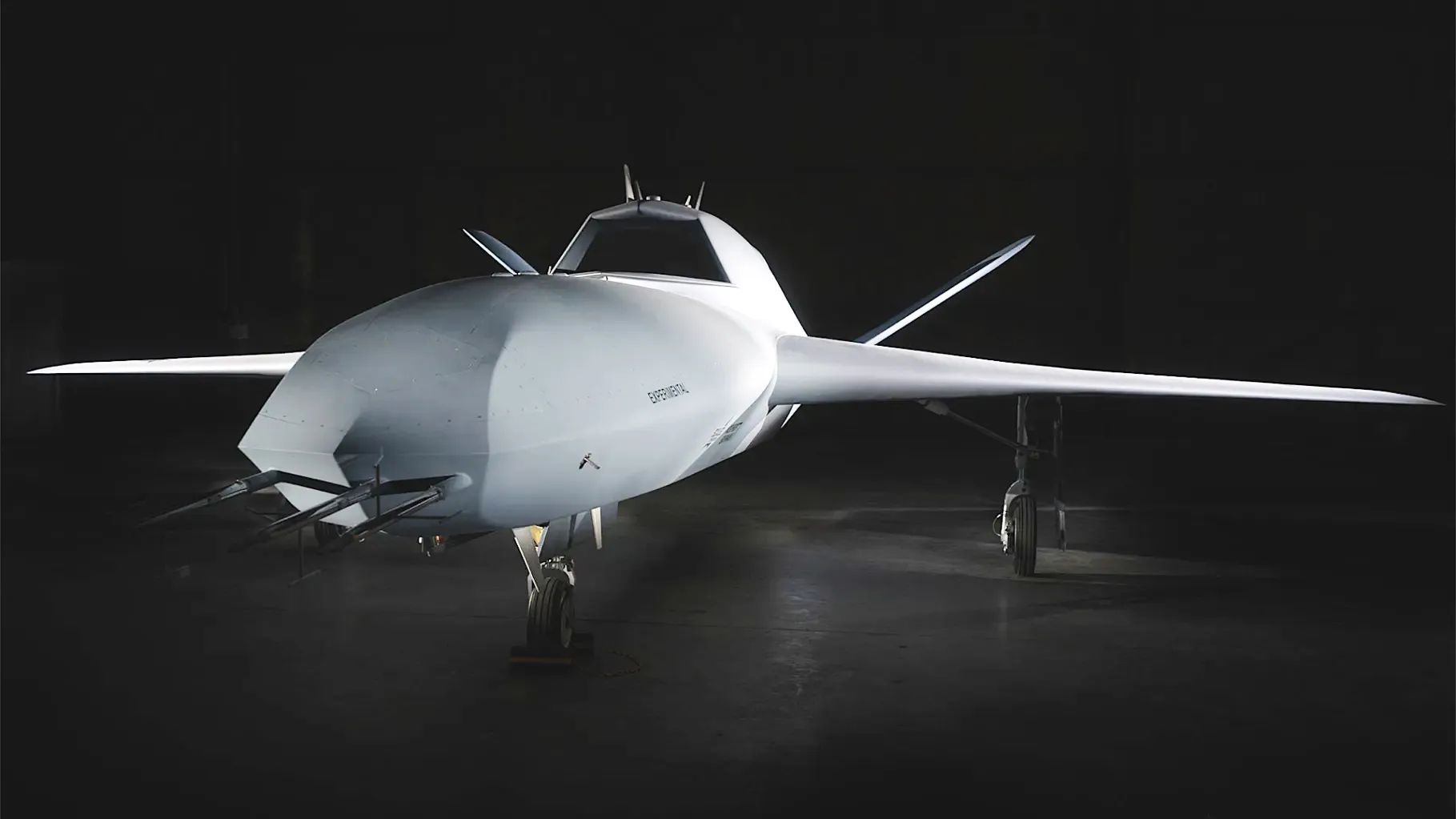
The Northrop Grumman YFQ-48A Talon Blue is an uncrewed, semi-autonomous collaborative combat aircraft prototype developed for future U.S. Air Force requirements. Northrop Grumman presents the aircraft as an autonomous wingman intended to operate with crewed fighters, while the Air Force has treated it as a contender within its Collaborative Combat Aircraft program.
YFQ-48A is part of Northrop Grumman's company-funded Project Talon portfolio. The program combines the Talon Blue aircraft with a broader autonomy-development effort intended to shorten the cycle between software development, flight evaluation, and integration of new mission functions.
The aircraft remained under development in the supplied 2026 sources. A first flight was projected for 2026, but the supplied evidence does not establish that the YFQ-48A itself had completed that flight, so 2026 is treated here as a planned first-flight year rather than an accomplished milestone.
Development
Northrop Grumman developed Talon after its earlier proposal was not selected to continue into the Engineering and Manufacturing Development phase of CCA Increment 1, which instead advanced General Atomics' YFQ-42A and Anduril's YFQ-44A. Northrop Grumman and its subsidiary Scaled Composites then pursued a smaller and less complex follow-on design under the codename Project Lotus. The effort was later renamed Project Talon.
The revised aircraft was shaped by feedback from the earlier competition. Compared with Northrop Grumman's previous CCA Increment 1 proposal, company figures cited in the supplied sources describe the new design as approximately 454 kg (1,000 lb) lighter, with about 50 percent fewer parts and an estimated 30 percent reduction in build time. These are comparative program figures rather than absolute YFQ-48A weight or production specifications.
Northrop Grumman publicly unveiled Project Talon in late 2025. On 22 December 2025, the U.S. Air Force assigned the Mission Design Series designation YFQ-48A to the aircraft. The Air Force announcement described it as a semi-autonomous prototype and a strong contender in the CCA program. The official Northrop Grumman overview identifies Talon Blue as the autonomous wingman within Project Talon.
Northrop Grumman stated that Project Talon was designed and built on a compressed schedule and was on track to fly within 24 months. Reporting in early 2026 also said that the company had used its Model 437-based Beacon autonomous testbed to accelerate the program; this development path is described in Aviation Tech Today.
Autonomy development and flight-test ecosystem
Project Talon is not limited to the YFQ-48A airframe. Northrop Grumman also uses Talon IQ as a flying environment for integrating and evaluating autonomy software before capabilities are transferred toward operational applications. The supplied source identifies Talon IQ as being based on the Scaled Composites Model 437. This test architecture is intended to give government teams, industry partners, and third-party developers a platform for evaluating software and mission functions without locking the YFQ-48A into a single fixed configuration.
The Model 437 figures supplied for Talon IQ should not be treated as YFQ-48A specifications. The test aircraft is described as approximately 12.5 m long with a similar wingspan, powered by a Pratt & Whitney PW535 turbofan producing about 15.1 kN (3,400 lbf) of thrust. Its cited maximum takeoff weight is about 4,536 kg, payload capacity about 907 kg, endurance up to six hours, and range about 5,556 km (3,000 nmi). Those values belong to the Model 437-based test environment, not to Talon Blue.
Design
Airframe
The YFQ-48A uses a long, slender fuselage with swept lambda wings, V-tails, and an air intake on the upper fuselage. Public descriptions also show widely spaced main landing gear that retract into the wings. Northrop Grumman emphasizes a modular structure and manufacturing approach intended to reduce part count, weight, and assembly time.
The airframe uses composite materials, while some components are derived from existing designs to reduce development cost and lead time. The manufacturer describes the design as fully modular and suitable for adaptation to different mission requirements rather than being fixed to one configuration.
Autonomy and mission integration
Talon Blue is designed around autonomous and semi-autonomous operation as a collaborative aircraft supporting crewed fighters. Northrop Grumman describes plug-and-play mission-autonomy integration as a central feature, allowing new software functions to be introduced and modified as mission requirements change. The broader Project Talon concept links this aircraft-level integration to software tested in the company's autonomy-development environment.
The intended role is to expand the number of combat aircraft available in contested environments while allowing crewed and uncrewed platforms to share tasks. Public material describes air-to-air teaming as an intended mission area, but the supplied evidence does not identify a confirmed YFQ-48A weapon load.
Propulsion and ground operations
The YFQ-48A is described as being powered by a Pratt & Whitney PW500-family turbofan variant. The supplied sources do not provide a confirmed engine subtype or thrust rating for Talon Blue. Northrop Grumman also highlights a high-mounted intake, a wide wheelbase intended to support operations from less-developed locations, and a design approach aimed at reducing maintenance demands during intensive combat operations.
Program status
The YFQ-48A is not identified in the supplied material as an operational aircraft. Its status is under development, with the U.S. Air Force designation recognizing the prototype as a CCA contender rather than confirming production or service entry.
The Air Force's CCA acquisition strategy uses continuing competition and future on-ramps. In December 2025 the service also awarded nine concept-refinement contracts for Increment 2, but the companies were not publicly identified. Reporting by Air & Space Forces Magazine noted that neither the Air Force designation nor public statements confirmed that Northrop Grumman was one of those nine recipients. The YFQ-48A should therefore be described as a strong CCA contender, not as a selected Increment 2 production aircraft.
By 2026, General Atomics' YFQ-42A and Anduril's YFQ-44A were the two Increment 1 CCA designs in development, while Northrop Grumman continued Project Talon as an independently funded route into later Air Force competitions. The program's emphasis remained rapid design iteration, modular manufacturing, and the ability to incorporate evolving autonomy software.
Specifications (YFQ-48A Talon Blue)
General characteristics
- Type: Uncrewed semi-autonomous collaborative combat aircraft prototype
- Manufacturer: Northrop Grumman, with Scaled Composites involvement
- Configuration: Long slender fuselage, swept lambda wings, V-tails, and upper-fuselage air intake
- Construction: Composite structure with modular manufacturing and some components derived from existing designs
- Landing gear: Widely spaced main landing gear retracting into the wings
Propulsion
- Powerplant: Pratt & Whitney PW500-family turbofan variant; exact subtype and thrust are not disclosed in the supplied sources
Program-level design targets
- Part count: Approximately 50 percent fewer parts than Northrop Grumman's earlier CCA Increment 1 proposal
- Relative weight: Approximately 454 kg (1,000 lb) lighter than the earlier proposal
- Relative build time: Approximately 30 percent faster to produce than the earlier proposal
- Mission integration: Modular, plug-and-play autonomy architecture intended to support changing mission functions
Related equipment
- Talon IQ: Model 437-based flying test environment used within Project Talon to integrate and evaluate autonomy software; it is separate from the YFQ-48A airframe.
- General Atomics YFQ-42A: Collaborative Combat Aircraft developed for U.S. Air Force CCA Increment 1.
- Anduril YFQ-44A: Collaborative Combat Aircraft developed for U.S. Air Force CCA Increment 1.
- Boeing MQ-28 Ghost Bat: Uncrewed collaborative aircraft developed for the Royal Australian Air Force and used in related U.S.-supported experimentation.
 Argentina
 Armenia
 Australia
 Austria
 Austria-Hungary
 Belgium
 Brazil
 United Kingdom
 Brunei
 Bulgaria
 Canada
 Chile
Chile China
China Colonial America
 Colombia
 Confederate States
 Croatia
 Czech
Czech Denmark
 Egypt
Egypt Finland
 France
 Georgia
 Germany
 German Imperial
 Greece
 Holland
 Hungary
 India
India Indonesia
 Iran
Iran Iraq
Iraq Ireland
 Israel
 Italy
Italy Japan
Japan Japan (1940)
 Jordan
 Kingdom of Italy
 Malaysia
 Mexico
 Myanmar
 Nazi Germany
 Netherlands
 New Zealand
 North Korea
 Norway
 Pakistan
 Peru
Peru Philippines
 Poland
 Portugal
 Prussia
 Romania
 Russia
 Saudi Arabia
 Serbia
 Singapore
 Slovakia
 Slovenia
 South Africa
 South Korea
 Soviet Union
 Spain
Spain Sweden
 Switzerland
 Syria
Syria Taiwan
 Thailand
 Turkey
 UAE
UAE Ukraine
 Vietnam
 Yugoslavia