
History
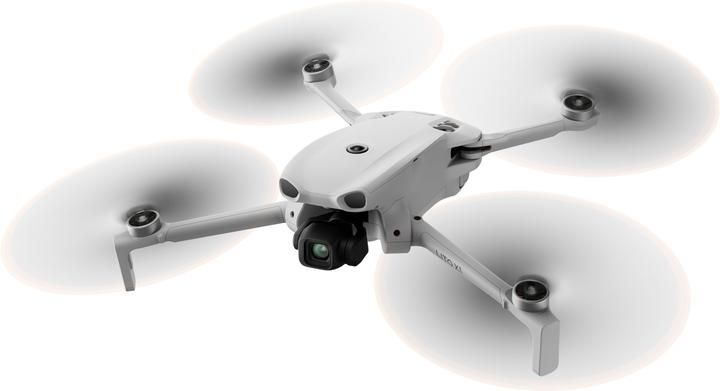
DJI introduced the Lito 1 in April 2026 as the entry model in its new Lito family of compact folding camera drones. The series was aimed at first-time aerial creators and recreational pilots, while retaining automated flight and sensing functions previously associated with more expensive DJI models. The Lito 1 is a sub-250 g quadcopter built around a 48 MP camera, O4 video transmission, and omnidirectional vision-based obstacle sensing.
The Lito family was announced on 23 April 2026 with two models, the Lito 1 and the more capable Lito X1. Contemporary launch coverage and later reviews consistently place the Lito 1 below the X1 in camera, storage, and low-light sensing capability. Production and release began in 2026, which is therefore the earliest supported year for the Lito 1 as a physical production model.
The Lito 1 occupies DJI's entry-level consumer camera-drone tier. It uses the company's familiar folding layout but adds obstacle sensing, ActiveTrack subject tracking, automated shooting modes, and a stabilized 4K camera. The principal compromise is that it lacks the Lito X1's larger sensor, forward-facing LiDAR, internal storage, HDR mode, and D-Log M recording.
Launch and positioning
DJI launched the Lito series as a new beginner-oriented line alongside its continuing higher-end compact drones. The Lito name replaced the older Mini branding at the lower end of the range in several 2026 reviews, while the Mini 5 Pro remained positioned above it. Independent launch coverage from CineD described the series as a sub-249 g family for first-time aerial creators.
Reviews emphasized that the Lito 1's most important step beyond earlier budget DJI models was omnidirectional obstacle sensing. Digital Camera World reported that the vision system could detect and avoid trees in suitable light and found the AI subject tracking effective. The same review also noted that the Lito 1 requires a microSD card because it has no internal storage.
Design
Airframe
The Lito 1 is a folding quadcopter with a standard takeoff weight of approximately 249 g using the DJI Lito 1 Intelligent Flight Battery. DJI lists a maximum takeoff weight of approximately 340 g when accessories such as propeller guards and a microSD card are fitted. The aircraft measures 149 × 94 × 62 mm folded without propellers and 183 × 251 × 79 mm unfolded. Some early review material listed a folded length of 144 mm; this article uses the later official DJI specification of 149 mm.
The arms fold against the fuselage for transport. The aircraft is designed around the sub-250 g category in its standard configuration and carries an EU C0 classification according to DJI. The standard Lito 1 battery is a 2590 mAh lithium-ion pack with 18.96 Wh of energy. DJI also lists a 4680 mAh Intelligent Flight Battery Plus for some markets, but states that this battery is not supported by the Lito 1 in the European Union or United Kingdom.
Camera and gimbal
The camera uses a 1/2-inch CMOS sensor with 48 MP effective resolution and a maximum still-image size of 8000 × 6000 pixels. Its lens has a 79-degree field of view, a 26.2 mm full-frame-equivalent focal length, a fixed f/1.8 aperture, and focus from 4 m to infinity. The camera is carried on a three-axis mechanical gimbal controlling tilt, roll, and pan.
Still images can be recorded as JPEG or DNG RAW files. Supported photo functions include 12 MP and 48 MP single shots, 12 MP burst shooting, automatic exposure bracketing, and timed shooting. Video can be recorded at up to 3840 × 2160 resolution at 60 frames per second in normal playback, with 4K recording at 100 frames per second available for slow motion. Full HD is also available up to 100 frames per second, while vertical 2.7K recording reaches 60 frames per second.
The Lito 1 records only in DJI's Normal color mode and does not provide D-Log M or HDR capture. Official specifications nevertheless distinguish between 8-bit 4:2:0 Normal recording with H.264 and 10-bit 4:2:0 Normal recording with H.265, so the absence of a log profile should not be confused with an absolute 8-bit limitation. Maximum video bitrate is 130 Mbps.
Obstacle sensing
The aircraft uses an omnidirectional monocular vision system supplemented by a downward-facing infrared sensor. DJI specifies vision coverage forward, backward, laterally, upward, and downward. The system requires surfaces with discernible patterns and adequate illumination, generally more than 5 lux. The downward infrared sensor has a measurement range of 0.3 to 8 m under the stated reflectivity conditions.
Forward vision detection is specified from 0.5 to 20 m, while backward, lateral, upward, and downward vision zones are specified from 0.5 to 15 m. Effective sensing speed varies by direction, reaching up to 12 m/s forward and lower limits in the other directions. The Lito 1 does not have the forward-facing LiDAR fitted to the Lito X1, so its obstacle detection remains dependent on suitable visual conditions.
Control and transmission
The Lito 1 uses DJI's O4 video transmission system. With a compatible remote controller, live view is available at up to 1080p at 60 frames per second. DJI specifies a maximum unobstructed transmission distance of 15 km under the IC standard and 8 km under CE, SRRC, and MIC standards. These are communication-system figures measured under controlled conditions rather than a legal or practical operating radius.
The DJI RC-N3 controller uses a connected smartphone for the live camera view and settings. The controller has removable sticks that can be stored in the body when not in use. Wi-Fi 6 QuickTransfer is supported at up to 50 MB/s under laboratory conditions, and Bluetooth 5.4 is also included. Because the aircraft has no internal storage, recorded media must be saved to a compatible microSD card.
Flight features
The Lito 1 provides Cine, Normal, and Sport flight modes. Sport mode raises the maximum horizontal speed to 18 m/s, while Normal mode is limited to 12 m/s. Cine mode reduces speed and control sensitivity for smoother camera movement. Maximum ascent and descent speed is 7 m/s in Sport mode, 5 m/s in Normal mode, and 3 m/s in Cine mode.
Automated functions include ActiveTrack subject tracking, QuickShots, MasterShots, Hyperlapse, and Panorama. These modes automate parts of the flight path or camera movement. Reviewers found the tracking system to be one of the stronger features of the entry-level model, particularly because obstacle sensing remains active around the aircraft in suitable lighting.
Quick Takeoff allows departure before a full satellite position fix is established, while Return to Home provides automated recovery. Review material also describes the aircraft as using its recorded takeoff route during the later stage of the return process, reducing dependence on a strong GPS fix near the landing point. DJI lists GPS, Galileo, and BeiDou satellite navigation support.
Performance and endurance
DJI rates the Lito 1 for a maximum horizontal speed of 18 m/s in Sport mode, equivalent to 64.8 km/h, and 12 m/s in Normal mode. Maximum wind-speed resistance is 10.7 m/s. The aircraft's specified operating temperature is 0 to 40 degrees Celsius. Maximum takeoff altitude with the standard Lito 1 battery is 4500 m under DJI's test conditions.
With the 2590 mAh standard battery, DJI quotes a maximum flight time of 36 minutes and a typical flight time of 23 minutes. The maximum figure is based on controlled wind-tunnel conditions, whereas the typical figure includes climbing, forward flight, video recording, maneuvering, hovering, and an automatic return. In independent testing, Space.com's reviewer obtained about 24 minutes before Return to Home was initiated at roughly 16 percent remaining battery, closely matching DJI's typical-flight estimate.
DJI specifies a maximum flight distance of 20 km with the standard battery under controlled, windless test conditions. This figure is an endurance measurement and should not be confused with the O4 transmission limit or with the distance at which local regulations permit operation.
Variants
- DJI Lito 1 — Baseline 2026 model with a 48 MP 1/2-inch CMOS camera, no internal storage, omnidirectional vision-based obstacle sensing, O4 transmission, and a standard maximum flight time of 36 minutes.
- DJI Lito X1 — Higher-specification sister model with a larger 48 MP 1/1.3-inch sensor, 42 GB of internal storage, forward-facing LiDAR to supplement obstacle sensing, HDR capability, and D-Log M recording.
Specifications (DJI Lito 1)
General characteristics
- Type: Folding camera quadcopter unmanned aerial vehicle
- Standard takeoff weight: Approximately 249 g
- Maximum takeoff weight: Approximately 340 g
- Dimensions, folded: 149 × 94 × 62 mm without propellers
- Dimensions, unfolded: 183 × 251 × 79 mm without propellers
- Operating temperature: 0 to 40 °C
- Satellite navigation: GPS, Galileo, BeiDou
- EU class: C0
Camera and imaging
- Sensor: 1/2-inch CMOS, 48 MP effective resolution
- Maximum still resolution: 8000 × 6000 pixels
- Lens: 79° field of view, 26.2 mm equivalent, f/1.8, focus from 4 m to infinity
- Photo formats: JPEG and DNG RAW
- Video: 4K up to 60 fps normal playback and 100 fps slow motion; Full HD up to 100 fps; 2.7K vertical up to 60 fps
- Video formats: MP4 with H.264 or H.265 encoding
- Maximum video bitrate: 130 Mbps
- Color mode: Normal; 8-bit 4:2:0 with H.264 or 10-bit 4:2:0 with H.265
- Gimbal: Three-axis mechanical stabilization
- Internal storage: None; microSD card required
Performance
- Maximum horizontal speed: 18 m/s in Sport mode; 12 m/s in Normal mode
- Maximum ascent speed: 7 m/s in Sport mode
- Maximum descent speed: 7 m/s in Sport mode
- Maximum wind resistance: 10.7 m/s
- Maximum takeoff altitude: 4500 m with the standard Intelligent Flight Battery
- Maximum flight time: 36 minutes under DJI test conditions
- Typical flight time: 23 minutes under DJI's representative-use test
- Maximum flight distance: 20 km under DJI test conditions
Battery and communications
- Standard battery: 2590 mAh lithium-ion, 18.96 Wh, approximately 79 g
- Video transmission: DJI O4
- Live view: Up to 1080p/60 fps with remote controller
- Maximum unobstructed transmission distance: 15 km under IC; 8 km under CE, SRRC, and MIC
- Wi-Fi: 802.11 a/b/g/n/ac/ax with Wi-Fi 6 QuickTransfer up to 50 MB/s under laboratory conditions
- Bluetooth: Bluetooth 5.4
Related equipment
- DJI Lito X1 — Closely related higher-specification Lito model sharing the folding airframe concept and O4 transmission while adding a larger camera sensor, internal storage, LiDAR, HDR, and D-Log M.
- DJI Mini 5 Pro — Higher-tier sub-250 g DJI camera drone positioned above the Lito family in 2026.
 Argentina
 Armenia
 Australia
 Austria
 Austria-Hungary
 Belgium
 Brazil
 United Kingdom
 United States
 Brunei
 Bulgaria
 Canada
 Chile
Chile Colonial America
 Colombia
 Confederate States
 Croatia
 Czech
Czech Denmark
 Egypt
Egypt Finland
 France
 Georgia
 Germany
 German Imperial
 Greece
 Holland
 Hungary
 India
India Indonesia
 Iran
Iran Iraq
Iraq Ireland
 Israel
 Italy
Italy Japan
Japan Japan (1940)
 Jordan
 Kingdom of Italy
 Malaysia
 Mexico
 Myanmar
 Nazi Germany
 Netherlands
 New Zealand
 North Korea
 Norway
 Pakistan
 Peru
Peru Philippines
 Poland
 Portugal
 Prussia
 Romania
 Russia
 Saudi Arabia
 Serbia
 Singapore
 Slovakia
 Slovenia
 South Africa
 South Korea
 Soviet Union
 Spain
Spain Sweden
 Switzerland
 Syria
Syria Taiwan
 Thailand
 Turkey
 UAE
UAE Ukraine
 Vietnam
 Yugoslavia