

History
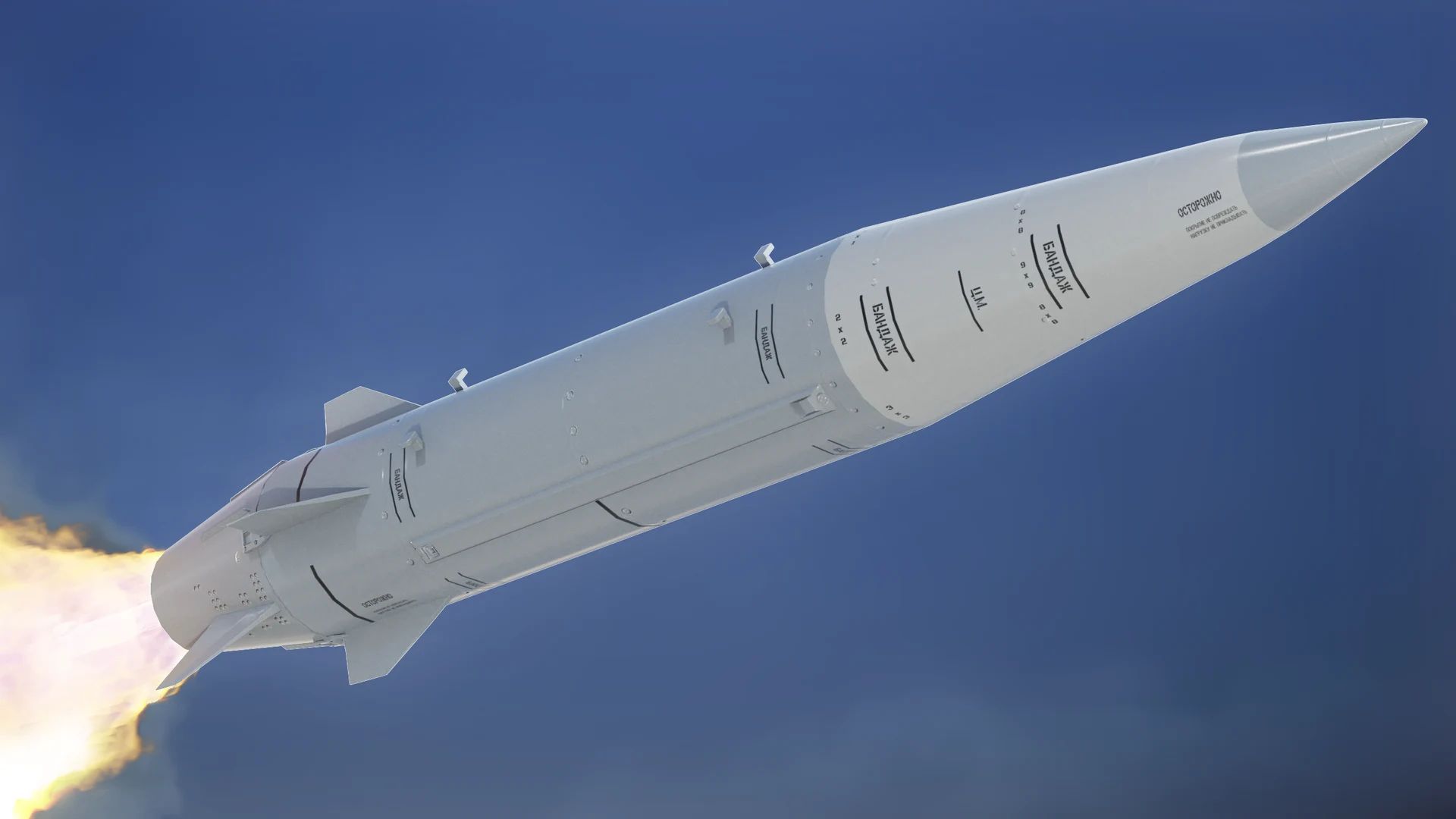
The KBM Kh-47M2 Kinzhal is a Russian air-launched ballistic missile designed for high-speed strike missions. Russian sources describe it as a hypersonic weapon, while independent analyses note that its trajectory is fundamentally ballistic rather than that of a hypersonic glide vehicle.
The missile is widely assessed to be derived from the ground-launched 9K720 Iskander-M. Air launch extends the weapon's operational reach by allowing the carrier aircraft to choose launch position and direction before releasing the missile.
The Kinzhal entered trial or experimental service in 2017 and was publicly unveiled in 2018. It has since been used in combat during the Russia-Ukraine war, while Ukrainian and Western sources have also reported successful interceptions by the MIM-104 Patriot system.
Development
Public information does not establish a single uncontested development attribution. Airforce Technology identifies KBM as the manufacturer, while other references attribute design or production roles to different Russian missile organizations. The overall configuration is nevertheless consistently described as closely related to the Iskander-M short-range ballistic missile.
Concepts for mounting an Iskander-family missile on the MiG-31 appeared publicly around 2010. The air-launched configuration changed the tail section and control surfaces for carriage and release from an aircraft. CSIS Missile Threat describes a redesigned tail, reduced rudders, and a protective tail component associated with the engine nozzle.
Russia stated that the Kinzhal had entered a trial period at southern Russian airfields in December 2017. On 1 March 2018, President Vladimir Putin publicly presented the weapon as one of six new Russian strategic systems. Russian media then released footage in March 2018 showing a launch from a modified MiG-31, with the Russian Ministry of Defense reporting that the missile hit the designated test target.
Production and status
By 2018, Russian reports indicated that modified MiG-31 aircraft had been assigned to experimental combat duty with the Kinzhal. The missile remained operational in subsequent years and was deployed with the Russian Aerospace Forces.
In August 2026, Ukrainian military intelligence reported that Russia had halted production of the Kh-47M2 Kinzhal. The supplied report attributes the claim to Vadym Skibitsky, deputy head of Ukraine's Defense Intelligence Directorate. The available source excerpt does not provide enough detail to establish the exact date production stopped or independently confirm the production status, so the claim should be treated as a Ukrainian intelligence assessment.
Design
The Kh-47M2 is an air-launched ballistic missile with a solid-propellant rocket motor. Its shape and internal concept are generally associated with the 9M723 missile of the Iskander-M system, but the Kinzhal is adapted for carriage and release from high-speed aircraft.
Airframe and propulsion
The missile uses a streamlined cylindrical body with a pointed nose and rear control surfaces. Published dimensions vary by source. CSIS gives a length of about 8 m and a body diameter of about 1 m, with a launch mass of approximately 4,300 kg. Other references publish somewhat different dimensions, reflecting the limited official technical data available.
A solid-fuel rocket motor accelerates the missile after release. Russian claims place maximum speed as high as Mach 10. CSIS notes that the missile rapidly accelerates after launch and may reach this speed, but also cautions that describing Kinzhal as hypersonic can be misleading because ballistic missiles can exceed Mach 5 during portions of flight.
Guidance and flight profile
Published sources describe inertial guidance as the core navigation method. Some sources also report satellite-navigation updates and a terminal seeker. Missile Defense Advocacy Alliance lists inertial guidance, satellite navigation, and a terminal seeker, while other references provide fewer details. The exact guidance architecture therefore remains incompletely documented in open sources.
The missile follows a ballistic or quasi-ballistic trajectory and is reported to retain some maneuvering capability. High speed and maneuvering can reduce warning and engagement time for missile-defense systems, but combat experience has shown that interception is possible.
Range and payload
Range figures require careful interpretation because some published values combine the missile's reach with the combat radius of its carrier aircraft. CSIS lists a reported range of 1,500 to 2,000 km, while other analysis cited in the Kh-47M2 Kinzhal reference summary estimates the missile's own post-launch range at roughly 460 to 480 km. These figures describe different definitions and should not be treated as directly equivalent.
The Kinzhal is reported to carry either a conventional or nuclear warhead. Multiple sources give a nominal payload of about 480 kg. Some secondary references provide broader warhead-weight estimates, but the 480 kg figure is the more consistently cited value in the supplied research.
Launch platforms
The principal carrier is the modified MiG-31K interceptor. Russian reporting has also associated Kinzhal with the Tu-22M3 family, and later reports describe use or integration with the Su-34. The Su-57 has been discussed as a planned carrier. These platform claims do not all represent the same level of confirmed operational integration.
Operational history
After the 2017 trial period and the 2018 public unveiling, MiG-31 crews conducted repeated training sorties with the weapon. In November 2019, Russian state media reported a Kinzhal launch in the Arctic from a MiG-31K against a target at the Pemboy proving ground.
In March 2022, Russia announced the first combat use of the Kinzhal during its invasion of Ukraine, claiming a strike on a munitions storage site near Deliatyn. Further Kinzhal attacks were reported during the conflict, including large missile strikes in 2023.
Ukraine reported the first interception of a Kinzhal over Kyiv on 4 May 2023 using a MIM-104 Patriot missile-defense system. The Pentagon subsequently confirmed that a Patriot system had downed the missile. Ukraine later reported additional Kinzhal interceptions during attacks on Kyiv, while Russia disputed some Ukrainian interception claims.
In October 2023, Russia announced permanent Black Sea patrols by MiG-31K aircraft armed with Kinzhal missiles. Reports in 2025 stated that Russia had modified Iskander and Kinzhal flight behavior to complicate Patriot interception, including terminal-phase maneuvering. These reports indicate continuing adaptation of the weapon during wartime service.
Operators
- Russia — Russian Aerospace Forces; operational use has been reported from MiG-31K aircraft and during the Russia-Ukraine war.
Specifications (Kh-47M2 Kinzhal)
General characteristics
- Type: Air-launched ballistic missile.
- Origin: Russia.
- Length: Approximately 8 m according to CSIS and Airforce Technology.
- Body diameter: Approximately 1 m according to CSIS.
- Launch mass: Approximately 4,300 kg.
- Payload: Approximately 480 kg.
- Propulsion: Solid-propellant rocket motor.
Performance
- Reported system range: 1,500-2,000 km; published figures may include the carrier aircraft's contribution to total reach.
- Estimated missile-only range: Approximately 460-480 km in one cited analysis.
- Maximum speed: Claimed up to Mach 10.
Warhead and guidance
- Warhead: Conventional or nuclear.
- Guidance: Inertial guidance; some sources additionally report satellite navigation and a terminal seeker.
Related equipment
- 9K720 Iskander-M — Ground-launched ballistic-missile system widely considered the technical basis for the Kh-47M2 Kinzhal.
 Argentina
 Armenia
 Australia
 Austria
 Austria-Hungary
 Belgium
 Brazil
 United Kingdom
 United States
 Brunei
 Bulgaria
 Canada
 Chile
Chile China
China Colonial America
 Colombia
 Confederate States
 Croatia
 Czech
Czech Denmark
 Egypt
Egypt Finland
 France
 Georgia
 Germany
 German Imperial
 Greece
 Holland
 Hungary
 India
India Indonesia
 Iran
Iran Iraq
Iraq Ireland
 Israel
 Italy
Italy Japan
Japan Japan (1940)
 Jordan
 Kingdom of Italy
 Malaysia
 Mexico
 Myanmar
 Nazi Germany
 Netherlands
 New Zealand
 North Korea
 Norway
 Pakistan
 Peru
Peru Philippines
 Poland
 Portugal
 Prussia
 Romania
 Saudi Arabia
 Serbia
 Singapore
 Slovakia
 Slovenia
 South Africa
 South Korea
 Soviet Union
 Spain
Spain Sweden
 Switzerland
 Syria
Syria Taiwan
 Thailand
 Turkey
 UAE
UAE Ukraine
 Vietnam
 Yugoslavia