
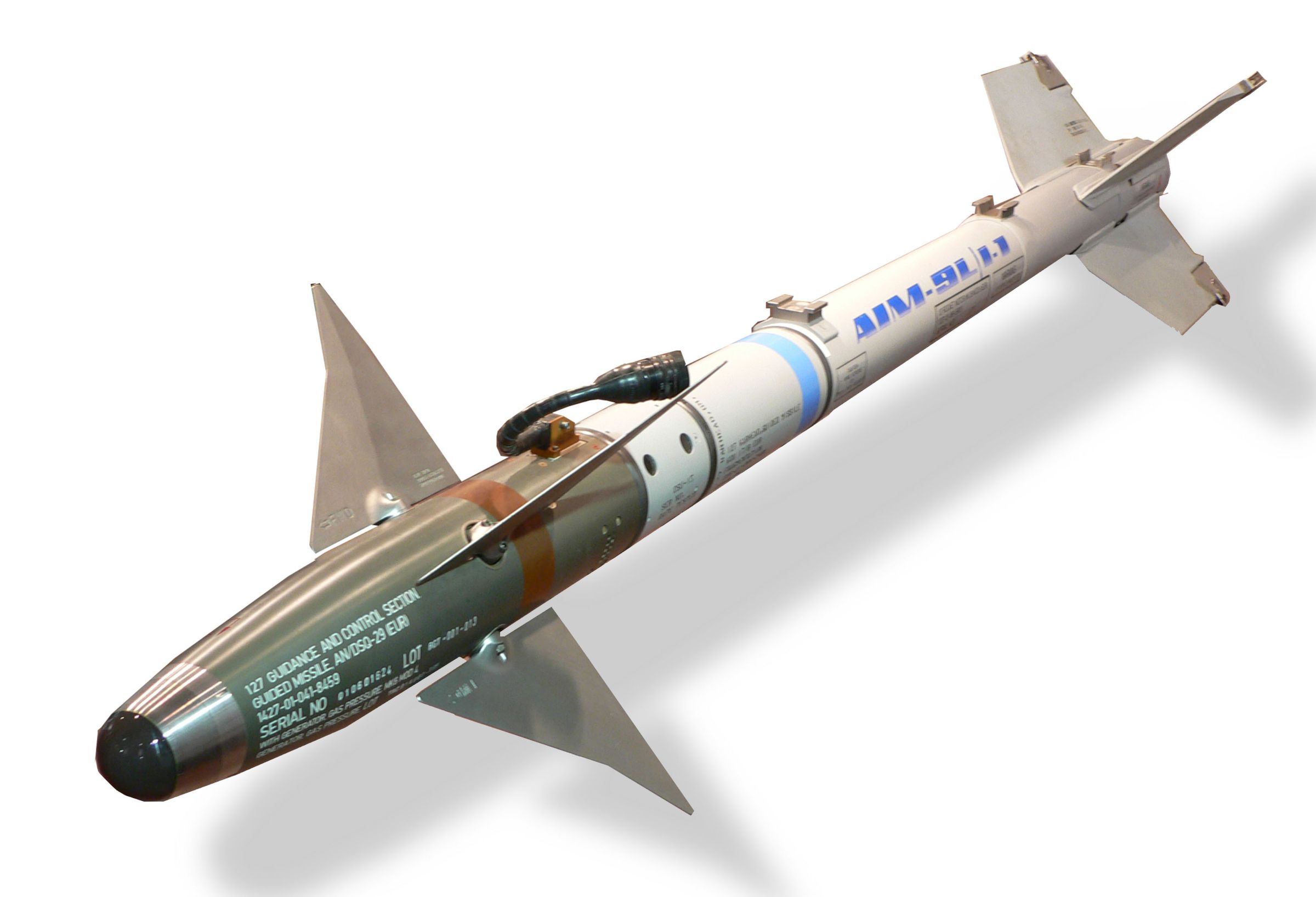
History
The AIM-9X Sidewinder Block II is a United States short-range infrared-guided air-to-air missile developed by Raytheon, now part of RTX. It is an advanced member of the long-running Sidewinder family and incorporates a high off-boresight imaging infrared seeker, thrust-vectoring control, and a weapon datalink.
Block II builds on the original AIM-9X configuration while adding capabilities intended to expand the engagement envelope. Its principal distinguishing feature is a datalink that supports lock-on-after-launch operation, allowing the missile to receive information from the launching aircraft after release.
By 2026, AIM-9X Block II was an established U.S. and export configuration. On 21 August 2026, the U.S. Department of State approved a possible Foreign Military Sale to the Republic of Korea covering 103 AIM-9X Sidewinder Block II tactical missiles and ten Block II Tactical Guidance Units at an estimated total cost of $125 million.
Development
The AIM-9X was developed as a major improvement over the AIM-9M. According to U.S. Naval Air Systems Command, it retained several AIM-9M legacy components, including the rocket motor, warhead, and active optical target detector, while introducing a high off-boresight focal-plane-array seeker, improved infrared counter-countermeasures, and a substantially more maneuverable airframe.
The initial AIM-9X entered service before the Block II configuration. Block II introduced further changes including enhanced electronics and a datalink. Secondary technical reporting also describes a redesigned fuze and digital ignition safety device. NAVAIR identifies Block II as the most advanced short-range air-to-air missile in the U.S. inventory.
South Korean procurement
South Korea has operated AIM-9X missiles since 2011, initially for the F-15K Slam Eagle. The F-15K fleet was equipped with the Joint Helmet Mounted Cueing System, allowing pilots to cue compatible weapons by looking toward a target rather than pointing the aircraft directly at it.
By 2023, AIM-9X was reported in South Korean service on the F-15K, KF-16 Fighting Falcon, and F-35A Lightning II. On 21 August 2026, the U.S. Department of State announced approval of a possible sale of 103 AIM-9X Sidewinder Block II tactical missiles and ten Tactical Guidance Units to South Korea. The proposed package also included active optical target detectors, training equipment, spare parts, weapon-system support, and U.S. government and contractor engineering, technical, and logistics services. RTX Corporation was named as the principal contractor. The approval represented authorization for a possible sale rather than confirmation that a final contract had been signed or deliveries completed. The official notice was published by the U.S. Department of State.
Design
The AIM-9X Block II is designed primarily for short-range air-to-air engagements. Its guidance and control system combines an advanced imaging infrared seeker with high off-boresight acquisition and thrust-vectoring maneuverability. These features allow the missile to engage targets well away from the launching aircraft's forward axis.
Guidance and datalink
NAVAIR describes the AIM-9X as using a high off-boresight focal-plane-array seeker with improved infrared counter-countermeasures. The Block II configuration adds a weapon datalink and supports lock-on after launch. This allows the missile to be launched before its seeker has independently acquired the target and to receive targeting information after release.
The combination of the datalink, thrust vectoring, and imaging infrared seeker also allows engagements against targets positioned behind the launching fighter under suitable targeting conditions. The official NAVAIR description identifies these features as defining capabilities of Block II.
Propulsion and control
The missile uses an ATK MK-139 solid-propellant rocket motor. Thrust vectoring supplements aerodynamic control and provides the maneuverability required for high off-boresight engagements. NAVAIR lists both maximum speed and range as classified. Public secondary sources commonly publish approximate figures near Mach 2.5 and about 32–35 km, but these should be treated as estimates rather than official Block II performance values.
Warhead
The AIM-9X uses an annular blast-fragmentation warhead. NAVAIR also identifies an active optical target detector among the legacy AIM-9M components retained in the AIM-9X design.
Operational history
The AIM-9X family is used by the United States and numerous allied air forces. South Korea's operational use began in 2011 and later expanded across several fighter types. The August 2026 U.S. approval for a possible additional Block II sale was intended to expand South Korean air-defense capability and interoperability with U.S. forces.
The 2026 authorization covered tactical missiles as well as separate Tactical Guidance Units and support equipment. Because the announcement concerned a proposed Foreign Military Sale, it did not itself establish the number of missiles ultimately contracted or delivered.
Variants
- AIM-9X Block I: Initial AIM-9X configuration with high off-boresight infrared guidance, improved infrared counter-countermeasures, helmet-mounted cueing compatibility, and thrust-vectoring maneuverability.
- AIM-9X Block II: Improved configuration with enhanced electronics and a weapon datalink supporting lock-on-after-launch engagements. Secondary reporting also identifies a redesigned fuze and digital ignition safety device among its changes.
Operators
- United States: AIM-9X Block II is identified by NAVAIR as the most advanced short-range air-to-air missile in the U.S. inventory.
- South Korea: Operates AIM-9X missiles on F-15K, KF-16, and F-35A fighters. A possible 2026 Foreign Military Sale covered 103 AIM-9X Sidewinder Block II tactical missiles and ten Tactical Guidance Units.
Specifications (AIM-9X Sidewinder Block II)
General characteristics
- Type: Short-range infrared-guided air-to-air missile
- Length: 3.02 m (9.9 ft)
- Diameter: 0.13 m (5 in)
- Wingspan: 0.45 m (17.6 in)
- Launch weight: 84.37 kg (186 lb)
- Powerplant: ATK MK-139 solid-propellant rocket motor
- Guidance: Solid-state infrared homing system with high off-boresight focal-plane-array seeker; Block II datalink supports lock-on after launch
- Warhead: Annular blast-fragmentation
Performance
- Range: Classified by NAVAIR
- Maximum speed: Classified by NAVAIR
 Argentina
 Armenia
 Australia
 Austria
 Austria-Hungary
 Belgium
 Brazil
 United Kingdom
 Brunei
 Bulgaria
 Canada
 Chile
Chile China
China Colonial America
 Colombia
 Confederate States
 Croatia
 Czech
Czech Denmark
 Egypt
Egypt Finland
 France
 Georgia
 Germany
 German Imperial
 Greece
 Holland
 Hungary
 India
India Indonesia
 Iran
Iran Iraq
Iraq Ireland
 Israel
 Italy
Italy Japan
Japan Japan (1940)
 Jordan
 Kingdom of Italy
 Malaysia
 Mexico
 Myanmar
 Nazi Germany
 Netherlands
 New Zealand
 North Korea
 Norway
 Pakistan
 Peru
Peru Philippines
 Poland
 Portugal
 Prussia
 Romania
 Russia
 Saudi Arabia
 Serbia
 Singapore
 Slovakia
 Slovenia
 South Africa
 South Korea
 Soviet Union
 Spain
Spain Sweden
 Switzerland
 Syria
Syria Taiwan
 Thailand
 Turkey
 UAE
UAE Ukraine
 Vietnam
 Yugoslavia