
History
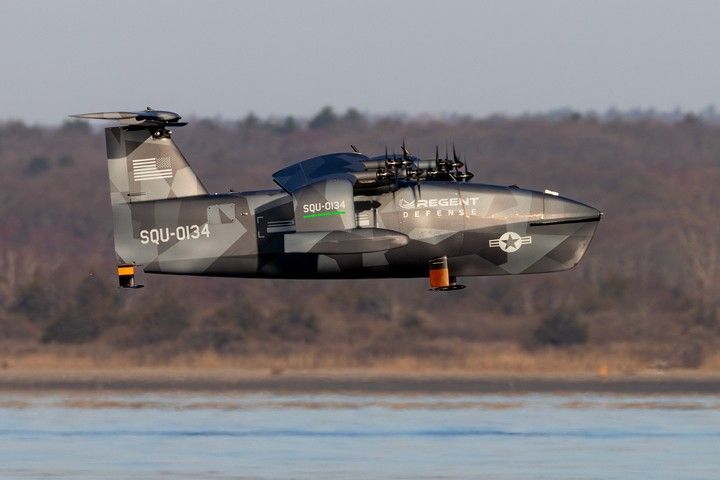
The REGENT Craft Squire is an autonomous wing-in-ground-effect seaglider developed in the United States for military experimentation and uncrewed maritime missions. REGENT describes the platform as part of its Seaglider USA-V class.
Squire is designed to travel very close to the water surface while carrying configurable mission payloads. Its development has included military testing for electronic warfare, logistics, rescue, surveillance, and other maritime roles.
The aircraft made its first flight in April 2026. Later in 2026, it participated in U.S. military experimentation that evaluated uncrewed systems operating in contested electromagnetic environments.
Development and early testing
REGENT Craft, a Rhode Island-based company, developed Squire as an autonomous military-purpose seaglider. According to reporting based on company information, the program is associated with a $15 million U.S. Marine Corps contract and development relationships with U.S. Special Operations Command and the U.S. Coast Guard.
Earlier in 2026, REGENT conducted rescue and logistics demonstrations with the Marine Corps Warfighting Laboratory. Reported activities included lifting a stretcher near a dock, evacuating personnel from shore, and recovering people from a life raft in open water. These trials were intended to evaluate medical evacuation, casualty evacuation, and logistics applications.
Silent Swarm 2026
Squire participated in Silent Swarm, a 13-day U.S. military experimentation event held from July 13 to July 24, 2026, across Michigan's Northern Lower Peninsula and the Alpena Combat Readiness Training Center. The event focused on operations in the electromagnetic spectrum and on the performance of small multidomain uncrewed systems in environments affected by radar, communications, navigation, infrared, directed-energy, and other signals.
During the event, Squire carried multiple payloads for electronic attack, electronic protection, and electronic warfare support tasks. It operated alongside other robotic systems and was exposed to realistic electronic signals and interference. REGENT reported receiving feedback from personnel associated with the U.S. Air Force, Army, Coast Guard, Marine Corps, and Navy. Contemporary accounts of the trials were published by Dealroom, RBC-Ukraine, and The Military Channel.
Design
Wing-in-ground-effect configuration
Squire is a wing-in-ground-effect aircraft intended to fly within approximately one wingspan of the water surface. At this height, aerodynamic interaction between the wing and the surface increases lift efficiency. The low operating altitude also places the vehicle below the line-of-sight coverage of many conventional radar installations, according to descriptions of the platform.
The concept combines aircraft-like speed with the ability to operate over coastal and maritime routes while carrying mission payloads. Squire is autonomous and does not require an onboard crew.
Mission equipment
The aircraft can carry a configurable payload of up to 23 kg (50 lb). During Silent Swarm, this payload capacity was used for electronic warfare equipment supporting electronic attack, electronic protection, and electronic warfare support functions.
REGENT has also described mission applications including intelligence and surveillance, precision logistics, search and rescue, and military maritime operations. Reporting differs on some proposed combat roles: one account identifies anti-submarine warfare, while another describes anti-ship operations. These should therefore be regarded as development objectives rather than confirmed operational capabilities.
Program status
As of August 2026, Squire remained a developmental and experimental uncrewed platform rather than an operational military aircraft. Its first flight had occurred in April 2026, followed by rescue, logistics, and electronic warfare experimentation during the year.
No confirmed operational service-entry date has been disclosed in the available sources. REGENT has reported defense-related agreements and cooperation with U.S. organizations, but these relationships do not establish Squire as an operationally deployed system.
Specifications (Squire)
General characteristics
- Crew: Uncrewed; autonomous operation
- Configuration: Wing-in-ground-effect seaglider
- Maximum payload: Up to 23 kg (50 lb), configurable
Performance
- Maximum speed: Up to 70 knots
- Planned operational range: More than 100 nautical miles (185 km)
- Operating profile: Flight within approximately one wingspan of the water surface
Mission payloads
- Electronic warfare: Payloads for electronic attack, electronic protection, and electronic warfare support were tested during Silent Swarm 2026
- Other proposed roles: Intelligence and surveillance, precision logistics, and search and rescue
 Argentina
 Armenia
 Australia
 Austria
 Austria-Hungary
 Belgium
 Brazil
 United Kingdom
 Brunei
 Bulgaria
 Canada
 Chile
Chile China
China Colonial America
 Colombia
 Confederate States
 Croatia
 Czech
Czech Denmark
 Egypt
Egypt Finland
 France
 Georgia
 Germany
 German Imperial
 Greece
 Holland
 Hungary
 India
India Indonesia
 Iran
Iran Iraq
Iraq Ireland
 Israel
 Italy
Italy Japan
Japan Japan (1940)
 Jordan
 Kingdom of Italy
 Malaysia
 Mexico
 Myanmar
 Nazi Germany
 Netherlands
 New Zealand
 North Korea
 Norway
 Pakistan
 Peru
Peru Philippines
 Poland
 Portugal
 Prussia
 Romania
 Russia
 Saudi Arabia
 Serbia
 Singapore
 Slovakia
 Slovenia
 South Africa
 South Korea
 Soviet Union
 Spain
Spain Sweden
 Switzerland
 Syria
Syria Taiwan
 Thailand
 Turkey
 UAE
UAE Ukraine
 Vietnam
 Yugoslavia