
History
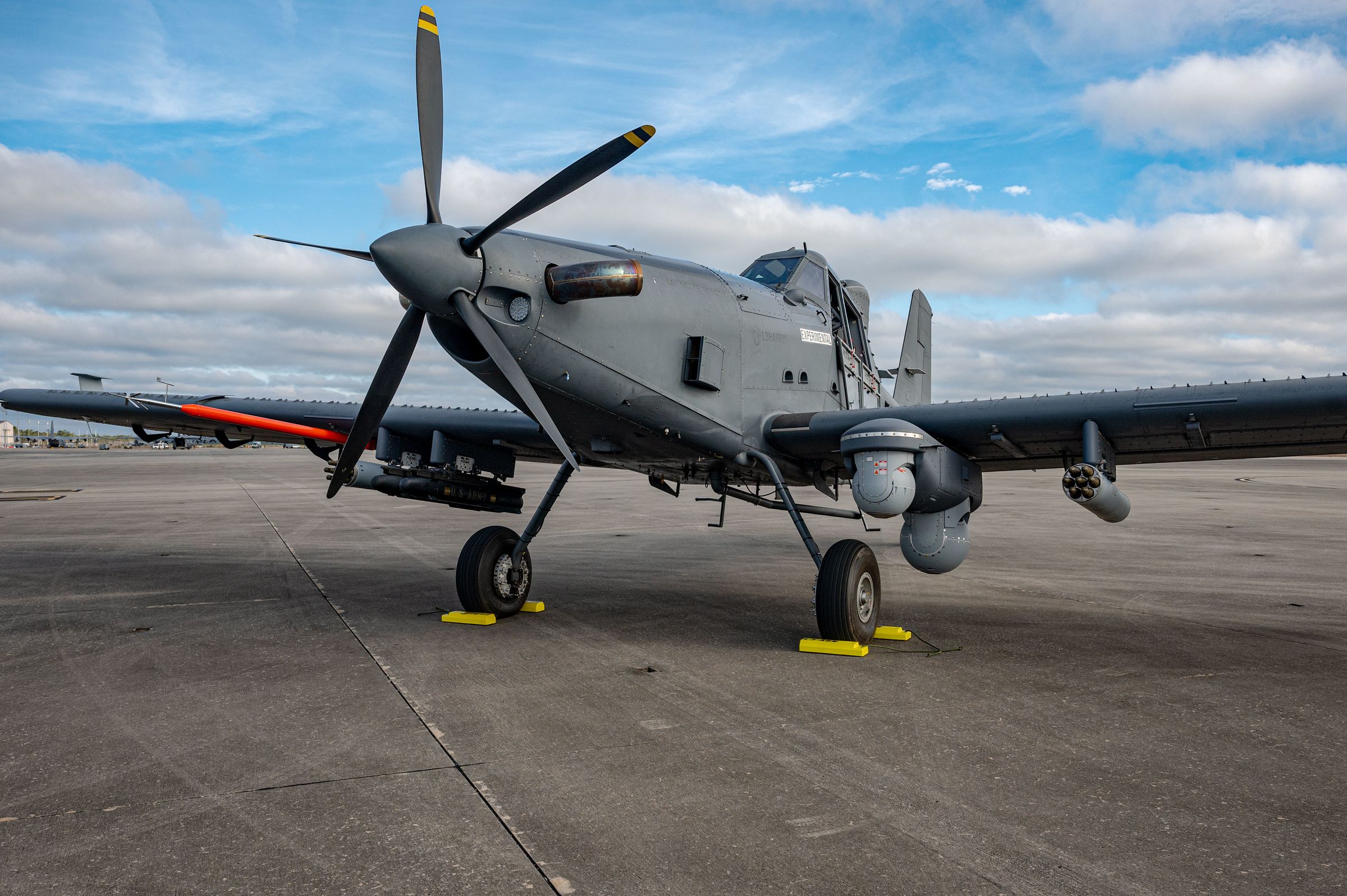
The OA-1K Skyraider II is a two-seat, single-engine turboprop aircraft developed by Air Tractor and L3Harris Technologies for the U.S. Special Operations Command Armed Overwatch program. It combines armed intelligence, surveillance and reconnaissance, precision strike, and close air support functions with the ability to operate from short and austere airfields.
The aircraft is derived from the Air Tractor AT-802 family and the militarized AT-802U concept. Air Tractor produces the basic airframe, while L3Harris integrates mission equipment, survivability features, communications, sensors, and provisions for weapons.
The program is intended to provide U.S. special operations forces with persistent crewed airborne support at substantially lower operating cost and with a smaller logistical footprint than conventional combat aircraft. By 2026, aircraft had been delivered for training and fielding while operational testing and further weapons integration continued.
Development
U.S. Special Operations Command selected the AT-802U-based design in 2022 for the Armed Overwatch requirement. The program addressed missions in which special operations forces required long-duration surveillance, rapid tactical decision-making, and precision fire support without relying on high-performance fighters for every task.
Air Tractor and L3Harris received a contract valued at up to $3 billion for an original planned fleet of 75 aircraft. The aircraft was subsequently designated OA-1K. In February 2025, Air Force Special Operations Command announced the service name Skyraider II, referencing the earlier Douglas A-1 Skyraider while identifying the OA-1K as a separate modern aircraft.
The planned fleet size has changed as budgets and requirements evolved. A reduction from 75 to 62 aircraft was reported during the program's early fielding period. By May 2026, U.S. Special Operations Command's procurement plan had been reduced to 53 airframes because of resource constraints, while Air Force Special Operations Command continued to state a requirement for 75. Additional program information and technical data have been published by Air & Space Forces Magazine.
Training and fielding
Two AT-802U aircraft were delivered to Hurlburt Field, Florida, in June 2024 to prepare test pilots, instructors, and initial cadre crews before the arrival of missionized OA-1Ks. Training began in July 2024, and one of the aircraft was transferred to Will Rogers Air National Guard Base in Oklahoma for training associated with the future OA-1K Formal Training Unit.
The first operationally configured OA-1K was delivered to Air Force Special Operations Command at Hurlburt Field on April 3, 2025. Further aircraft were assigned to training and evaluation activities at Will Rogers and other locations. An OA-1K was substantially damaged in a forced landing in October 2025.
By May 2026, Air Force Special Operations Command had received its 18th OA-1K airframe. Initial crews continued training at Will Rogers Air National Guard Base, while the command prepared for operational testing later in 2026. The Oklahoma Air National Guard's 137th Special Operations Wing was among the organizations helping develop pilot qualifications, maintenance procedures, and employment concepts for the aircraft.
Design
The OA-1K retains the basic high-wing, single-engine configuration of the Air Tractor AT-802 family but incorporates military mission systems and survivability equipment. Its tailwheel landing gear and low-speed handling support operations from short, semi-prepared, and unimproved surfaces. Published data indicate that the aircraft can operate from airstrips shorter than approximately 430 m (1,400 ft), depending on conditions and configuration.
Cockpit and survivability
The aircraft has a two-person crew consisting of a pilot and a combat systems operator. The cockpit uses digital displays and mission systems intended to support surveillance, targeting, communications, and weapons employment.
Survivability features include armor around the cockpit and engine compartment and self-sealing fuel tanks. Defensive systems and countermeasures are also incorporated. These measures provide protection against some battlefield threats but do not make the aircraft a stealth platform or a substitute for aircraft designed for heavily defended airspace.
Sensors and communications
The OA-1K is configured for intelligence, surveillance and reconnaissance using electro-optical and infrared sensors. Published descriptions identify line-of-sight and beyond-line-of-sight communications, Link 16, and air-to-ground networking among its mission systems. The aircraft can carry external sensor payloads and is intended to share information with ground forces and other elements of the joint force.
The modular mission architecture is intended to allow different combinations of fuel, sensors, communications equipment, and weapons according to mission requirements. Air Force Special Operations Command has also discussed future integration of additional intelligence-collection systems and other payloads.
Powerplant
The OA-1K is powered by one Pratt & Whitney Canada PT6A-67F turboprop rated at approximately 1,600 shp. The turboprop configuration supports long endurance and lower fuel consumption than high-performance jet combat aircraft used for other missions.
Armament
The aircraft can carry up to approximately 2,720 kg (6,000 lb) of weapons and external sensor payloads. Weapons associated with the program include AGM-114 Hellfire missiles, GBU-12 Paveway II laser-guided bombs, and Advanced Precision Kill Weapon System laser-guided rockets. Integration and certification have continued during the fielding program, so individual weapon types should not be assumed to have reached the same operational status at the same time.
Air Force Special Operations Command has also examined longer-range weapons, including the Red Wolf miniature cruise missile, as a possible future addition. This remained an explored capability rather than a confirmed standard armament fit in the available 2026 information.
Expeditionary deployment
A major feature of the OA-1K concept is rapid worldwide deployment. The aircraft is designed so that crews and maintainers can disassemble major components and load the aircraft into large transport aircraft such as the C-5 or C-17. Air Force Special Operations Command reported that timed disassembly and reassembly had already been demonstrated in a hangar and planned to test the process with an actual mobility aircraft during operational testing in 2026.
After transport and reassembly, the two-person crew is trained to conduct functional check flights before operations. The concept is intended to allow OA-1Ks to move rapidly between theaters and operate with a relatively small support element from temporary or austere locations. Details of the 2026 rapid-deployment testing plans were described by The War Zone.
Program status
During 2026, the OA-1K remained in production, training, fielding, and capability demonstration. Air Force Special Operations Command planned operational testing later in the year and targeted initial operational capability in 2026, followed by a later progression toward full operational capability. Combat deployment had not been given a definitive date in the available May 2026 program statements.
The aircraft's mission set includes armed overwatch, close air support, armed intelligence, surveillance and reconnaissance, and precision strike. Air Force Special Operations Command has also described potential use in crisis response, irregular warfare, contingency operations, communications support, and missions supporting dispersed forces.
In July 2026, senior National Guard leadership visited the 137th Special Operations Wing and highlighted the unit's role in developing personnel and procedures around the OA-1K. The wing's pilots, intelligence personnel, maintainers, and support staff were participating in the broader effort to mature the aircraft for special operations use.
Operators
- United States Air Force Special Operations Command: Operator and capability sponsor for the OA-1K Armed Overwatch mission. Aircraft have been used for training, testing, and fielding through organizations including the 492nd Special Operations Wing.
- Oklahoma Air National Guard: The 137th Special Operations Wing at Will Rogers Air National Guard Base supports OA-1K training and fielding activities.
Specifications (OA-1K Skyraider II)
General characteristics
- Crew: 2, consisting of a pilot and combat systems operator
- Length: approximately 11.4 m (37.5 ft)
- Wingspan: approximately 18.1 m (59.2 ft)
- Maximum takeoff weight: approximately 7,260 kg (16,000 lb)
- Powerplant: 1 × Pratt & Whitney Canada PT6A-67F turboprop
- Power: approximately 1,600 shp (1,200 kW)
- External weapons and sensor payload: up to approximately 2,720 kg (6,000 lb)
Performance
- Maximum speed: approximately 394 km/h (245 mph)
- Range: approximately 2,410 km (1,500 mi) with auxiliary fuselage fuel
- Service ceiling: approximately 9,140 m (30,000 ft)
- Endurance: reported as more than six hours in suitable mission configurations
Mission equipment
- Sensors: electro-optical and infrared full-motion-video systems
- Communications: line-of-sight and beyond-line-of-sight communications and Link 16
- Networking: air-to-ground data sharing for coordination with ground forces
- Survivability: cockpit and engine armor, self-sealing fuel tanks, and defensive systems
Armament and planned weapons
- AGM-114 Hellfire: air-to-surface missile associated with the OA-1K weapons program
- Advanced Precision Kill Weapon System: laser-guided rocket planned for integration and operational use
- GBU-12 Paveway II: 227 kg (500 lb) class laser-guided bomb included among planned weapons
Related equipment
- Air Tractor AT-802: Civil agricultural and firefighting aircraft family from which the OA-1K design was developed.
- AT-802U: Militarized Air Tractor configuration that formed the basis of the Armed Overwatch aircraft selected for U.S. Special Operations Command.
- Douglas A-1 Skyraider: Historical attack aircraft whose name inspired the Skyraider II service name; it is not a direct development of the OA-1K.
 Argentina
 Armenia
 Australia
 Austria
 Austria-Hungary
 Belgium
 Brazil
 United Kingdom
 Brunei
 Bulgaria
 Canada
 Chile
Chile China
China Colonial America
 Colombia
 Confederate States
 Croatia
 Czech
Czech Denmark
 Egypt
Egypt Finland
 France
 Georgia
 Germany
 German Imperial
 Greece
 Holland
 Hungary
 India
India Indonesia
 Iran
Iran Iraq
Iraq Ireland
 Israel
 Italy
Italy Japan
Japan Japan (1940)
 Jordan
 Kingdom of Italy
 Malaysia
 Mexico
 Myanmar
 Nazi Germany
 Netherlands
 New Zealand
 North Korea
 Norway
 Pakistan
 Peru
Peru Philippines
 Poland
 Portugal
 Prussia
 Romania
 Russia
 Saudi Arabia
 Serbia
 Singapore
 Slovakia
 Slovenia
 South Africa
 South Korea
 Soviet Union
 Spain
Spain Sweden
 Switzerland
 Syria
Syria Taiwan
 Thailand
 Turkey
 UAE
UAE Ukraine
 Vietnam
 Yugoslavia