
History
The BAE Systems Advanced Precision Kill Weapon System II, or APKWS II, is a laser-guided weapon derived from the 70 mm Hydra rocket architecture. The air-to-air configuration adapts the system for interception of unmanned aircraft and other relatively low-performance aerial threats.
The air-to-air development retains the modular APKWS II concept, in which a guidance section is installed between the rocket motor and warhead. The AGR-20F configuration developed under the U.S. Air Force FALCO program combines updated guidance software with a proximity fuze for counter-unmanned-aircraft missions.
APKWS II therefore differs from a conventional purpose-built air-to-air missile. Its air-to-air configuration provides a precision-guided, multi-round option intended to complement higher-performance missiles when engaging drones and similar targets.
Development
The original Advanced Precision Kill Weapon System requirement was formulated by the U.S. Army in 1996 to provide a weapon between unguided 70 mm Hydra rockets and more complex guided missiles. The first APKWS program was ultimately cancelled in April 2005 after poor test results.
The competition was reopened as APKWS II, with the weapon required to remain based on the Hydra 70 and Mk 66 rocket architecture. In April 2006, a BAE Systems-led team was selected for further development, testing and initial production. The selected design used a WGU-59-series mid-body guidance section with a Distributed Aperture Semi-Active Laser Seeker. According to NAVAIR, production began in 2011 and initial operational capability was declared in 2012 on U.S. Marine Corps AH-1W and UH-1Y helicopters.
APKWS II subsequently expanded from its helicopter origins to fixed-wing aircraft. NAVAIR states that the weapon was fielded on the AV-8B, F-16 and A-10 in 2016. U.S. military model designations were also assigned to several APKWS II all-up rounds beginning in that period.
Air-to-air development
The U.S. Air Force developed the AGR-20F under the FALCO, or Fixed-Wing, Air-Launched, Counter-Unmanned Aircraft Systems Ordnance, program. The variant is optimized for the air-to-air role against small and relatively slow unmanned aircraft. It uses the WGU-59B/B guidance section with updated software and a TSC VIPER proximity fuze.
The AGR-20F was integrated on the F-16 in 2024, providing the earliest explicitly supported physical milestone for the air-to-air configuration covered here. Integration on the F-15E followed in 2025. Published information compiled by Designation-Systems.net states that the AGR-20F was successfully used in the Middle East in 2025 against low-cost one-way attack drones.
In 2025, BAE Systems also unveiled a dual-mode APKWS II development incorporating an imaging infrared seeker in addition to the established guidance architecture. This represents a further anti-air development and should not be confused with the laser-guided AGR-20F configuration described in the specifications below.
Proposed Italian acquisition
On 21 August 2026, the United States approved a possible Foreign Military Sale to Italy involving 5,031 WGU-59B/B guidance sections for the Single Variant Air-to-Air configuration of APKWS II. The package was estimated at $364 million and also included LAU-131 A/A launchers, Mk 152 high-explosive warheads, Mk 66 rocket motors, proximity fuzes, WTU-1/B practice warheads, inert motors and support equipment.
The proposed sale was reported as a counter-drone and short-range air-defense capability. The intended Italian service and launch platform were not identified in the available notification, so an Italian Eurofighter F-2000 integration remains unconfirmed. The $364 million package value includes equipment and support beyond the guidance sections and therefore does not represent the unit price of an individual rocket. Details of the proposed package were reported by Army Recognition.
Design
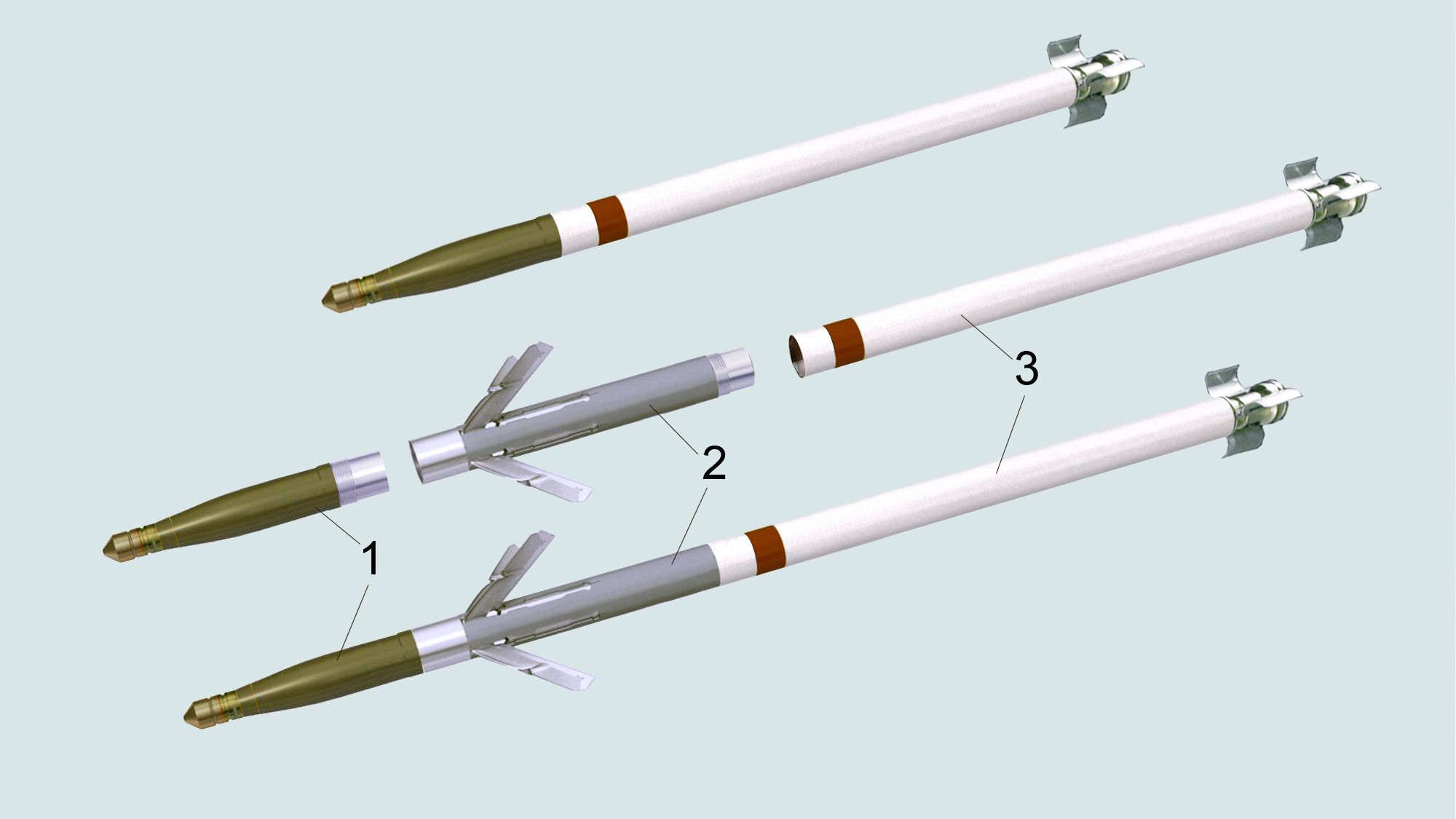
APKWS II converts an unguided 70 mm rocket into a precision-guided weapon by inserting a guidance section between the warhead and Mk 66 rocket motor. This modular arrangement allows the system to retain major components of the established Hydra-family rocket architecture while adding guidance and control.
Guidance
The APKWS II guidance section uses Distributed Aperture Semi-Active Laser Seeker technology. Seeker optics are distributed across four deployable guidance wings. The published instantaneous field of regard is 40 degrees. In the air-to-air configuration, the weapon remains dependent on laser designation rather than using the autonomous radar or infrared seekers associated with many conventional air-to-air missiles.
The AGR-20F uses the WGU-59B/B guidance section with updated software described as the True Pulse Logic Update. The proximity fuze is particularly important for aerial targets because it allows the warhead to function without requiring a direct impact.
Rocket and launcher
The all-up weapon uses a 70 mm Mk 66 Mod 4 solid-propellant rocket motor. APKWS II rounds are longer than standard unguided rockets because of the inserted guidance section and therefore require launchers with sufficiently long tubes. Compatible launchers include the seven-tube LAU-68F/A and LAU-131A/A.
Multi-round launchers allow an aircraft to carry several APKWS II weapons on a single launcher. In the counter-UAS role, this can provide greater engagement capacity against numerous low-cost aerial targets than carrying the same number of conventional single-rail air-to-air missiles.
Warhead and fuze
The AGR-20F configuration is associated with the M151 high-explosive warhead and the VIPER proximity fuze. Other APKWS II configurations can use different compatible warheads and fuzes, but those combinations should not be treated as specifications of the AGR-20F air-to-air variant.
Operational history
The broader APKWS II family entered operational service in 2012 and was later fielded on fixed-wing aircraft. Its air-to-air application emerged from demonstrations and counter-UAS development that showed the laser-guided rocket could be used against airborne targets.
The AGR-20F air-to-air configuration was integrated on the F-16 in 2024 and on the F-15E in 2025. Published reporting states that the variant was successfully employed in the Middle East during 2025 against one-way attack drones.
The proposed 2026 Italian acquisition would substantially expand the international inventory of APKWS II air-to-air guidance sections if completed. The approval concerns a possible sale rather than confirmation that Italy has received or operationally fielded the weapons.
Variants
- AGR-20F: Fixed-wing APKWS II configuration developed under the U.S. Air Force FALCO program for counter-UAS air-to-air use. It employs the WGU-59B/B guidance section, updated software and a VIPER proximity fuze.
- Single Variant Air-to-Air APKWS II: Designation used for the configuration included in the proposed 2026 U.S. Foreign Military Sale to Italy, centered on WGU-59B/B guidance sections and proximity-fuzed rockets.
- Dual-mode APKWS II: Development unveiled in 2025 with an additional imaging infrared seeker to improve anti-air capability. It is distinct from the laser-guided AGR-20F configuration.
Operators
- United States: The AGR-20F was developed for the U.S. Air Force and integrated on the F-16 in 2024 and F-15E in 2025.
Specifications (AGR-20F)
General characteristics
- Length: 1.875 m (73.8 in)
- Diameter: 70 mm (2.75 in)
- Weight: 14.8 kg (32.6 lb)
- Propulsion: Mk 66 Mod 4 solid-propellant rocket motor
- Warhead: M151 high-explosive, approximately 3.95 kg (8.7 lb)
- Guidance: WGU-59B/B semi-active laser guidance section with updated software
- Fuze: TSC VIPER proximity fuze
Performance
- Maximum speed: approximately 1,000 m/s
- Published range: more than 12 km (7.5 mi)
 Argentina
 Armenia
 Australia
 Austria
 Austria-Hungary
 Belgium
 Brazil
 United Kingdom
 Brunei
 Bulgaria
 Canada
 Chile
Chile China
China Colonial America
 Colombia
 Confederate States
 Croatia
 Czech
Czech Denmark
 Egypt
Egypt Finland
 France
 Georgia
 Germany
 German Imperial
 Greece
 Holland
 Hungary
 India
India Indonesia
 Iran
Iran Iraq
Iraq Ireland
 Israel
 Italy
Italy Japan
Japan Japan (1940)
 Jordan
 Kingdom of Italy
 Malaysia
 Mexico
 Myanmar
 Nazi Germany
 Netherlands
 New Zealand
 North Korea
 Norway
 Pakistan
 Peru
Peru Philippines
 Poland
 Portugal
 Prussia
 Romania
 Russia
 Saudi Arabia
 Serbia
 Singapore
 Slovakia
 Slovenia
 South Africa
 South Korea
 Soviet Union
 Spain
Spain Sweden
 Switzerland
 Syria
Syria Taiwan
 Thailand
 Turkey
 UAE
UAE Ukraine
 Vietnam
 Yugoslavia