
History
The Raytheon AIM-424 Malice, formally described as the Long Range Air-to-Air Missile (LRAAM), is a next-generation air-to-air missile under development for the U.S. Department of the Navy. It is intended to increase the engagement range, lethality, and combat effectiveness of U.S. Navy and Marine Corps aviation.
The missile was publicly disclosed at the Tailhook Symposium in Reno, Nevada, on August 22, 2026. By that time, AIM-424 hardware had already been used in flight testing, including carriage by an F/A-18E Super Hornet, while another missile had been installed in the internal weapons bay of an F-35C.
The U.S. Navy fact file identifies Raytheon as the contractor and gives the AIM-424 a disclosed range exceeding 463 km (250 nautical miles). The Navy describes the missile as being designed for fourth-, fifth-, and sixth-generation aircraft.
Development and disclosure
The AIM-424 was developed before its public unveiling, although the available sources do not provide a confirmed date for the beginning of the program. Naval News reported that Raytheon's Advanced Technology division developed the missile and that work associated with infrastructure for integration across U.S. Air Force and Navy systems was also underway.
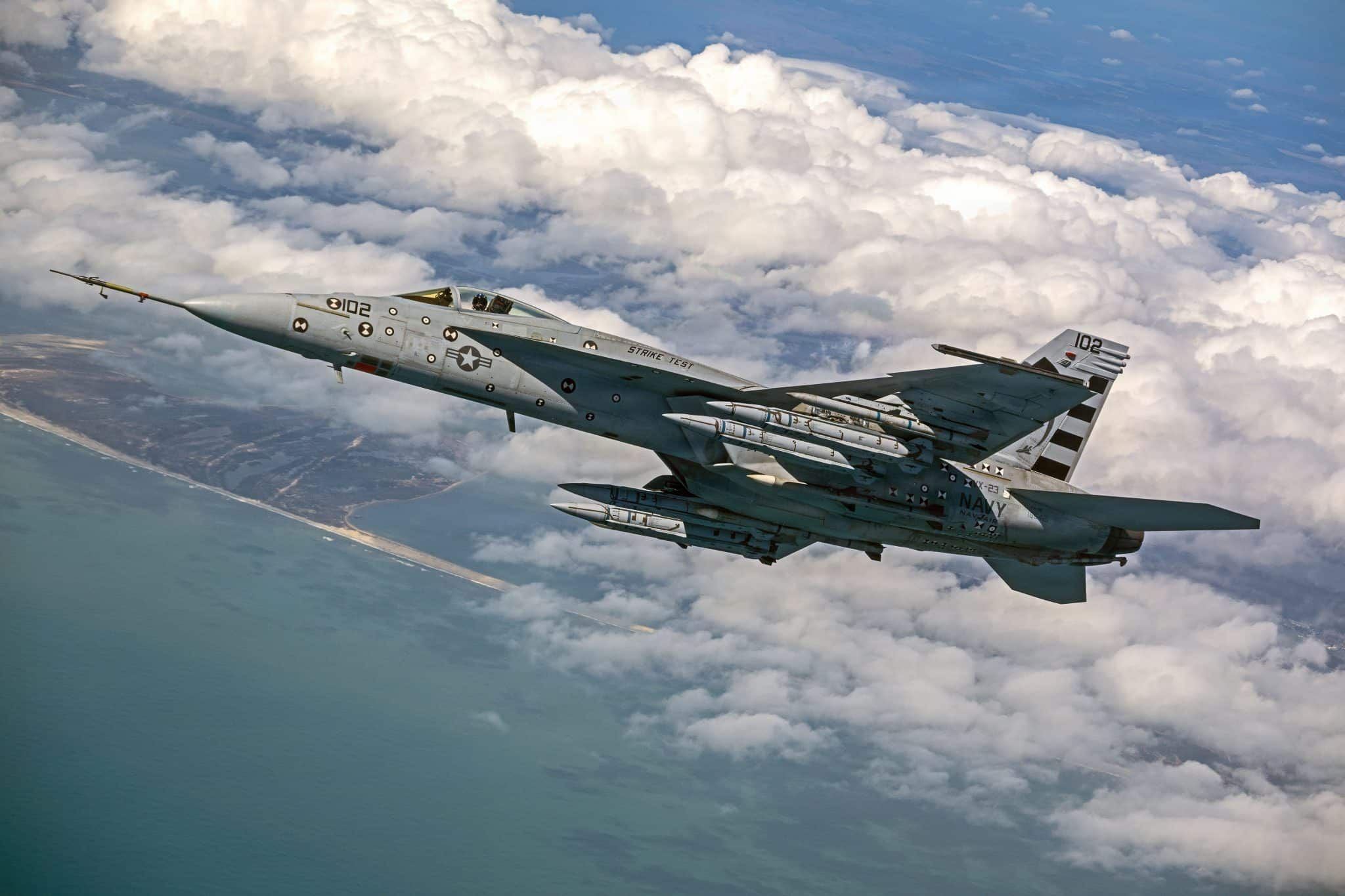
A U.S. Navy photograph documented four AIM-424 missiles carried by an F/A-18E Super Hornet assigned to Air Test and Evaluation Squadron 23 during a test event. Reporting associated with the disclosure dates at least one captive-carry flight test to April 2026. This provides the earliest explicitly supported physical milestone for the missile in the available material.
The existence of the AIM-424 was publicly announced during the Tailhook Symposium on August 22, 2026. At disclosure, the weapon was already in testing rather than operational service. The Navy stated that the LRAAM was being developed to strengthen fleet defense and improve the reach and survivability of Marine and Naval aviation forces.
The program is intended to support the F/A-18E/F Super Hornet and F-35C Lightning II, as well as future combat aircraft. The Navy specifically describes AIM-424 as suitable for fourth-, fifth-, and sixth-generation platforms. Contemporary reporting also associates the missile with the future F/A-XX carrier fighter.
Design
The AIM-424 is a large air-launched missile optimized for very-long-range air-to-air engagements. According to the Navy's published specifications, it is 4.11 m long, 0.34 m in diameter, has a wingspan of 0.67 m, and weighs approximately 680.4 kg.
Propulsion and aerodynamic configuration
The U.S. Navy identifies the propulsion system as a solid-propellant rocket motor. TWZ reporting cited contemporary reporting describing AIM-424 as a two-stage design, but the Navy's public specification does not provide that level of detail. The two-stage characterization should therefore be treated as reported information rather than a fully described official propulsion configuration.
The missile's published dimensions make it substantially larger than conventional medium-range air-to-air missiles. Its disclosed maximum range is in excess of 463 km, or 250 nautical miles. Detailed information about acceleration, maximum speed, flight profile, propulsion stages, or end-game energy has not been publicly provided in the cited Navy specifications.
Warhead and guidance
The AIM-424 carries a blast-fragmentation warhead. The U.S. Navy has not publicly disclosed the missile's seeker type, guidance architecture, datalink configuration, terminal guidance method, or other detailed engagement-system characteristics in the available material.
Aircraft integration
The AIM-424 has been shown carried externally by an F/A-18E Super Hornet. A U.S. Navy image of a VX-23 test aircraft showed four AIM-424 missiles loaded for a test event, demonstrating integration work with an existing carrier-based fighter.
The missile has also been installed inside the weapons bay of an F-35C. The internal fit demonstrates that AIM-424 is being developed with compatibility for low-observable internal carriage rather than exclusively for external pylons. Available imagery also shows an AIM-120 carried on a weapons-bay door station alongside the internally mounted AIM-424.
The Navy also intends the LRAAM concept for future sixth-generation aircraft. Reporting surrounding the public disclosure identifies the future F/A-XX carrier fighter as one planned platform. These future integrations remain developmental and should not be interpreted as evidence that the missile has entered operational service.
Program status
As of its August 2026 public disclosure, AIM-424 was under development and flight testing. The available sources do not establish an initial operational capability date, production quantity, procurement schedule, or unit cost.
The Navy describes the missile as a fleet-defense weapon intended to provide greater air-to-air engagement reach and tactical flexibility. Its officially stated range exceeds 463 km, giving naval aircraft the potential to engage airborne threats at significantly greater distances than weapons in the traditional medium-range class.
The program is associated with current and future U.S. carrier aviation. Testing has included the F/A-18E Super Hornet, while internal carriage has been demonstrated on the F-35C. Integration with the future F/A-XX remains planned because that aircraft itself is a future platform.
Public information remains limited. The Navy has not disclosed detailed guidance, seeker, datalink, propulsion-cycle, deployment-timeline, or production information, and some specific capabilities remain classified.
Specifications (AIM-424 Malice)
General characteristics
- Primary function: Long-range air-to-air missile
- Contractor: Raytheon
- Length: 4.11 m (13.5 ft)
- Diameter: 0.34 m (13.5 in)
- Wingspan: 0.67 m (26.2 in)
- Weight: 680.4 kg (1,500 lb)
Performance
- Range: In excess of 463 km (250 nautical miles)
- Propulsion: Solid-propellant rocket motor
Warhead
- Warhead: Blast-fragmentation
Compatible and planned platforms
- F/A-18E/F Super Hornet: Test integration demonstrated, including four-missile carriage on an F/A-18E.
- F-35C Lightning II: Internal weapons-bay fit demonstrated.
- F/A-XX: Future carrier fighter identified as an intended platform.
 Argentina
 Armenia
 Australia
 Austria
 Austria-Hungary
 Belgium
 Brazil
 United Kingdom
 Brunei
 Bulgaria
 Canada
 Chile
Chile China
China Colonial America
 Colombia
 Confederate States
 Croatia
 Czech
Czech Denmark
 Egypt
Egypt Finland
 France
 Georgia
 Germany
 German Imperial
 Greece
 Holland
 Hungary
 India
India Indonesia
 Iran
Iran Iraq
Iraq Ireland
 Israel
 Italy
Italy Japan
Japan Japan (1940)
 Jordan
 Kingdom of Italy
 Malaysia
 Mexico
 Myanmar
 Nazi Germany
 Netherlands
 New Zealand
 North Korea
 Norway
 Pakistan
 Peru
Peru Philippines
 Poland
 Portugal
 Prussia
 Romania
 Russia
 Saudi Arabia
 Serbia
 Singapore
 Slovakia
 Slovenia
 South Africa
 South Korea
 Soviet Union
 Spain
Spain Sweden
 Switzerland
 Syria
Syria Taiwan
 Thailand
 Turkey
 UAE
UAE Ukraine
 Vietnam
 Yugoslavia