
History
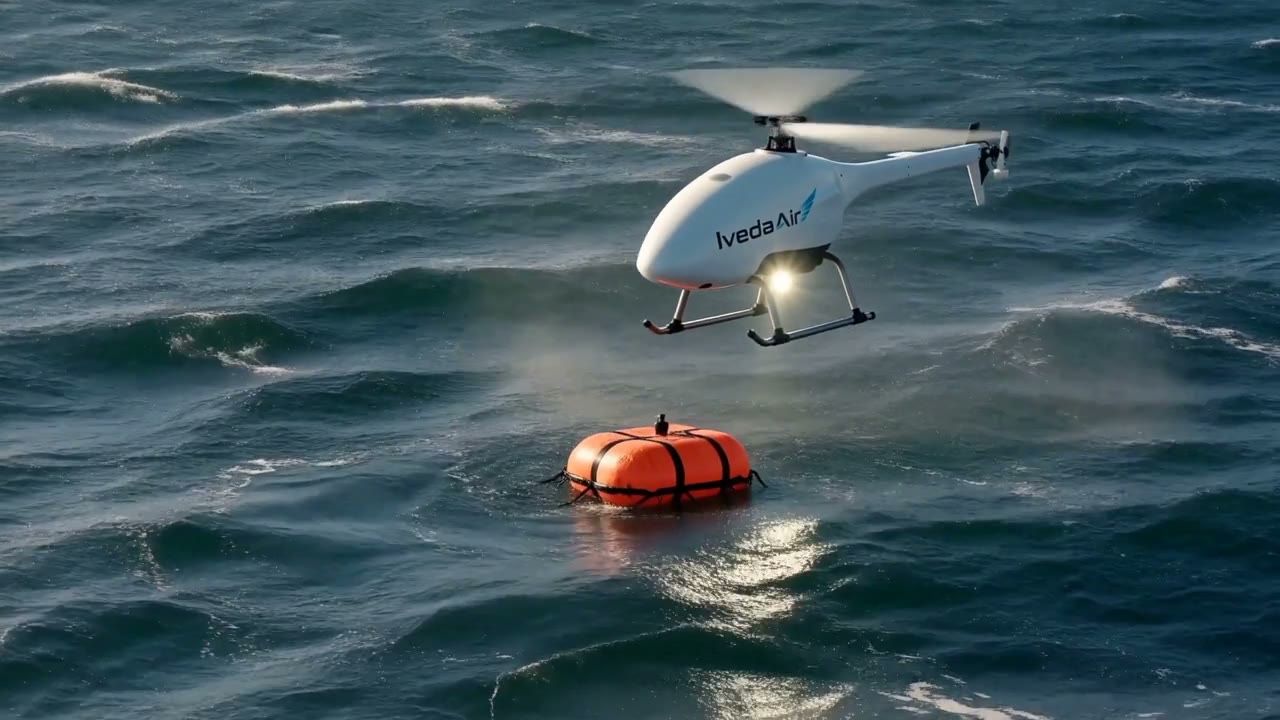
Iveda IvedaAir is a line of autonomous rotary-wing unmanned aircraft introduced in 2026 for public-safety, maritime, emergency-response, infrastructure, and defense missions. The aircraft use a helicopter-style configuration rather than the multirotor layout common to many small unmanned aircraft systems.
The line is led by the gasoline-powered GX10-F100, which Iveda states can remain airborne for more than 150 minutes. IvedaAir combines autonomous and semi-autonomous flight functions with IvedaAI software for aerial sensing, object detection, tracking, and monitoring.
The system is intended for missions requiring vertical takeoff and landing, hover capability, extended endurance, and greater payload flexibility than small battery-powered quadcopters can normally provide.
Development and introduction
Iveda announced IvedaAir on 19 August 2026 as a new rotary-wing unmanned aircraft line. The announcement described the system as intended for public safety, maritime security, emergency response, military support, and other operations where long endurance and stable flight are important. Contemporary coverage by DroneExpos reproduced the launch information, while Military Aerospace subsequently described the platform and its intended government and defense applications.
The GX10-F100 was presented as the principal gas-powered aircraft in the initial line. Iveda selected gasoline propulsion to extend flight endurance beyond that normally associated with small battery-powered quadcopters while retaining the ability to take off vertically, land vertically, and hover. The company identified coastal areas, high-wind environments, remote terrain, and extended deployments among the operating conditions for which the aircraft was designed.
Published specifications were independently repeated by Interesting Engineering, DroneFront, and TechRadar. These reports consistently describe a flight endurance exceeding 150 minutes, a maximum payload of approximately 9 kg, a maximum speed of about 109 km/h, and a stated range of approximately 31 km.
Government procurement
Iveda stated that its rotary-wing UAS could be ordered by eligible federal customers through GlobalMed using the Defense Logistics Agency Tailored Logistics Support contract vehicle. The company also stated that additional federal procurement arrangements were anticipated.
Iveda describes IvedaAir as compliant with National Defense Authorization Act and Trade Agreements Act requirements. Models can also be configured with communications equipment supporting FIPS 140-3-validated cryptographic modules and components aligned with the U.S. Department of Defense Blue UAS framework. These are procurement and security options rather than measures of aircraft flight performance.
Design
Airframe and propulsion
IvedaAir uses a conventional helicopter-form rotary-wing layout. Unlike a quadcopter, the GX10-F100 relies on a gasoline-powered propulsion system and a main rotor. The configuration provides vertical takeoff and landing and allows the aircraft to maintain a stabilized hover.
The GX10-F100 is approximately 1.83 m long and has a rotor diameter of approximately 1.83 m. Published descriptions identify carbon-fiber construction associated with its semi-symmetrical aerodynamic structure. The aircraft carries about 5 liters of fuel.
The gasoline propulsion system is the main factor behind the platform's stated endurance of more than 150 minutes. Actual endurance can vary with payload, weather, flight profile, and other operating conditions, and the available sources do not provide independent endurance testing at maximum payload.
Payload and mission equipment
The GX10-F100 can carry up to approximately 9 kg of payload. Iveda positions this capacity for sensors, communications equipment, supplies, and other mission-specific loads. Detailed sensor configurations have not been disclosed in the available material.
Proposed applications include maritime vessel tracking, shipping-lane monitoring, search support, search and rescue, emergency supply delivery, infrastructure inspection, topographic mapping, disaster response, reconnaissance, logistics, and aerial communications relay. Military use described by Iveda centers on reconnaissance, supply transport, and communications support rather than an announced weapon capability.
Autonomy and IvedaAI
IvedaAir supports autonomous waypoint missions, semi-autonomous operation, and stabilized hovering. IvedaAI software can process aerial information for real-time object detection, anomaly detection, tracking, monitoring, and incident-response workflows.
The system supports real-time video and image transmission through 4G, 5G, and LTE networks. Iveda also describes encrypted video transmission and AES-encrypted communications. The available sources do not establish how much AI processing takes place directly aboard the aircraft and how much is performed elsewhere in the connected network.
Automated navigation and analytics are intended to reduce the need for continuous manual control and continuous observation of a raw video feed. During a waypoint mission or stationary surveillance task, software can identify objects or events requiring operator attention while the aircraft continues its assigned route or hover.
Program status
IvedaAir was commercially introduced in August 2026 and was described as available for government procurement through GlobalMed. The available material does not identify military units that have placed the GX10-F100 into operational service, so prospective military and government applications should not be interpreted as confirmed operational deployment.
Iveda has also proposed using technology developed through IvedaAir as a pathway for converting retired full-size helicopters into autonomous aircraft. This remains a future objective and is separate from the capabilities announced for the current purpose-built GX10-F100 unmanned helicopter.
Variants
- GX10-F100: Gasoline-powered rotary-wing UAS and the principal model identified in the initial IvedaAir line. It is described with more than 150 minutes of endurance and a payload capacity of approximately 9 kg.
- Autonomous full-size helicopter conversion concept: Proposed future application of Iveda's autonomous aviation technology to retired conventional helicopters. No completed conversion is identified in the available sources.
Specifications (GX10-F100)
General characteristics
- Type: Gasoline-powered autonomous rotary-wing unmanned aircraft system
- Length: approximately 1.83 m
- Rotor diameter: approximately 1.83 m
- Fuel capacity: approximately 5 liters
- Maximum payload: approximately 9 kg
Performance
- Endurance: more than 150 minutes, manufacturer-stated
- Maximum speed: approximately 109 km/h
- Stated range: approximately 31 km
Mission systems
- Flight functions: autonomous waypoint missions, semi-autonomous flight, and stabilized hover
- Analytics: IvedaAI object detection, anomaly detection, tracking, and monitoring
- Data transmission: 4G, 5G, and LTE image and video transmission
- Communications security: encrypted communications, with government-oriented options supporting FIPS 140-3-validated cryptographic modules and Blue UAS-aligned components
 Argentina
 Armenia
 Australia
 Austria
 Austria-Hungary
 Belgium
 Brazil
 United Kingdom
 Brunei
 Bulgaria
 Canada
 Chile
Chile China
China Colonial America
 Colombia
 Confederate States
 Croatia
 Czech
Czech Denmark
 Egypt
Egypt Finland
 France
 Georgia
 Germany
 German Imperial
 Greece
 Holland
 Hungary
 India
India Indonesia
 Iran
Iran Iraq
Iraq Ireland
 Israel
 Italy
Italy Japan
Japan Japan (1940)
 Jordan
 Kingdom of Italy
 Malaysia
 Mexico
 Myanmar
 Nazi Germany
 Netherlands
 New Zealand
 North Korea
 Norway
 Pakistan
 Peru
Peru Philippines
 Poland
 Portugal
 Prussia
 Romania
 Russia
 Saudi Arabia
 Serbia
 Singapore
 Slovakia
 Slovenia
 South Africa
 South Korea
 Soviet Union
 Spain
Spain Sweden
 Switzerland
 Syria
Syria Taiwan
 Thailand
 Turkey
 UAE
UAE Ukraine
 Vietnam
 Yugoslavia