
History
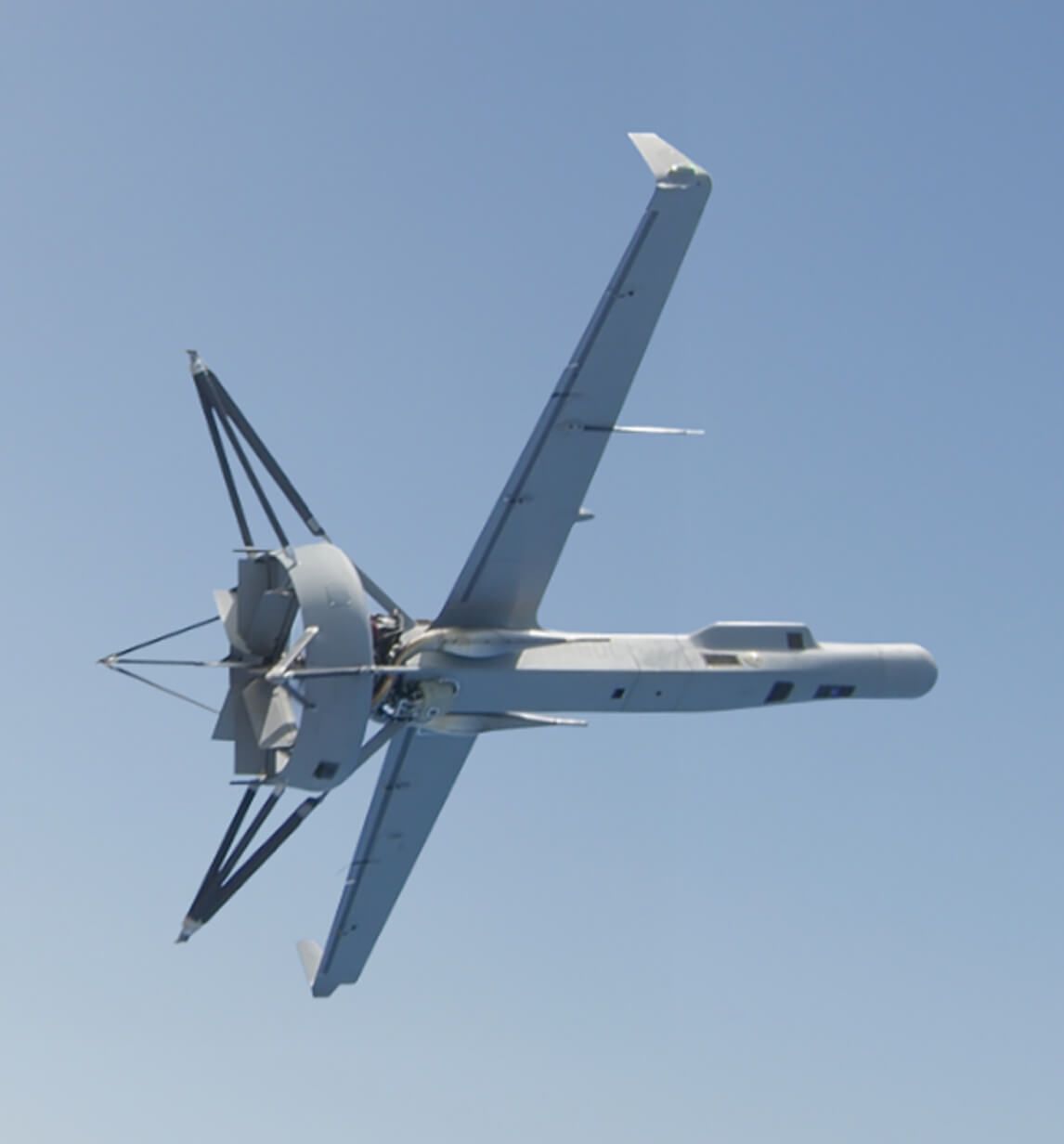
The Shield AI V-BAT, also designated MQ-35A, is an American vertical-takeoff-and-landing unmanned aerial vehicle developed for intelligence, surveillance, reconnaissance, and targeting missions. Its ducted-fan tailsitter configuration allows it to launch and recover vertically without a runway, supporting operations from ships and confined land sites.
The aircraft originated with Martin UAV and later became part of Shield AI. The V-BAT has subsequently been developed for maritime, expeditionary, and electronically contested operations, including missions in which satellite navigation or communications may be disrupted.
By 2026, the V-BAT had been adopted or ordered by military and maritime organizations in several regions. Taiwan was preparing the largest reported procurement of the aircraft, with a planned acquisition of 280 V-BATs between 2026 and 2029.
Development and early service
In 2021, the United States Navy awarded Shield AI a contract to prototype and develop the V-BAT. On 21 December 2022, a V-BAT and a Skyways V2.6B carried out unmanned cargo deliveries to a U.S. Navy ship at sea. Each aircraft carried a reported 22.5 kg payload over approximately 200 nautical miles, or 370 km. This 2022 mission is the earliest precisely dated physical operating milestone supported by the supplied material.
In October 2023, Shield AI announced coordinated multi-aircraft operations using its Hivemind autonomy software. The system was demonstrated as a means of allowing several V-BAT aircraft to coordinate their activities with reduced dependence on continuous human control.
In April 2024, a V-BAT involved in a U.S. Navy recovery operation seriously injured a sailor who was assisting the aircraft during landing. Military customers subsequently imposed restrictions while the incident was investigated. Later versions incorporated unassisted vertical launch and recovery, reducing the requirement for personnel to approach the aircraft during these phases.
The V-BAT entered battlefield testing in Ukraine in June 2024 under conditions that included Russian GPS jamming and communications interference. During an August 2024 experiment, V-BAT aircraft searched for Russian surface-to-air missile positions and transmitted targeting information subsequently used for M142 HIMARS engagements. One reported mission sent a V-BAT approximately 100 km beyond the frontline electronic-warfare barrier while searching for a Buk-M1 surface-to-air missile system.
In July 2024, the U.S. Coast Guard awarded Shield AI a maritime unmanned-aircraft services contract valued at $198 million, according to a technical profile of the V-BAT.
Block 5.3
Shield AI introduced the V-BAT Block 5.3 configuration in April 2025. The upgrade replaced the earlier gasoline engine with a 33 hp heavy-fuel engine compatible with JP-5 fuel. This improved compatibility with naval and expeditionary fuel systems. Maximum payload increased from 11.3 kg to 18.1 kg, while larger fuel tanks supported endurance exceeding 12 hours with an electro-optical and infrared payload.
The Block 5.3 configuration also incorporated satellite communications and unassisted vertical takeoff and landing. Published summaries of the configuration are available through the MQ-35 V-BAT overview and more detailed reporting on the aircraft's procurement and capabilities.
Expansion during 2025 and 2026
The Japan Maritime Self-Defense Force received its first V-BAT in December 2025. The Royal Netherlands Navy acquired 12 aircraft for use across eight vessels following shipboard trials. Other reported users included the Colombian Navy, the Hellenic Army, Indonesian special operations forces, Ukraine, and United States organizations.
In January 2026, Shield AI and South Korea's LIG Nex1 agreed to integrate the laser-guided L-MDM missile with the V-BAT. Released imagery reportedly showed a V-BAT carrying as many as four missiles. This represented a planned expansion toward precision-strike missions and should not be interpreted as evidence that an armed V-BAT configuration was already in routine operational service.
During June and July 2026, two V-BATs operated from the Italian Coast Guard patrol vessel Dattilo during a Frontex trial in the central Mediterranean. The two aircraft accumulated approximately 150 flight hours over 19 days. Flights reached about 150 km from the ship, and one search-and-rescue exercise involved locating a small inflatable boat.
In September 2026, Taiwan was preparing a procurement program covering 2026 through 2029 for 280 V-BAT aircraft, 140 control systems, and 82 transport vehicles. The reported program value was NT$36.00658 billion, approximately $1.1356 billion. Planned deliveries comprised 40 aircraft in 2026, 110 in 2027, 64 in 2028, and 66 in 2029. The planned purchase was reported by both Army Recognition and Mezha Defense.
Design
The V-BAT is a single-engine tailsitter unmanned aircraft built around a ducted-fan propulsion arrangement. It stands vertically for takeoff and landing and transitions to wing-borne horizontal flight after departure. This configuration eliminates the need for a runway, catapult, or arresting system and allows operations from small ship decks, coastal positions, roads, and other confined areas.
The aircraft has a reported maximum gross weight of approximately 75 kg. Secondary sources consulted for the V-BAT assign the reported 3.8 m and 2.9 m dimensions differently between length, wingspan, and height, so those dimensions are not repeated as definitive specifications here.
The aircraft can reportedly be assembled and prepared for a mission in less than 30 minutes by at least two personnel. Vertical recovery requires a footprint of approximately 4.6 by 4.6 to 4.7 m. Automated vertical launch and recovery have been demonstrated in winds up to 25 kt and from ships moving at up to 10 kt.
Powerplant
V-BAT Block 5.3 uses a 33 hp heavy-fuel engine compatible with JP-5. The change from gasoline was intended to simplify logistics aboard naval vessels and at expeditionary sites where heavy aviation fuels are already available.
Navigation and autonomy
The V-BAT uses Shield AI's Hivemind autonomy software. Reported functions include state estimation, mapping, object tracking, task planning, behavior planning, and motion planning. Visual odometry allows the aircraft to estimate its position without relying continuously on satellite navigation, supporting operation in GPS- or GNSS-denied environments.
Hivemind also supports coordinated multi-aircraft operations. Shield AI demonstrated multi-V-BAT coordination in 2023 and later described four aircraft as a standard V-BAT team. Autonomous processing is intended to reduce the volume of continuous piloting commands and sensor data that must pass through a potentially disrupted communications link.
Communications
Reported communications options include mesh radio, phased-array communications, and satellite communications. Mesh radio is listed with a line-of-sight range of approximately 139 km, while phased-array communications extend the reported figure to approximately 180 km. Satellite communications provide a beyond-line-of-sight option.
Sensors and mission equipment
Available mission payloads include electro-optical and infrared sensor turrets, synthetic-aperture radar, Automatic Identification System equipment, ViDAR wide-area optical search sensors, satellite communications equipment, anti-jam GNSS systems, M-Code GNSS, laser range finders, laser target designators, and signals-intelligence-related equipment. The aircraft can reportedly provide up to 600 W of electrical power to mission payloads.
ViDAR uses multiple passive optical sensors for broad-area search. Reported coverage reaches as much as 3,140 square nautical miles per hour, approximately 10,770 km² per hour under stated conditions. Onboard processing can filter imagery and transmit selected detections, tracks, images, and coordinates instead of continuously sending every full-resolution sensor feed.
Operational history
The V-BAT has been used in maritime and land-based roles. U.S. organizations have operated the aircraft from naval and Coast Guard vessels, while Ukraine has used it under severe electronic-warfare conditions for reconnaissance and targeting support. The type has also participated in shipboard trials and maritime surveillance activities in Europe.
Operations in Ukraine provided evidence of the aircraft's ability to continue missions where satellite navigation and communications were actively contested. Reported missions included searching for mobile Russian air-defense systems and relaying targeting information for long-range fires.
Maritime trials have emphasized the V-BAT's small deck footprint, vertical recovery, and ability to search well beyond the immediate sensor horizon of a ship. The 2026 Dattilo deployment demonstrated sustained flight operations from a patrol vessel during a multi-week Frontex trial.
Procurement and program status
Taiwan's planned 280-aircraft procurement would distribute V-BAT systems among surface warfare groups and littoral combat forces. The package also includes 140 control systems and 82 transport vehicles, producing a nominal ratio of two aircraft per control system. The planned organization is intended to provide mobile, runway-independent reconnaissance and targeting detachments rather than concentrate the aircraft at a single fixed base.
Taiwan's planned purchase exceeds the roughly 250 V-BAT aircraft that Shield AI was reported to have delivered cumulatively to customers worldwide by late 2024. Taiwan also plans a separate maritime UAV procurement involving the domestically produced NCSIST Albatross II, creating a layered unmanned reconnaissance force with different endurance, payload, and support requirements.
Variants
- V-BAT: Original family designation for the ducted-fan VTOL unmanned aircraft developed by Martin UAV and later Shield AI.
- MQ-35A V-BAT: U.S. military designation used for the V-BAT.
- V-BAT Block 5.3: Configuration introduced in April 2025 with a 33 hp heavy-fuel engine, increased payload capacity, larger fuel tanks, satellite communications, and unassisted vertical takeoff and landing.
- L-MDM integration configuration: Proposed armed configuration announced through a January 2026 Shield AI and LIG Nex1 integration agreement. Released imagery showed carriage of up to four laser-guided missiles, but routine operational service of this configuration is not established by the supplied sources.
Operators
- United States: V-BAT aircraft have been operated by U.S. military and maritime organizations, including Navy and Coast Guard activities.
- Ukraine: Used by Ukrainian forces for reconnaissance and targeting support under Russian electronic-warfare conditions.
- Colombia: The Colombian Navy was reported to have received three systems in 2024.
- Greece: The Hellenic Army was reported as a V-BAT user by May 2025.
- Indonesia: Indonesian Kopassus Group 5 has been identified as an operator.
- Japan: The Japan Maritime Self-Defense Force received its first V-BAT in December 2025.
- Netherlands: The Royal Netherlands Navy acquired 12 V-BAT aircraft for support across eight vessels.
Specifications (V-BAT Block 5.3)
General characteristics
- Type: Vertical-takeoff-and-landing unmanned aerial vehicle.
- Configuration: Single-engine ducted-fan tailsitter.
- Maximum gross weight: Approximately 75 kg.
- Maximum payload: 18.1 kg.
- Engine: 33 hp heavy-fuel engine.
- Fuel compatibility: JP-5-compatible heavy fuel.
- Payload electrical power: Up to 600 W.
- Mission preparation: Less than 30 minutes with at least two personnel.
- Vertical recovery footprint: Approximately 4.6 by 4.6 to 4.7 m.
Performance
- Maximum speed: Approximately 90 km/h.
- Operating ceiling: Approximately 5,500 m.
- Endurance: More than 12 hours with an EO/IR payload.
- One-way range: Up to approximately 1,200 km with a 9.1 kg payload and SATCOM; this figure is not a combat radius.
- Mesh-radio line-of-sight range: Approximately 139 km.
- Phased-array communications range: Approximately 180 km.
- Shipboard launch and recovery: Automated operation reported in winds up to 25 kt and from ships moving at up to 10 kt.
Mission equipment
- Electro-optical and infrared sensors: EO/IR observation and targeting payloads.
- Radar: Synthetic-aperture radar available as a mission payload.
- Maritime identification: Automatic Identification System equipment available.
- Wide-area search: ViDAR optical search system with reported coverage up to 3,140 square nautical miles per hour.
- Navigation: GNSS anti-jam equipment, M-Code GNSS, and visual-odometry-based navigation.
- Communications: Mesh radio, phased-array communications, and SATCOM options.
- Autonomy: Shield AI Hivemind software for navigation, planning, tracking, and multi-aircraft coordination.
 Argentina
 Armenia
 Australia
 Austria
 Austria-Hungary
 Belgium
 Brazil
 United Kingdom
 Brunei
 Bulgaria
 Canada
 Chile
Chile China
China Colonial America
 Colombia
 Confederate States
 Croatia
 Czech
Czech Denmark
 Egypt
Egypt Finland
 France
 Georgia
 Germany
 German Imperial
 Greece
 Holland
 Hungary
 India
India Indonesia
 Iran
Iran Iraq
Iraq Ireland
 Israel
 Italy
Italy Japan
Japan Japan (1940)
 Jordan
 Kingdom of Italy
 Malaysia
 Mexico
 Myanmar
 Nazi Germany
 Netherlands
 New Zealand
 North Korea
 Norway
 Pakistan
 Peru
Peru Philippines
 Poland
 Portugal
 Prussia
 Romania
 Russia
 Saudi Arabia
 Serbia
 Singapore
 Slovakia
 Slovenia
 South Africa
 South Korea
 Soviet Union
 Spain
Spain Sweden
 Switzerland
 Syria
Syria Taiwan
 Thailand
 Turkey
 UAE
UAE Ukraine
 Vietnam
 Yugoslavia