
History
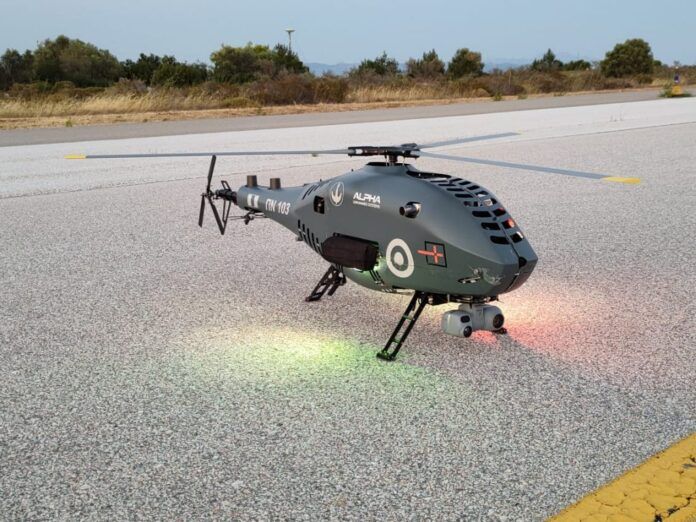
The Alpha Unmanned Systems A900 is a lightweight unmanned helicopter developed in Spain for intelligence, surveillance and reconnaissance, maritime surveillance, border control, communications relay and other sensor-carrying missions. Its maximum take-off weight is below 25 kg, allowing it to combine a small logistical footprint with vertical take-off and landing capability.
The A900 has been evaluated aboard Spanish Navy vessels and in multinational naval exercises. In September 2026, the Spanish Navy selected the aircraft for a structured maritime surveillance evaluation through its Centro de Experimentación y Vehículos no Tripulados, or CEVENTA.
The aircraft is designed around interchangeable mission payloads and can operate from moving vessels. Published specifications include endurance of up to four hours, payload capacity of up to 4 kg and a maximum speed of 100 km/h.
Naval trials
The A900 was already being used in naval experimentation by 2022. During REPMUS 2022, Alpha unmanned aircraft operated from Spanish naval patrol vessels and were connected to a shore-based command-and-control node. In 2023, the A900 participated in Dynamic Messenger and was integrated with the combat system of the Spanish Navy maritime action vessel Furor through Navantia's NAIAD system. The demonstration included simultaneous command and control of unmanned aerial and surface vehicles.
In May 2026, an A900 participated in a manned-unmanned teaming trial conducted with Airbus Helicopters España from the Spanish Navy patrol vessel Rayo off Cádiz. The activity also involved a Spanish Navy H135 helicopter and the Airbus Flexrotor vertical take-off and landing unmanned aircraft. The unmanned systems took off from and landed on the moving vessel while an H135 pilot controlled them through Airbus HTeaming technology. Information from the aircraft was integrated with the ship's systems during the exercise. A detailed account of this trial and the earlier exercises is provided by AeroMorning.
Spanish Navy order
On 3 September 2026, Alpha Unmanned Systems announced that the Spanish Navy had selected an A900-based Class I remotely piloted aircraft system for CEVENTA. The ordered system is to contain at least three A900 helicopters in maritime configuration with electro-optical and infrared sensors. The package also includes vessel-based and terrestrial control stations, a flight simulator, AIS transceiver modules, logistics support, and training for operators and technicians. The procurement was reported by Electronics Media.
The CEVENTA programme is intended to assess the A900 during maritime reconnaissance and surveillance activities following the earlier demonstration programme. The reported contract value is €1.3 million. The evaluation is intended to examine the usefulness of a lightweight rotary-wing unmanned aircraft for shipboard surveillance and its integration with naval command-and-control systems.
Design
Airframe and flight system
The A900 is a compact conventional unmanned helicopter with a main rotor diameter of 2.07 m and an overall length of 1.76 m. Maximum take-off weight is below 25 kg. Its vertical take-off and landing configuration allows operation without a runway and supports deployment from ships with limited deck space.
The aircraft is designed for automatic take-off and landing from moving vessels. Published material also describes redundant critical systems, autonomous autorotation capability and emergency flotation equipment. A radar altimeter and navigation lights are provided for operation in demanding navigation environments. The A900 catalogue states that the aircraft is designed to comply with STANAG 4738 and that critical systems meet MIL-STD 416F and 810F requirements.
Powerplant
The A900 uses a 100 cc two-stroke low-vibration boxer engine with a maximum stated output of 4 kW. It can use 98-octane gasoline or heavy aviation fuels including Jet A-1, JP-5 and JP-8. Heavy-fuel compatibility is particularly relevant to naval operation because these fuels are commonly available aboard military vessels.
An onboard generator can provide up to 150 W for mission equipment. Published endurance is up to four hours in forward flight, while sustained hover endurance is listed as up to 2.5 hours.
Mission equipment
The helicopter has four payload bays with a combined payload capacity of up to 4 kg. Supported mission equipment includes electro-optical and infrared sensors, Automatic Identification System equipment, LiDAR and other specialized payloads. The platform can therefore be configured for intelligence, surveillance and reconnaissance, maritime surveillance, border monitoring, infrastructure inspection, mapping, communications relay and target-system duties.
For the Spanish Navy configuration ordered in 2026, the confirmed payload includes electro-optical and infrared sensors. AIS transceiver modules are also included within the overall system package.
Program status
As of September 2026, the A900 has progressed beyond demonstration-only activity with the Spanish Navy but remains the subject of a dedicated CEVENTA evaluation programme rather than being described in the supplied sources as a broadly deployed operational fleet. At least three aircraft are to be supplied for this assessment in maritime configuration.
The programme follows several years of shipboard experimentation, including REPMUS 2022, Dynamic Messenger 2023 and the May 2026 manned-unmanned teaming trial from Rayo. These activities established the basis for further assessment of reconnaissance, surveillance, shipboard operation and interoperability with naval systems.
Specifications (A900)
General characteristics
- Type: unmanned helicopter / vertical take-off and landing UAV
- Maximum take-off weight: less than 25 kg
- Length: 1.76 m
- Main rotor diameter: 2.07 m
- Payload capacity: up to 4 kg across four payload bays
- Engine: 100 cc two-stroke boxer engine
- Maximum engine output: 4 kW
- Fuel: 98-octane gasoline, Jet A-1, JP-5 or JP-8
- Payload electrical power: up to 150 W from onboard generator
Performance
- Maximum speed: 100 km/h
- Cruise speed: approximately 60 km/h
- Endurance: up to 4 hours
- Hover endurance: up to 2.5 hours
- Operational radius: up to 60 km in the Spanish Navy surveillance configuration
- Radio range: up to 100 km
- Maximum published range: up to 200 km, depending on configuration
- Ceiling: approximately 3,000 m
Mission systems
- Sensors and payloads: EO/IR cameras, AIS equipment, LiDAR and other interchangeable mission payloads
- Shipboard capability: automatic vertical take-off and landing from moving vessels
- Safety features: redundant critical systems, autorotation capability and emergency flotation equipment
Operators
- Spain: the Spanish Navy selected an A900-based system for CEVENTA in September 2026. The package is to include at least three A900 unmanned helicopters in maritime configuration for reconnaissance and surveillance evaluation.
 Argentina
 Armenia
 Australia
 Austria
 Austria-Hungary
 Belgium
 Brazil
 United Kingdom
 United States
 Brunei
 Bulgaria
 Canada
 Chile
Chile China
China Colonial America
 Colombia
 Confederate States
 Croatia
 Czech
Czech Denmark
 Egypt
Egypt Finland
 France
 Georgia
 Germany
 German Imperial
 Greece
 Holland
 Hungary
 India
India Indonesia
 Iran
Iran Iraq
Iraq Ireland
 Israel
 Italy
Italy Japan
Japan Japan (1940)
 Jordan
 Kingdom of Italy
 Malaysia
 Mexico
 Myanmar
 Nazi Germany
 Netherlands
 New Zealand
 North Korea
 Norway
 Pakistan
 Peru
Peru Philippines
 Poland
 Portugal
 Prussia
 Romania
 Russia
 Saudi Arabia
 Serbia
 Singapore
 Slovakia
 Slovenia
 South Africa
 South Korea
 Soviet Union
 Sweden
 Switzerland
 Syria
Syria Taiwan
 Thailand
 Turkey
 UAE
UAE Ukraine
 Vietnam
 Yugoslavia