
History
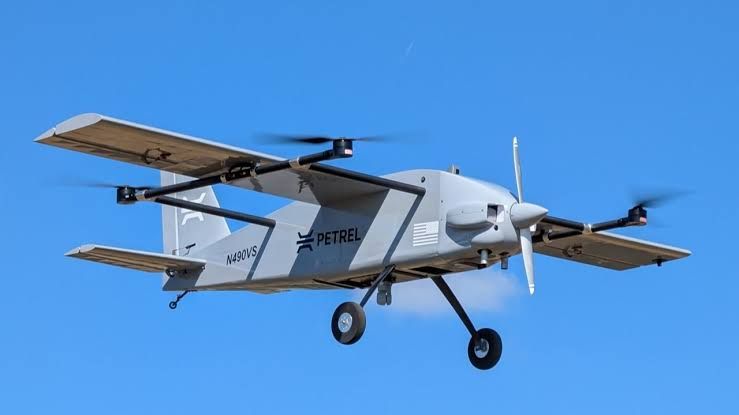
Petrel Technologies AERO Sky is a Group 3 hybrid vertical-takeoff-and-landing unmanned aircraft developed for long-endurance reconnaissance, modular payload carriage, logistics support, communications relay, and strike-support missions. Its hybrid VTOL configuration combines vertical launch and recovery with efficient fixed-wing cruise.
In 2026, the aircraft attracted U.S. Army attention as a carrier for smaller FPV strike drones. During live-fire exercises, AERO Sky was used as an airborne mothership that transported externally mounted FPV drones toward the target area before releasing them for the terminal phase of the mission.
The system remained an experimental and evaluation platform in the reported 2026 activities. Public reporting did not identify a U.S. Army procurement decision or a standardized operational configuration.
Development
Petrel Technologies developed AERO Sky after work that originated with Sustainable Skylines, a company that used lightweight unmanned aircraft for aerial advertising. Petrel Technologies later redirected the design approach toward military applications. According to Tectonic Defense, the aircraft uses a combination of carbon fiber and balsa wood to obtain a lightweight structure while keeping production costs relatively low.
By February 2026, AERO Sky had completed a six-hour endurance test. Reporting on the test described the aircraft conducting real-time reconnaissance while using vertical takeoff, hybrid-electric endurance, and mission-configurable payloads. The aircraft was presented as a platform intended for reconnaissance, strike, and logistics missions.
U.S. Army evaluations
During a Joint Readiness Training Center rotation at Fort Polk in 2026, soldiers from the U.S. Army's 101st Airborne Division evaluated AERO Sky in long-range intelligence, surveillance, and reconnaissance missions and as a mothership for FPV strike drones. Tectonic Defense reported that the unit conducted several days of live drops and successfully employed two live kinetic effects against targets.
The larger aircraft carried the smaller drones forward before release. After a target was identified, FPV pilots controlled the released drones during their terminal approach. The concept was intended to move the launch point farther from ground forces and extend the practical reach of small one-way attack drones.
In September 2026, Petrel Technologies said that the U.S. Army's 75th Ranger Regiment had also evaluated AERO Sky during live-fire mothership operations. Defence Agenda reported that the company also described an airborne communications-relay role during this activity. No corresponding Army procurement award or fielding announcement was publicly identified in the cited reporting, so the Ranger activity represented a company-reported evaluation rather than confirmed adoption.
Design
Airframe and VTOL configuration
AERO Sky is a fixed-wing Group 3 unmanned aircraft with a hybrid VTOL configuration. Vertical lift allows launch and recovery without a conventional runway, while wing-borne forward flight provides greater endurance than a pure multicopter configuration. The aircraft has a reported wingspan of approximately 3.35 m and a maximum takeoff weight of roughly 45 kg.
The airframe is reported to use carbon fiber and balsa wood. This construction contributes to a lightweight structure. Petrel Technologies also designed the aircraft for field assembly, with reporting indicating that it can be assembled in about four minutes.
Propulsion and endurance
AERO Sky uses a hybrid-electric propulsion arrangement. Public reporting describes endurance of approximately six to eight hours depending on configuration. A six-hour flight had been demonstrated by February 2026, while longer endurance figures remained configuration-dependent reported performance.
Payloads and autonomy
The aircraft has a reported payload capacity of approximately 14-23 kg. Its modular payload architecture allows different mission equipment to be carried according to the assigned role. Reported applications include reconnaissance sensors, communications-relay equipment, logistics payloads, and externally carried FPV strike drones.
Petrel Technologies developed in-house launch-to-land autonomy software for AERO Sky. The company also described mission-specific autonomous functions for configurations such as the small-drone mothership role. Public reporting does not provide sufficient technical detail to define the exact level of autonomy used during each Army evaluation.
Drone mothership role
In the mothership configuration, AERO Sky carries smaller FPV or one-way attack drones and releases them from the air. This allows the smaller systems to begin their independent flight closer to the target area instead of traveling the entire distance from a ground launch site.
The 101st Airborne Division live-fire evaluation demonstrated the release of armed FPV drones from AERO Sky. Reporting from Interesting Engineering and Army Recognition described multiple armed FPVs being deployed during the exercise. Public sources did not disclose the warhead type, release-rack design, arming interface, or detailed datalink architecture used in the demonstrated configuration.
Communications relay
Petrel Technologies also reported use of AERO Sky as an airborne communications relay. In this configuration, the aircraft can carry communications equipment at altitude to extend links beyond direct line of sight. The September 2026 Ranger evaluation was reported to include this relay function alongside the mothership role, although detailed relay specifications were not published.
Program status
As of September 2026, AERO Sky had undergone U.S. Army evaluations with the 101st Airborne Division and, according to Petrel Technologies, the 75th Ranger Regiment. The activities demonstrated reconnaissance, airborne FPV release, live-fire strike support, and communications-relay applications.
The available reporting does not confirm that AERO Sky had entered a formal U.S. Army program of record or that the Army had awarded a production procurement contract. The aircraft should therefore be regarded as an actively evaluated system rather than a standard operational Army platform.
Specifications (AERO Sky)
General characteristics
- Type: Group 3 hybrid VTOL unmanned aircraft
- Wingspan: approximately 3.35 m (11 ft)
- Maximum takeoff weight: approximately 45 kg (100 lb)
- Payload capacity: approximately 14-23 kg (30-50 lb), depending on configuration
- Construction: carbon fiber and balsa wood
- Assembly time: approximately four minutes
Performance
- Endurance: approximately 6-8 hours depending on configuration
Mission equipment
- Reconnaissance: mission-configurable intelligence, surveillance, and reconnaissance payloads
- Communications: airborne relay payloads
- Strike support: externally carried FPV or one-way attack drones in the demonstrated mothership configuration
- Logistics: modular payload carriage for transport missions
 Argentina
 Armenia
 Australia
 Austria
 Austria-Hungary
 Belgium
 Brazil
 United Kingdom
 Brunei
 Bulgaria
 Canada
 Chile
Chile China
China Colonial America
 Colombia
 Confederate States
 Croatia
 Czech
Czech Denmark
 Egypt
Egypt Finland
 France
 Georgia
 Germany
 German Imperial
 Greece
 Holland
 Hungary
 India
India Indonesia
 Iran
Iran Iraq
Iraq Ireland
 Israel
 Italy
Italy Japan
Japan Japan (1940)
 Jordan
 Kingdom of Italy
 Malaysia
 Mexico
 Myanmar
 Nazi Germany
 Netherlands
 New Zealand
 North Korea
 Norway
 Pakistan
 Peru
Peru Philippines
 Poland
 Portugal
 Prussia
 Romania
 Russia
 Saudi Arabia
 Serbia
 Singapore
 Slovakia
 Slovenia
 South Africa
 South Korea
 Soviet Union
 Spain
Spain Sweden
 Switzerland
 Syria
Syria Taiwan
 Thailand
 Turkey
 UAE
UAE Ukraine
 Vietnam
 Yugoslavia