
History
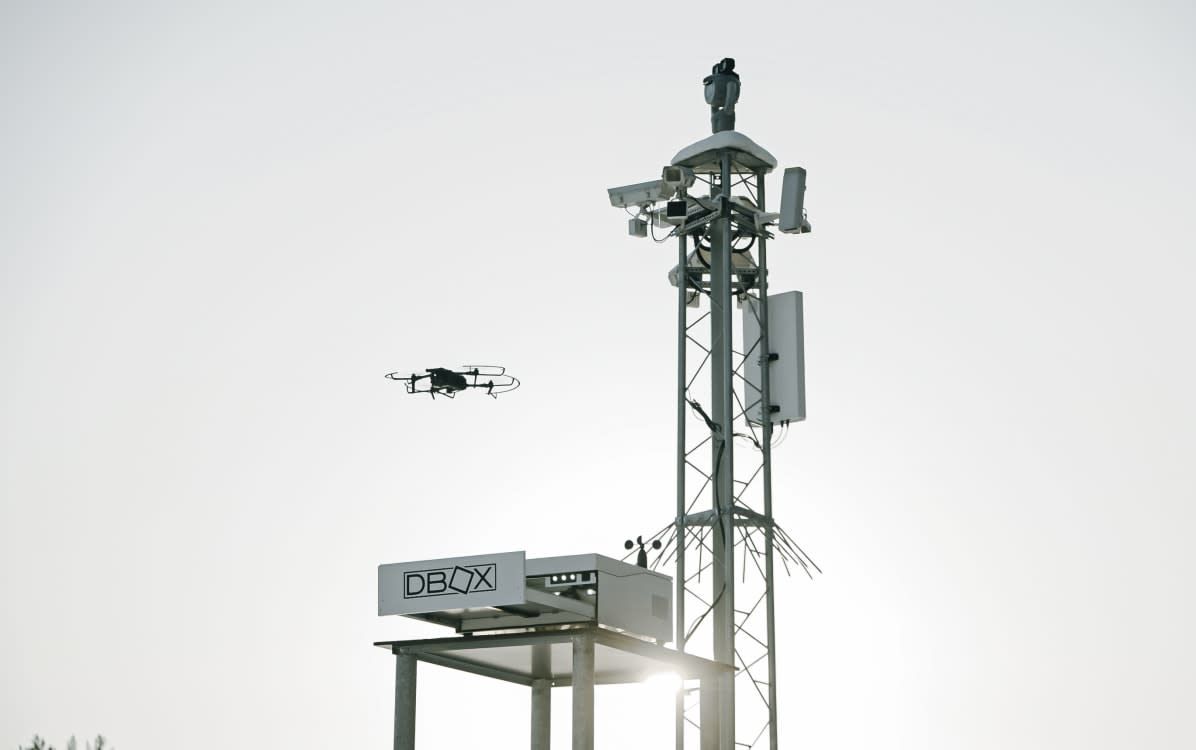
DBOX PRT is an autonomous drone docking system developed for remotely managed and automated unmanned aircraft operations. It combines a fixed docking station, a networking station, compatible aircraft, and DBOX Ground Control Software into an integrated platform for repeatable aerial missions.
The system is intended for drone-as-first-responder programs, incident response, search operations, area surveillance, perimeter monitoring, infrastructure protection, and remote situational awareness. It provides a fixed launch and recovery point that allows aircraft to be deployed without requiring personnel to remain at the operating site between missions.
DBOX PRT is designed for selected Parrot ANAFI UKR-series aircraft, including the ANAFI UKR, ANAFI UKR GOV, and ANAFI UKR XLR. The system supports automated deployment, precision recovery, aircraft charging, data transfer, and remote mission management.
United States distribution
On August 13, 2026, XTI Aerospace announced that its Drone Nerds subsidiary had partnered with DBOX to expand access to the system in the United States. Drone Nerds became the exclusive U.S. distributor for DBOX autonomous docking solutions aimed at public safety and government customers.
The partnership combined DBOX docking hardware and software with Drone Nerds integration, training, maintenance, and support services. The arrangement was intended to support agencies establishing new drone-as-first-responder programs as well as organizations converting existing Parrot drone operations to remotely managed dock-based missions.
In September 2026, the DBOX PRT was being presented for applications including emergency response, search and rescue, area surveillance, perimeter monitoring, border monitoring, critical infrastructure security, and command-center situational awareness.
Design
Docking station
The DBOX PRT uses a fixed weather-resistant docking station that houses a compatible unmanned aircraft between missions. It is designed to provide autonomous deployment and recovery, allowing the aircraft to launch from and return to a predetermined remote site.
The station incorporates sensors for rain, wind, temperature, and humidity. Four security cameras provide monitoring around the installation. Environmental information can be used as part of the operating workflow when deciding whether conditions are suitable for a mission.
The docking system also supports automatic aircraft charging between missions. A precision landing capability is intended to guide the aircraft directly onto the docking pad during day or night operations.
Networking and data
DBOX PRT includes a networking station for communications between the remote installation and operators. Network interfaces include Gigabit Ethernet and redundant dual-SIM 5G cellular access. Aircraft data can be transferred through physical USB, Wi-Fi, or 5G connections depending on the selected configuration.
The combination of fixed networking infrastructure and remote-control capability allows pilots or command centers with internet access to operate aircraft without being physically located at the docking site. This arrangement is intended for distributed installations where continuous staffing at each launch point would otherwise be required.
Ground control software
DBOX Ground Control Software provides the software layer for managing the docking system and associated aircraft. Supported functions include mission scheduling, fleet management, automated data handling, system dashboards, security triggers, manual override, geofencing, no-fly-zone management, and user-role administration.
The system is described as using AI-assisted software for operational monitoring and analysis. Its primary role is to coordinate repeatable remote missions, aircraft deployment and recovery, data handling, and supervision of distributed drone assets.
Compatible aircraft
DBOX PRT is designed to operate with the Parrot ANAFI UKR, ANAFI UKR GOV, and ANAFI UKR XLR families. These aircraft provide optical navigation intended to support flight where GNSS signals are unavailable or disrupted.
The ANAFI UKR GOV uses Wi-Fi, LoRa, and 5G multi-link communications and has a stated endurance of up to 70 minutes and a stated flight distance of up to 40 km. The ANAFI UKR XLR also uses LoRa and 5G multi-link communications with an extended-capacity battery and a stated endurance of up to 70 minutes. The standard ANAFI UKR is specified with MARS eight-channel and LoRa connectivity and a stated endurance of up to 38 minutes.
Compatible aircraft can carry electro-optical and infrared imaging systems for surveillance and emergency-response missions. The ANAFI UKR GOV configuration includes a 640 × 512-pixel FLIR Boson thermal sensor and supports up to 35× digital zoom.
Applications
For drone-as-first-responder operations, a DBOX installation can provide a permanently stationed aircraft that can be launched remotely when an incident is reported. This allows operators to obtain aerial imagery before personnel arrive at the scene and can support assessment of traffic incidents, perimeter threats, emergencies, and other developing situations.
In search-and-rescue operations, the system can provide remote aerial observation of terrain and areas of interest. Optical and thermal imaging from compatible aircraft can be transmitted to command centers to support search coordination and situational awareness.
DBOX PRT is also intended for scheduled or event-driven monitoring of critical infrastructure, government facilities, energy sites, airports, military installations, borders, and other remote areas. In these roles, the station provides a persistent launch and recovery location for repeated patrols rather than continuous airborne coverage.
Program status
As of 2026, DBOX PRT was being offered as an integrated autonomous docking platform for public safety, government, infrastructure, and security organizations. Drone Nerds was responsible for distribution, integration, training, and support in the U.S. public safety and government market.
The product literature lists an IP55 ingress-protection rating as pending. Deployment requirements can vary according to aircraft configuration, communications coverage, site conditions, operational procedures, airspace rules, data-security requirements, and other regulatory or procurement conditions.
Specifications (DBOX PRT)
General characteristics
- Docking station weight: approximately 44.9 kg (99 lb)
- Networking station weight: approximately 9.1 kg (20 lb)
- Docking station dimensions, closed: approximately 861 × 820 × 599 mm (33.9 × 32.3 × 23.6 in)
- Docking station dimensions, opened: approximately 1,621 × 820 × 599 mm (63.8 × 32.3 × 23.6 in)
- Operating temperature: -36°C to 50°C (-32.8°F to 122°F)
- Environmental sensors: rain, wind, temperature, and humidity
- Security cameras: four
- Ingress protection: IP55, listed as pending
Communications and software
- Network access: Gigabit Ethernet and redundant dual-SIM 5G
- Aircraft data transfer: physical USB, Wi-Fi, or 5G depending on configuration
- Ground control software: DBOX Ground Control Software
- Supported functions: mission scheduling, fleet management, automated data handling, manual override, geofencing, no-fly-zone management, security triggers, dashboards, and user-role management
Aircraft compatibility
- Parrot ANAFI UKR: supported
- Parrot ANAFI UKR GOV: supported
- Parrot ANAFI UKR XLR: supported
 Argentina
 Armenia
 Australia
 Austria
 Austria-Hungary
 Belgium
 Brazil
 United Kingdom
 United States
 Brunei
 Bulgaria
 Canada
 Chile
Chile China
China Colonial America
 Colombia
 Confederate States
 Croatia
 Czech
Czech Denmark
 Egypt
Egypt Finland
 France
 Georgia
 Germany
 German Imperial
 Greece
 Holland
 Hungary
 India
India Indonesia
 Iran
Iran Iraq
Iraq Ireland
 Israel
 Italy
Italy Japan
Japan Japan (1940)
 Jordan
 Kingdom of Italy
 Malaysia
 Mexico
 Myanmar
 Nazi Germany
 Netherlands
 New Zealand
 North Korea
 Norway
 Pakistan
 Peru
Peru Philippines
 Poland
 Portugal
 Prussia
 Romania
 Russia
 Saudi Arabia
 Serbia
 Singapore
 Slovakia
 Slovenia
 South Africa
 South Korea
 Soviet Union
 Spain
Spain Sweden
 Switzerland
 Syria
Syria Taiwan
 Thailand
 Turkey
 UAE
UAE Ukraine
 Vietnam
 Yugoslavia