History
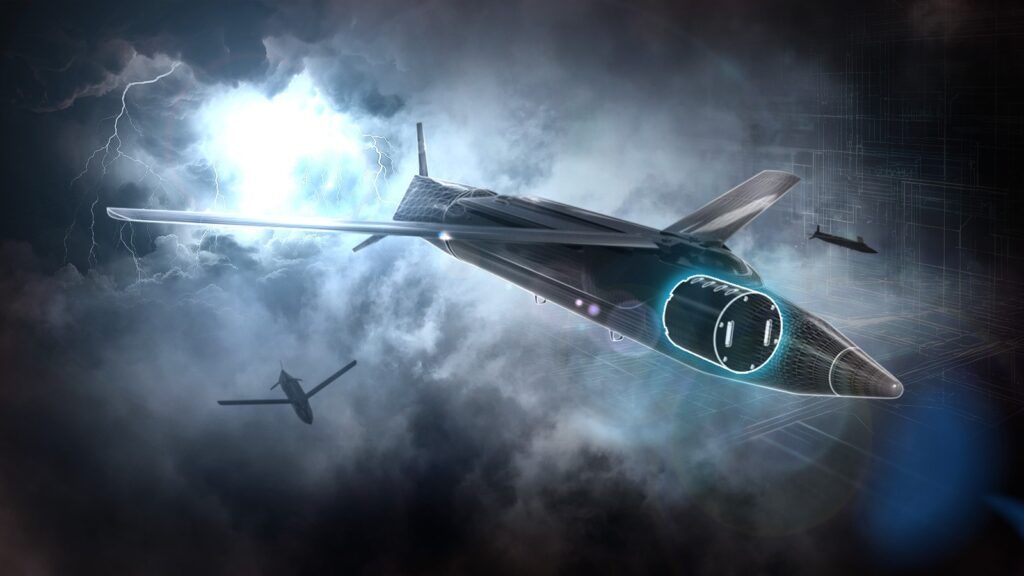
BAE Systems Shadow EW is a family of compact electronic-warfare payloads developed for small airborne platforms, including unmanned aerial vehicles. The family combines software-defined radio hardware with onboard processing and is intended to provide electronic-warfare functions in a substantially smaller form factor than systems traditionally installed on larger aircraft.
BAE Systems unveiled Shadow EW in September 2026. The company described the family as supporting situational awareness, targeting, deception, survivability, and collaborative electronic-warfare effects, with configurable hardware and software that can be updated as threats change.
The company designed Shadow EW around commercial components, open standards, and scalable manufacturing. BAE Systems states that this approach is intended to reduce cost, simplify integration across different platforms, and support high-volume production. The company's Shadow EW product page describes the family as compact, configurable, and intended for both crewed and uncrewed platforms.
Development
BAE Systems developed the Shadow EW family before receiving a specific platform requirement. Company officials said the program reflected a shift toward faster fielding, affordable mass, and production at greater volume rather than designing only highly customized electronic-warfare equipment for individual aircraft programs.
The design uses commercial microchips for high-performance computing instead of relying exclusively on highly specialized electronics. BAE Systems also adopted open standards and standardized interfaces to make the equipment as platform-agnostic as possible and reduce the work required to integrate it into different aircraft architectures.
The initial family consists of the Shadow EW 100, Shadow EW 120, and Shadow EW 500. According to BAE Systems planning documents, production is scheduled to begin with the Shadow EW 100 in 2027, followed by the Shadow EW 120 in 2028 and the Shadow EW 500 in 2029. These dates are planned production milestones rather than evidence that the systems are already in operational service.
Design
Shadow EW systems are hybrid software-defined radios optimized primarily for radar electronic-warfare operations. Depending on the model, they can also support signals intelligence and communications intelligence through streaming in-phase and quadrature data interfaces.
The family is designed around low size, weight, power, and cost requirements suitable for compact airborne payloads. Gigabit Ethernet interfaces and documented software and hardware interface control documents are intended to simplify integration with commercial and military system architectures. BAE Systems also emphasizes software configurability so that the hardware can be adapted to different missions and threat environments.
Processing and interfaces
The Shadow EW 100 uses a Jetson Orin NX 16 GB GPU/CPU together with a Kintex KU15P device for onboard processing. Its radio-frequency front end covers frequencies up to 6 GHz and supports instantaneous pulse descriptor word processing. The system also supports external power amplifiers and compatibility with the BIG IRON electronic-warfare framework. BAE Systems states that the Shadow EW 100 is MIL-STD-810H certified for operation in harsh environments. Detailed information is provided in the company's Shadow EW 100 specification sheet.
The Shadow EW 500 uses an Orin AGXi system-on-module and an UltraScale+ ZU47 device for edge processing. It has two wideband receiver channels, each providing 4 GHz of instantaneous receive bandwidth, and is designed to support radio-frequency direction finding and geolocation from a single platform. BAE Systems provides additional technical data in the Shadow EW 500 specification sheet.
Program status
As of its September 2026 unveiling, Shadow EW was presented as a new family intended for rapid integration and future high-volume production. BAE Systems identified production starts of 2027 for Shadow EW 100, 2028 for Shadow EW 120, and 2029 for Shadow EW 500. The available material does not establish operational deployment or named operators.
Variants
- Shadow EW 100: Compact hybrid software-defined radio optimized for radar electronic warfare, with additional SIGINT and COMINT support. It covers 70 MHz to 6 GHz and is planned to enter production in 2027.
- Shadow EW 120: Hybrid software-defined radio with wider low-frequency coverage than the Shadow EW 100 and increased transmit instantaneous bandwidth. Production is planned to start in 2028. BAE Systems publishes its technical data in the Shadow EW 120 specification sheet.
- Shadow EW 500: Higher-frequency model covering up to 18 GHz, with dual wideband receivers, direction finding, geolocation, and an internal power amplifier. Production is planned to start in 2029.
Specifications (Shadow EW 100)
General characteristics
- Weight: 3.3 kg (7.2 lb)
- Dimensions: approximately 112 × 85 × 176 mm (4.4 × 3.34 × 6.94 in)
- Maximum power consumption: less than 150 W
- RF inputs/outputs: 2/2
- Planned production start: 2027
Electronic characteristics
- Frequency coverage: 70 MHz to 6 GHz
- System receive instantaneous bandwidth: 6 GHz
- System transmit instantaneous bandwidth: 1.5 GHz
Specifications (Shadow EW 120)
General characteristics
- Weight: less than 3.2 kg (7.0 lb)
- Dimensions: approximately 112 × 85 × 176 mm (4.4 × 3.34 × 6.94 in)
- Maximum power consumption: less than 150 W
- RF inputs/outputs: 2/2
- Planned production start: 2028
Electronic characteristics
- Frequency coverage: 5 MHz to 6 GHz
- System receive instantaneous bandwidth: 6 GHz
- System transmit instantaneous bandwidth: 3 GHz, provided as two 1.5 GHz channels
Specifications (Shadow EW 500)
General characteristics
- Weight: 3.2 kg (7 lb)
- Dimensions: approximately 127 mm diameter × 140 mm (5 in diameter × 5.51 in)
- Maximum power consumption: less than 250 W with internal power amplifier
- RF inputs/outputs: 8
- Planned production start: 2029
Electronic characteristics
- Frequency coverage: 10 MHz to 18 GHz
- System receive instantaneous bandwidth: 8 GHz across two receivers, with 4 GHz per channel
- System transmit instantaneous bandwidth: 2 GHz
- Transmit output: 10 W effective isotropic radiated power
- Direction finding: Precision single-platform direction finding and geolocation capability
 Argentina
 Armenia
 Australia
 Austria
 Austria-Hungary
 Belgium
 Brazil
 United Kingdom
 United States
 Brunei
 Bulgaria
 Canada
 Chile
Chile China
China Colonial America
 Colombia
 Confederate States
 Croatia
 Czech
Czech Denmark
 Egypt
Egypt Finland
 France
 Georgia
 Germany
 German Imperial
 Greece
 Holland
 Hungary
 India
India Indonesia
 Iran
Iran Iraq
Iraq Ireland
 Israel
 Italy
Italy Japan
Japan Japan (1940)
 Jordan
 Kingdom of Italy
 Malaysia
 Mexico
 Myanmar
 Nazi Germany
 Netherlands
 New Zealand
 North Korea
 Norway
 Pakistan
 Peru
Peru Philippines
 Poland
 Portugal
 Prussia
 Romania
 Russia
 Saudi Arabia
 Serbia
 Singapore
 Slovakia
 Slovenia
 South Africa
 South Korea
 Soviet Union
 Spain
Spain Sweden
 Switzerland
 Syria
Syria Taiwan
 Thailand
 Turkey
 UAE
UAE Ukraine
 Vietnam
 Yugoslavia