
History
Swarm Aero Gamera is a large Group 5 uncrewed aircraft under development in the United States for long-range strike, sensing, electronic-warfare, communications-relay, and other missions. Swarm Aero unveiled the design at the Air & Space Forces Association Air, Space & Cyber Conference in September 2026.
The aircraft is intended to combine long range, a large modular payload, autonomous operation, and manufacturing methods aimed at reducing cost and supporting production in significant numbers. Swarm states that Gamera is designed for an unrefueled range of about 9,000 nautical miles and a payload exceeding 2,800 lb across seven store locations.
As of September 2026, Gamera had not flown, so its projected range, cost, payload performance, and operational characteristics remained to be demonstrated. A 2026 report indicated that the aircraft could become flight-ready as early as 2027, making 2027 the earliest stated planned physical milestone available for the program.
Development
The concept began taking shape in 2021, when Swarm Aero co-founders Oliver Palmer and Peter Kalogiannis identified a potential requirement for a large, relatively low-cost autonomous aircraft able to carry substantial payloads over theater and intercontinental distances. Swarm Aero was founded in 2022 and has stated that it has invested tens of millions of dollars in Gamera design, manufacturing methods, prototyping, and operational analysis since that year.
Swarm developed Gamera before the U.S. Air Force formally advanced its Massed Modular Aircraft concept. The company later positioned the aircraft as a candidate for that effort, which seeks risk-tolerant, modular uncrewed aircraft suitable for affordable high-rate production and long-range payload delivery. The company publicly unveiled Gamera on September 14, 2026. Swarm's announcement described it as a clean-sheet Group 5 strike and sensing UAS designed for persistent operations and coordinated employment in groups. The announcement is available from the Swarm Aero release.
Swarm also received more than $10 million in U.S. Air Force Research Laboratory contracts related to high-rate composite manufacturing. The company says manufacturability and production speed have been design requirements from the beginning rather than later modifications to the aircraft.
Planned flight testing
Gamera had not completed a first flight when it was unveiled in September 2026. Reporting by Tectonic indicated that the aircraft could be flight-ready as early as 2027. Consequently, all published performance figures remained design targets rather than demonstrated flight results at the time of unveiling.
Design
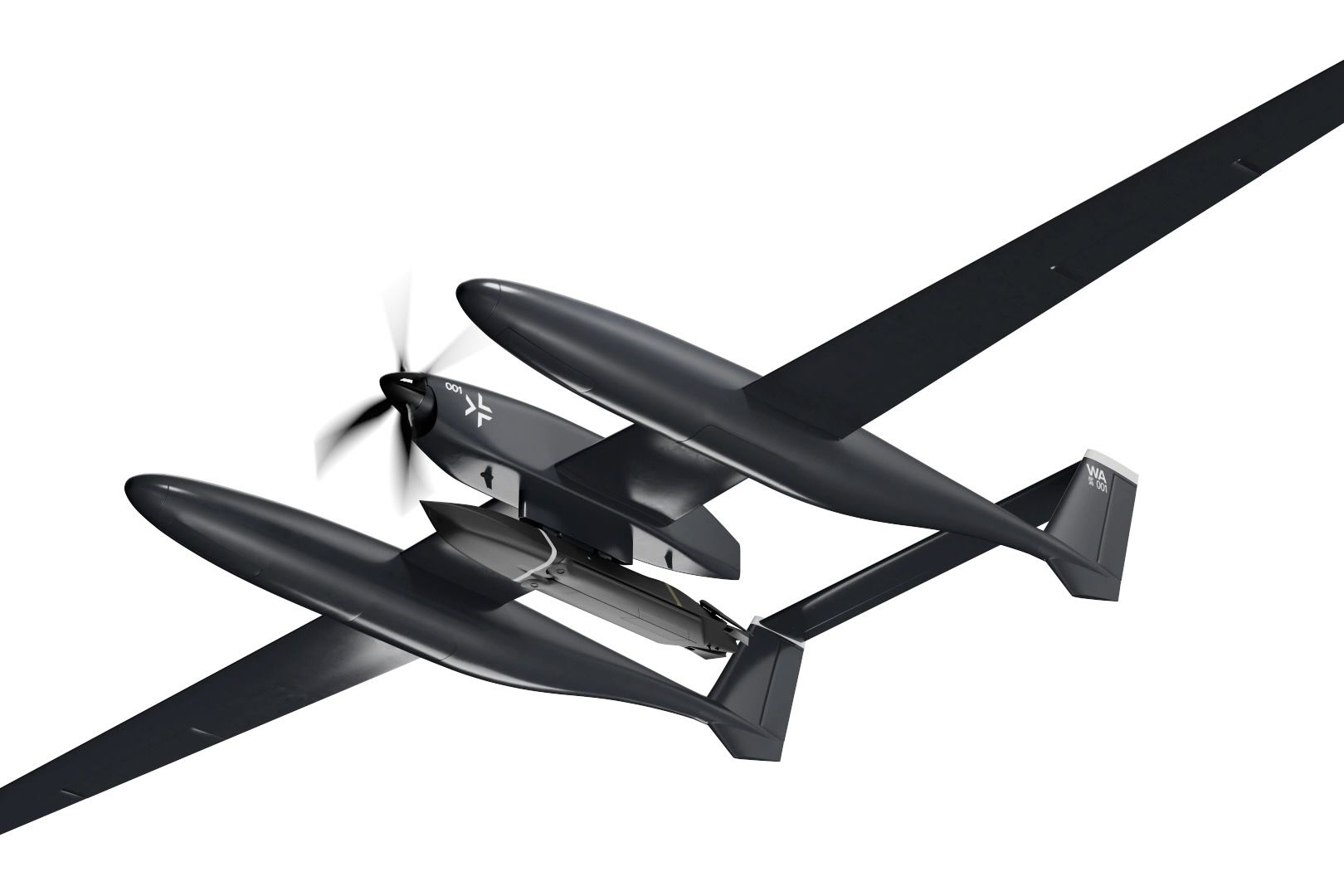
Gamera is a large propeller-driven uncrewed aircraft with a reported wingspan of approximately 72 ft. Published images show a wide-span twin-boom configuration. The aircraft is powered by a Honeywell TPE331 turboprop engine, according to independent aviation reporting.
Swarm describes the airframe as highly modular and optimized for efficient cruise and loiter. Its design is intended to support a variety of military payloads rather than a single fixed mission configuration.
Payload and stores
The aircraft is designed to carry more than 2,800 lb of payload distributed across seven available store locations. Swarm says these positions can accommodate combinations of weapons, sensors, and other mission equipment.
The company specifically identifies the AGM-158C Long Range Anti-Ship Missile and AGM-158B JASSM-ER class of weapons as intended payloads. Swarm also states that Gamera is designed to accommodate air-to-air, air-to-surface, sensing, cruise-missile, and hypersonic-missile payloads. These are planned integration capabilities and had not been demonstrated in flight as of the aircraft's 2026 unveiling.
Autonomy and command system
Gamera is paired with Swarm Aero's Legion command-and-control and autonomy software. Legion is intended to allow one operator or a small team to supervise multiple heterogeneous uncrewed systems rather than manually pilot each aircraft continuously.
Swarm states that Legion has been demonstrated with dozens of live assets and has been used during military exercises. The software was also selected as one of three command-and-control offerings for work connected with the Defense Innovation Unit's Autonomous Collaborative Teaming effort supporting Replicator-related activities. Gamera is intended to operate as part of such coordinated groups rather than solely as an individual aircraft.
Manufacturing concept
Swarm says Gamera was designed for high-rate manufacture using composite construction methods developed with cost and production speed as early design constraints. The company argues that this approach could reduce the cost of a large Group 5 UAS relative to traditional manufacturing methods. Published reporting quoted Swarm as saying that unit cost at volume could fall below $10 million, but this remained a company projection rather than a demonstrated production price.
Program status
As of September 2026, Gamera remained a development aircraft and had not flown. Swarm still needed to build, fly, test, and validate the aircraft's stated range, payload capacity, affordability, autonomous operation, and production approach.
Swarm is promoting Gamera for the U.S. Air Force and Defense Innovation Unit Massed Modular Aircraft initiative. The program seeks lower-cost autonomous aircraft able to perform long-range missions and carry substantial modular payloads. Gamera was not identified in the supplied material as an operational Air Force aircraft or as the winner of a production competition.
Specifications (Gamera planned configuration)
General characteristics
- Type: Group 5 uncrewed aerial vehicle
- Wingspan: approximately 21.9 m (72 ft)
- Powerplant: Honeywell TPE331 turboprop
- Payload capacity: more than 1,270 kg (2,800 lb)
- External or modular store locations: seven
Performance
- Projected unrefueled range: approximately 16,700 km (9,000 nmi)
- Reported mission radius: more than 4,600 km (2,500 mi)
- Reported cruise speed: more than 370 km/h (200 kt)
Armament and mission payloads
- Long-range strike weapons: designed to accommodate LRASM and JASSM-ER class weapons
- Other planned payloads: air-to-air weapons, air-to-surface weapons, sensors, electronic-warfare equipment, communications-relay equipment, and other modular payloads
Related equipment
- MQ-9 Reaper: Existing Group 5 uncrewed aircraft whose current mission set is referenced in Massed Modular Aircraft requirements and in Swarm's description of Gamera's intended capabilities.
- General Atomics Wildfire: Another concept publicly associated with the U.S. Air Force Massed Modular Aircraft effort.
 Argentina
 Armenia
 Australia
 Austria
 Austria-Hungary
 Belgium
 Brazil
 United Kingdom
 Brunei
 Bulgaria
 Canada
 Chile
Chile China
China Colonial America
 Colombia
 Confederate States
 Croatia
 Czech
Czech Denmark
 Egypt
Egypt Finland
 France
 Georgia
 Germany
 German Imperial
 Greece
 Holland
 Hungary
 India
India Indonesia
 Iran
Iran Iraq
Iraq Ireland
 Israel
 Italy
Italy Japan
Japan Japan (1940)
 Jordan
 Kingdom of Italy
 Malaysia
 Mexico
 Myanmar
 Nazi Germany
 Netherlands
 New Zealand
 North Korea
 Norway
 Pakistan
 Peru
Peru Philippines
 Poland
 Portugal
 Prussia
 Romania
 Russia
 Saudi Arabia
 Serbia
 Singapore
 Slovakia
 Slovenia
 South Africa
 South Korea
 Soviet Union
 Spain
Spain Sweden
 Switzerland
 Syria
Syria Taiwan
 Thailand
 Turkey
 UAE
UAE Ukraine
 Vietnam
 Yugoslavia