

History
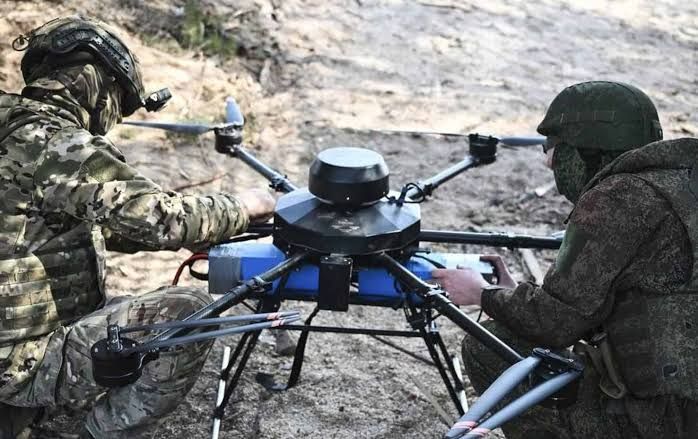
The Mangas is a Russian heavy reusable hexacopter developed for tactical bombing and battlefield logistics. Production was announced in 2025, and the aircraft was subsequently shown in Russian military use during 2026.
The UAV was developed by the Baikal Tactical Group in Ulan-Ude in cooperation with developers associated with the Kuryer robotic ground complex. It was conceived as a Russian counterpart to Ukrainian heavy multirotor strike UAVs such as the Vampire.
The Mangas combines a six-rotor electric airframe with an autopilot, a thermal imaging camera for night operations, and equipment intended to support both weapon delivery and transport missions. Its maximum claimed flight range with a minimum payload is up to 50 km.
Development
The first established public reference to the Mangas dates to September 2025, when the Baikal Tactical Group and developers of the Kuryer robotic ground complex announced the start of production of heavy hexacopters in Buryatia for Russian forces.
On 22 January 2026, a company named MANGAS was registered in Moscow with Chingis Dambiev as its founder and general director. Two days later, Dambiev filed an application for a hexacopter utility model incorporating a universal battery placement system. The utility model was registered in March 2026 as RU242404U1, with Dambiev listed as inventor and original rights holder.
The Mangas project also has organizational links with the developers of the Kuryer robotic ground complex. MANGAS and NRTK KAPS, a company owned by Zorikto Gombozhapov, were registered in the same Moscow building, while communications associated with the developers presented the two systems as related projects.
Testing and public demonstrations
The Mangas was demonstrated during the Russian-Mongolian Selenga-2026 exercises in Orkhon Province, Mongolia, in August 2026. Open demonstrations also showed the UAV carrying a release system with a mock TM-62 anti-tank mine and performing cargo transport tasks.
Design
The Mangas uses a conventional heavy multirotor configuration with six arms and six propellers. The hexacopter arrangement provides vertical takeoff and landing without requiring a runway.
Electrical power is supplied by rechargeable batteries. The aircraft is equipped with an autopilot system, while its battery arrangement was the subject of the 2026 utility model associated with the program.
A thermal imaging camera enables operation at night. The developers also claim that the UAV incorporates protection against electronic warfare and radio-frequency suppression, although the available material does not describe the protection system or independently verify its effectiveness.
Mission equipment
The Mangas can be configured as a tactical bomber using a suspended release mechanism. Demonstrations have included a mock TM-62 anti-tank mine. The same airframe can also carry supplies for frontline logistics missions.
Operational history
Russian forces have used the Mangas in the war against Ukraine. The Russian Ministry of Defense first publicly showed combat employment of the UAV on 18 September 2026 by personnel of the 11th Army Corps of the Sever group.
The aircraft is particularly suited to night missions because of its thermal imaging camera. Its documented roles include tactical bombing and delivery of supplies to frontline units.
In early 2026, Dambiev claimed that Mangas UAVs had already completed more than 500 combat sorties. This figure has not been independently confirmed. Available information also does not establish that the type has entered mass service across the Russian armed forces.
Specifications (Mangas)
General characteristics
- Type: Heavy reusable unmanned hexacopter
- Configuration: Six-arm, six-rotor multirotor
- Power source: Rechargeable battery
- Flight control: Autopilot
- Night equipment: Thermal imaging camera
- Electronic protection: Claimed protection against electronic warfare and radio-frequency suppression
Performance
- Maximum claimed flight range: Up to 50 km with a minimum payload
Mission equipment
- Bombing equipment: External release system demonstrated with a mock TM-62 anti-tank mine
- Secondary role: Cargo transport and battlefield logistics
 Argentina
 Armenia
 Australia
 Austria
 Austria-Hungary
 Belgium
 Brazil
 United Kingdom
 United States
 Brunei
 Bulgaria
 Canada
 Chile
Chile China
China Colonial America
 Colombia
 Confederate States
 Croatia
 Czech
Czech Denmark
 Egypt
Egypt Finland
 France
 Georgia
 Germany
 German Imperial
 Greece
 Holland
 Hungary
 India
India Indonesia
 Iran
Iran Iraq
Iraq Ireland
 Israel
 Italy
Italy Japan
Japan Japan (1940)
 Jordan
 Kingdom of Italy
 Malaysia
 Mexico
 Myanmar
 Nazi Germany
 Netherlands
 New Zealand
 North Korea
 Norway
 Pakistan
 Peru
Peru Philippines
 Poland
 Portugal
 Prussia
 Romania
 Saudi Arabia
 Serbia
 Singapore
 Slovakia
 Slovenia
 South Africa
 South Korea
 Soviet Union
 Spain
Spain Sweden
 Switzerland
 Syria
Syria Taiwan
 Thailand
 Turkey
 UAE
UAE Ukraine
 Vietnam
 Yugoslavia