
History
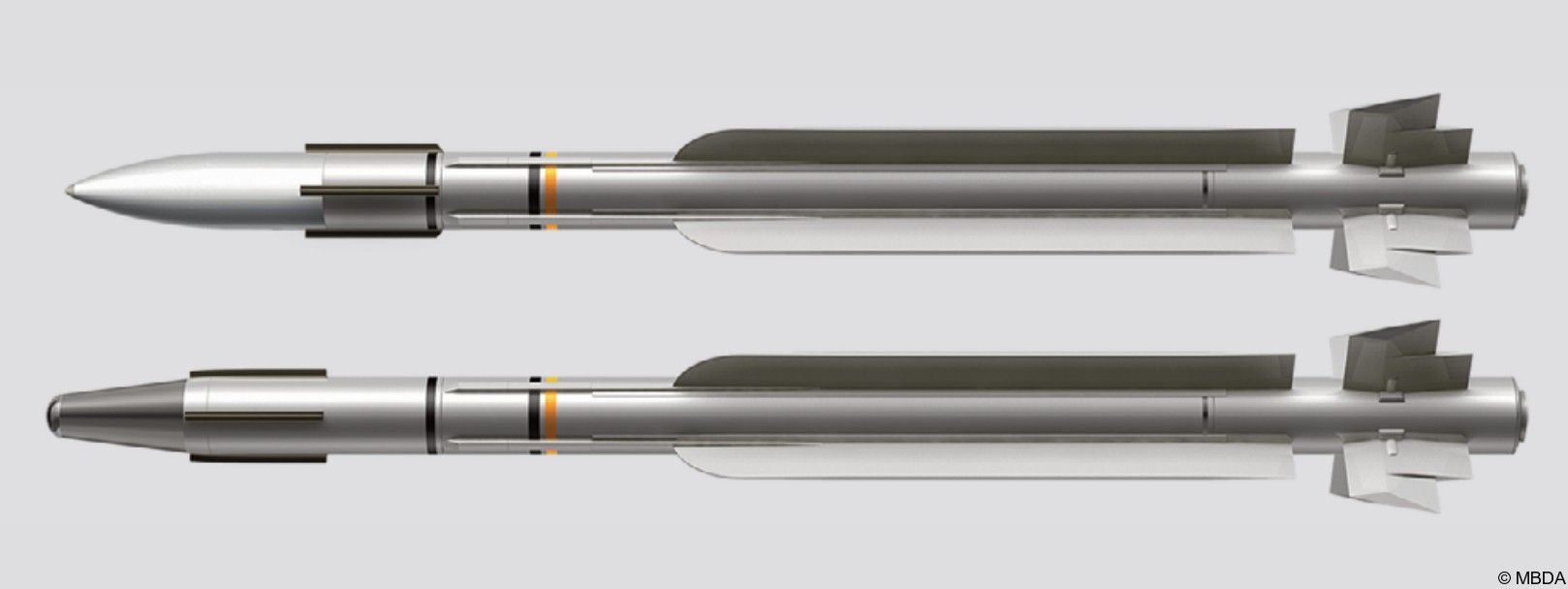
MBDA MICA is a French multi-mission air-to-air missile designed for both beyond-visual-range and short-range combat. The family uses interchangeable radar and imaging infrared seekers, allowing the same basic missile to cover interception and close-combat roles.
The missile was developed from 1982 by Matra as a replacement for the Super 530 in the interception role and the Magic II in close combat. The first trials took place in 1991, and MICA entered service in 1996 for use with Rafale and later versions of the Mirage 2000.
MICA combines inertial mid-course guidance, a data link, terminal homing and thrust-vector control. It can be launched from rail or ejection launchers and supports both lock-on-before-launch and lock-on-after-launch engagement modes.
On 11 June 2007, a MICA launched from a Rafale demonstrated an engagement against a target positioned behind the launch aircraft. Target information was provided by another aircraft through Link 16, demonstrating the missile's ability to conduct an over-the-shoulder engagement using externally supplied targeting data.
The MICA design was also adapted for surface launch. The VL MICA system completed a series of test firings in 2008, including an engagement against a low-flying target over the sea.
By September 2026, France had transferred additional MICA air-to-air missiles to Ukraine for use with Mirage 2000 fighters supplied to the Ukrainian Air Force.
Design
MICA was designed around a common missile body that can accept either an active radar seeker or a passive imaging infrared seeker. This architecture allows radar-guided and infrared-guided weapons to be carried together while retaining similar aircraft integration and handling characteristics.
Guidance
The missile uses a strap-down inertial reference unit for navigation and can receive updates through a data link before terminal homing. The radar-guided version uses an active monopulse Doppler seeker, while the infrared version uses a passive dual-waveband imaging infrared seeker. Supported target-designation sources include the launching aircraft's radar, electro-optical sensors, a helmet-mounted sight and autonomous acquisition by the infrared seeker.
MICA supports lock-on-before-launch and lock-on-after-launch modes. Lock-on-after-launch allows the missile to be fired before its seeker has independently acquired the target. The infrared seeker also provides a passive engagement option that does not require active radar illumination from the missile during terminal homing.
Airframe and control
The missile has long-chord wings, tail control surfaces and a thrust-vector-control system. Thrust vectoring increases maneuverability by directing motor thrust in addition to aerodynamic control. The propulsion system uses a high-impulse, low-smoke solid-propellant rocket motor.
Fuzing and warhead
MICA uses an RF proximity fuse and an impact fuse. Its warhead produces focused high-velocity fragments around the target during detonation.
Aircraft integration
MICA can be carried on rail or eject launchers. The missile has been integrated with the Mirage 2000-5 series and Rafale. The common missile architecture allows aircraft to carry combinations of radar-guided and infrared-guided missiles for different engagement conditions.
Operational history
MICA entered service in 1996 and became an air-to-air weapon for French combat aircraft including the Rafale and Mirage 2000 family. More than 5,900 MICA-family missiles had been sold worldwide by the early 2020s.
France subsequently supplied MICA missiles for Ukrainian Mirage 2000 fighters. The transfer confirmed MICA as part of the weapons support provided for the Ukrainian Mirage 2000 fleet by September 2026.
Variants
- MICA RF / MICA EM - Radar-guided air-to-air version using an active radar seeker for all-weather engagements.
- MICA IR - Air-to-air version using a passive dual-waveband imaging infrared seeker for short-range and beyond-visual-range engagements.
- VL MICA - Ground-launched surface-to-air derivative using a vertical-launch system.
- VL MICA-M - Naval vertical-launch derivative intended for installation aboard warships.
- MICA NG - New-generation development of the MICA family for Rafale. It retains radar-guided and infrared-guided versions, introduces an active RF AESA seeker for the radar version and uses a dual-pulse motor. Its planned performance includes a range increase of up to 40 percent compared with MICA. The first Rafale development firing took place in June 2025. A second development firing was completed on 5 June 2026 from a Rafale in supersonic flight, including evaluation of the infrared seeker under elevated-temperature conditions.
Operators
- France - MICA entered service in 1996 for use with French combat aircraft including Rafale and Mirage 2000 variants.
- Ukraine - France transferred MICA air-to-air missiles for Mirage 2000 fighters operated by the Ukrainian Air Force by September 2026.
Specifications (MICA air-to-air missile)
General characteristics
- Weight: 112 kg
- Length: 3.1 m
- Diameter: 160 mm
- Propulsion: High-impulse, low-smoke solid-propellant rocket motor
- Control: Aerodynamic control surfaces and thrust-vector control
- Launch methods: Rail or ejection launch
Performance
- Maximum speed: Up to Mach 4.9
- Engagement range: Approximately 60-80 km
Guidance
- Mid-course guidance: Inertial navigation with data-link updates
- Radar seeker: Active RF monopulse Doppler seeker
- Infrared seeker: Passive dual-waveband imaging infrared seeker
- Engagement modes: Lock-on-before-launch and lock-on-after-launch
Warhead and fuzing
- Warhead effect: Focused fragments
- Fuzes: RF proximity and impact
 Argentina
 Armenia
 Australia
 Austria
 Austria-Hungary
 Belgium
 Brazil
 United Kingdom
 United States
 Brunei
 Bulgaria
 Canada
 Chile
Chile China
China Colonial America
 Colombia
 Confederate States
 Croatia
 Czech
Czech Denmark
 Egypt
Egypt Finland
 Georgia
 Germany
 German Imperial
 Greece
 Holland
 Hungary
 India
India Indonesia
 Iran
Iran Iraq
Iraq Ireland
 Israel
 Italy
Italy Japan
Japan Japan (1940)
 Jordan
 Kingdom of Italy
 Malaysia
 Mexico
 Myanmar
 Nazi Germany
 Netherlands
 New Zealand
 North Korea
 Norway
 Pakistan
 Peru
Peru Philippines
 Poland
 Portugal
 Prussia
 Romania
 Russia
 Saudi Arabia
 Serbia
 Singapore
 Slovakia
 Slovenia
 South Africa
 South Korea
 Soviet Union
 Spain
Spain Sweden
 Switzerland
 Syria
Syria Taiwan
 Thailand
 Turkey
 UAE
UAE Ukraine
 Vietnam
 Yugoslavia