
History
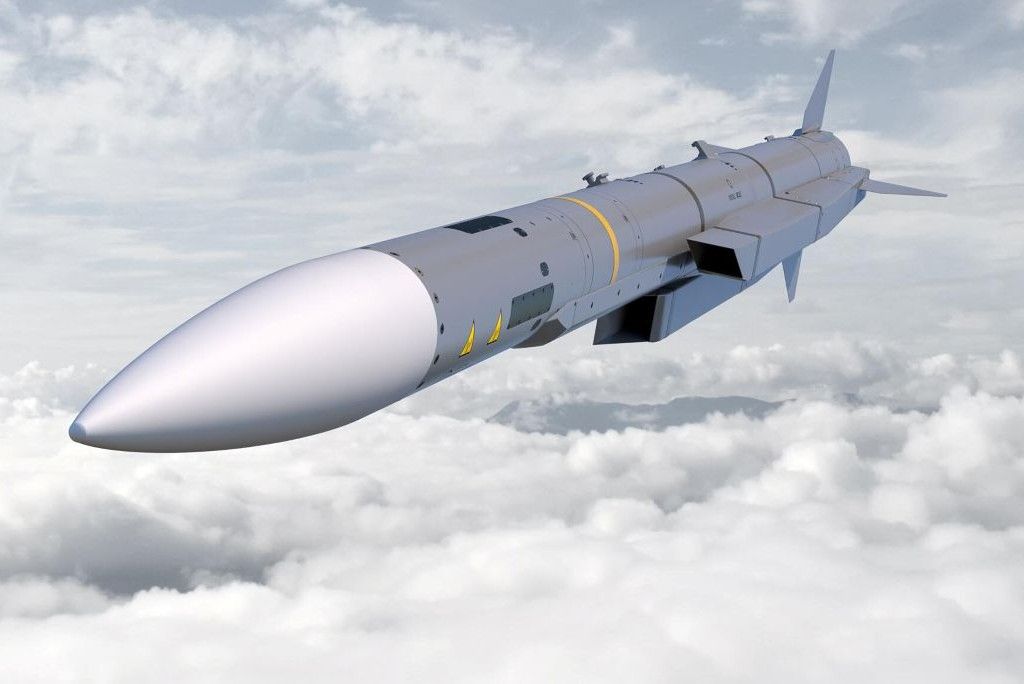
MBDA Meteor is a European beyond-visual-range air-to-air missile developed for modern fighter aircraft. It uses active radar guidance, data-link communication and an air-breathing propulsion system intended to retain substantial energy during long-range engagements.
The programme brought together the United Kingdom, Germany, France, Italy, Spain and Sweden. MBDA leads the multinational industrial team, with major contributions including the German-developed variable-flow ducted rocket propulsion system produced by Bayern-Chemie.
Meteor originated from requirements developed during the early 1990s for a new generation of medium- and long-range air-to-air weapon capable of replacing older missiles and defeating highly manoeuvrable aircraft in demanding electronic-countermeasure environments.
Development
During the 1990s, European and American industrial teams competed for the British beyond-visual-range air-to-air missile requirement. The European proposal evolved from earlier BAE-led concepts and adopted the Meteor name in 1996. Risk-reduction studies followed in 1997.
In July 1998, the United Kingdom, Germany, Italy, Sweden and Spain signed a statement of intent covering a common missile if the United Kingdom selected Meteor. France subsequently joined the programme. The United Kingdom selected Meteor in May 2000.
The programme entered its demonstration, development and manufacturing phase under a contract valued at approximately £1.2 billion during 2002–2003. The United Kingdom assumed the principal programme-management role through a multinational project organization, while industrial work was distributed among participating European companies.
The first flight of a Meteor test missile took place in 2005 from a French Navy Rafale F2. Development subsequently included firings and integration work with Gripen and Eurofighter Typhoon aircraft.
Production began in 2012. Integration trials on Eurofighter included launches at different speeds and altitudes and tests of the interfaces used for pre-launch preparation and post-launch communication between the aircraft, radar and missile.
Meteor entered operational service first with Sweden's JAS 39 Gripen fleet in 2016. Integration followed on other European combat aircraft, including Eurofighter Typhoon and Dassault Rafale. The Royal Air Force introduced Meteor on Typhoon in 2017.
Work has also been conducted to integrate Meteor with the F-35. British integration activity included modifications required for internal carriage on the F-35B. In 2025, an F-35B flew with Meteor as integration testing progressed, while F-35A ground testing was conducted ahead of flight trials.
Germany continued procuring Meteor after its original participation in the development programme. A further German order was contracted in January 2026. In September 2026, the Bundestag budget committee approved two additional special batches for German Eurofighter aircraft. These missiles are intended to support evaluation of tactics and technical solutions and integration work associated with modernization of the fighter's radar system.
Design
Meteor is designed for beyond-visual-range interception of fast and manoeuvrable aircraft as well as smaller aerial targets such as unmanned aircraft and cruise missiles. Its guidance and propulsion architecture is intended to maintain useful engagement performance against targets attempting to escape or manoeuvre late in an interception.
Guidance and data link
The missile uses an active radar seeker for terminal guidance. A two-way data link allows the launch aircraft to transmit target updates during flight and can support retargeting when required. The communication link can also return information concerning missile status, target information and seeker acquisition.
Meteor can use targeting information supplied through a network rather than relying solely on data generated by the launching aircraft. This allows the missile to receive updated engagement information while the interceptor and other sensors continue tracking the target.
Propulsion
Meteor uses a solid-fuel variable-flow ducted rocket, commonly described as a ramjet propulsion system. The motor is produced in Germany by MBDA subsidiary Bayern-Chemie. Unlike a conventional boost-and-coast rocket motor that produces most of its thrust early in flight, the Meteor propulsion system can continue generating thrust during the engagement.
Sustained propulsion allows the missile to preserve or increase energy during portions of its flight and improves its ability to pursue manoeuvring targets at extended distance. The missile has a quoted speed above Mach 4 and a stated engagement range exceeding 200 km, although usable range depends on launch conditions, target behaviour and engagement geometry.
Fuzing
Meteor is equipped with proximity and impact fuzing. These provide alternative methods for initiating the missile's terminal effect depending on the interception geometry and whether direct impact occurs.
Operational history
Sweden became the first country to place Meteor into operational service, introducing the missile with the JAS 39 Gripen in 2016. Meteor subsequently entered service on Eurofighter Typhoon and Dassault Rafale fleets operated by several participating and export nations.
The missile equips or has been integrated with combat aircraft including Gripen, Rafale, Eurofighter Typhoon and KF-21 Boramae. F-35 integration has continued as a separate development effort because the missile must be accommodated within the aircraft's internal weapons bays for low-observable operations.
Germany has continued expanding its Meteor inventory for Eurofighter. The 2026 procurement activity includes both additional operational missiles and special batches intended for integration and technical work connected with radar modernization.
Operators
- Sweden: Meteor entered operational service on the JAS 39 Gripen in 2016.
- United Kingdom: Meteor entered Royal Air Force service on Eurofighter Typhoon in 2017, with integration also planned for the F-35B.
- Germany: The German Air Force operates Meteor with Eurofighter and has placed additional orders, including further procurement approved in 2026.
- France: Meteor is operated with Dassault Rafale aircraft.
- Italy: Meteor equips Eurofighter aircraft, with integration also planned for Italian F-35 aircraft.
- Spain: Spain participates in the Meteor programme and has procured the missile for its combat-air fleet.
Specifications (Meteor)
General characteristics
- Type: Beyond-visual-range air-to-air missile
- Manufacturer: MBDA-led European industrial consortium
- Propulsion: Solid-fuel variable-flow ducted rocket ramjet
- Guidance: Active radar terminal guidance with two-way data link
- Fuzing: Proximity and impact fuzes
Performance
- Maximum speed: More than Mach 4
- Stated range: More than 200 km under suitable engagement conditions
Compatible aircraft
- Eurofighter Typhoon: Operational integration
- Dassault Rafale: Operational integration
- Saab JAS 39 Gripen: Operational integration
- KF-21 Boramae: Integrated combat-air platform
- F-35: Integration and testing in progress for selected variants
Related equipment
The United Kingdom and Japan have also cooperated on the Joint New Air-to-Air Missile programme, which combines technologies associated with Meteor with Japanese seeker development. The project represents a related development effort rather than the standard production Meteor configuration.
 Argentina
 Armenia
 Australia
 Austria
 Austria-Hungary
 Belgium
 Brazil
 United States
 Brunei
 Bulgaria
 Canada
 Chile
Chile China
China Colonial America
 Colombia
 Confederate States
 Croatia
 Czech
Czech Denmark
 Egypt
Egypt Finland
 France
 Georgia
 Germany
 German Imperial
 Greece
 Holland
 Hungary
 India
India Indonesia
 Iran
Iran Iraq
Iraq Ireland
 Israel
 Italy
Italy Japan
Japan Japan (1940)
 Jordan
 Kingdom of Italy
 Malaysia
 Mexico
 Myanmar
 Nazi Germany
 Netherlands
 New Zealand
 North Korea
 Norway
 Pakistan
 Peru
Peru Philippines
 Poland
 Portugal
 Prussia
 Romania
 Russia
 Saudi Arabia
 Serbia
 Singapore
 Slovakia
 Slovenia
 South Africa
 South Korea
 Soviet Union
 Spain
Spain Sweden
 Switzerland
 Syria
Syria Taiwan
 Thailand
 Turkey
 UAE
UAE Ukraine
 Vietnam
 Yugoslavia