
History
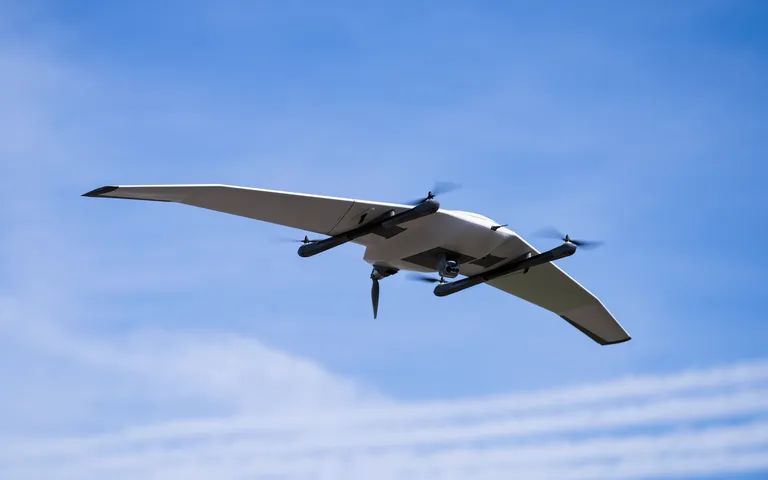
The DeltaQuad Evo-LE is a long-endurance electric fixed-wing vertical-takeoff-and-landing unmanned aerial vehicle developed for intelligence, surveillance, target acquisition and reconnaissance missions. It combines fixed-wing cruise with vertical takeoff and landing, allowing operation without a runway.
DeltaQuad introduced the Evo-LE in September 2026 as an endurance-focused member of the Evo family. The aircraft offers a maximum stated flight time of up to eight hours and a flight range of up to 480 km, depending on payload configuration, mission profile and operating conditions.
The platform was developed using operator feedback and experience accumulated during thousands of flight hours with earlier DeltaQuad systems. Its intended missions include long-range ISTAR, border surveillance, communications relay and search-and-rescue operations.
Development
The Evo-LE was designed around longer mission duration rather than simply increasing battery capacity. The redesign combines higher-energy-density battery technology, a dual-battery configuration, a revised electrical architecture and an upgraded VTOL drivetrain.
The aircraft uses the DeltaQuad Block 3 airframe, which is also employed by the standard Evo platform. The Evo-LE differs in its emphasis on endurance, while the standard Evo is configured primarily for payload flexibility and can use either single- or dual-battery arrangements.
Design
Airframe and VTOL system
The Evo-LE uses a ruggedised Block 3 composite airframe with redesigned composite structures. Its fixed-wing configuration provides efficient forward flight, while dedicated vertical-lift propulsion permits takeoff and landing from confined areas without runway infrastructure.
The airframe incorporates improved protection against dust and rain and uses a heated pitot tube. Navigation and anti-collision lighting are also incorporated. Redesigned landing legs are intended to detach during a hard landing to reduce the risk of damage to the main airframe.
An automatic landing-gear arrangement keeps the underside of the aircraft clear during flight, providing an unobstructed 360-degree field of view for compatible sensor payloads.
Power and endurance
The Evo-LE uses two batteries and higher-energy-density battery technology. Together with the redesigned electrical architecture and upgraded VTOL drivetrain, this configuration enables a stated maximum endurance of up to eight hours. Maximum mission distance is stated as up to 480 km, although actual performance varies with payload, mission profile and environmental conditions.
Mission systems
The aircraft can be configured with anti-jamming, secure communications and autonomous navigation capabilities. Navigation options include 4- or 8-array controlled reception pattern antenna anti-jamming GNSS equipment and an optional visual navigation system intended to support operation when satellite navigation is disrupted.
Secure communications options include mesh and phased-array broadband radios, with AES-256 encryption available on selected configurations. Auterion Tactical Stack avionics and a ruggedised ground-control setup can be integrated for field deployment.
The Evo-LE is currently offered with the NextVision Raptor payload, combining stabilised visible-light and thermal imaging for long-range surveillance and tracking. Mission configurations can also be tailored for communications relay and other supported roles.
Program status
DeltaQuad announced the Evo-LE on 22 September 2026 and made the aircraft available for order. The company also provides operator training, field support and lifecycle services for the platform.
Variants
- Evo-LE: Long-endurance Evo-family variant using a dual-battery configuration and optimised for missions in which endurance is the primary requirement.
- Evo: Related base platform configured primarily for payload flexibility and available with single- or dual-battery configurations.
Specifications (DeltaQuad Evo-LE)
General characteristics
- Type: Electric fixed-wing VTOL unmanned aerial vehicle
- Maximum takeoff weight: 13 kg
- Payload capacity: Up to 1.5 kg
- Battery configuration: Dual battery
Performance
- Maximum flight time: Up to 8 hours
- Maximum flight range: Up to 480 km
- Maximum radio range: Up to 120 km
Mission equipment
- Imaging payload: NextVision Raptor stabilised RGB and thermal imaging system
- Navigation options: 4- or 8-array CRPA anti-jamming GNSS and optional visual navigation
- Communications options: Mesh and phased-array broadband radios, with AES-256 encryption on selected configurations
- Avionics: Auterion Tactical Stack integration available
Related equipment
- DeltaQuad Evo: Evo-family VTOL UAV sharing the Block 3 airframe but configured primarily for payload flexibility rather than maximum endurance.
 Argentina
 Armenia
 Australia
 Austria
 Austria-Hungary
 Belgium
 Brazil
 United Kingdom
 United States
 Brunei
 Bulgaria
 Canada
 Chile
Chile China
China Colonial America
 Colombia
 Confederate States
 Croatia
 Czech
Czech Denmark
 Egypt
Egypt Finland
 France
 Georgia
 Germany
 German Imperial
 Greece
 Holland
 Hungary
 India
India Indonesia
 Iran
Iran Iraq
Iraq Ireland
 Israel
 Italy
Italy Japan
Japan Japan (1940)
 Jordan
 Kingdom of Italy
 Malaysia
 Mexico
 Myanmar
 Nazi Germany
 New Zealand
 North Korea
 Norway
 Pakistan
 Peru
Peru Philippines
 Poland
 Portugal
 Prussia
 Romania
 Russia
 Saudi Arabia
 Serbia
 Singapore
 Slovakia
 Slovenia
 South Africa
 South Korea
 Soviet Union
 Spain
Spain Sweden
 Switzerland
 Syria
Syria Taiwan
 Thailand
 Turkey
 UAE
UAE Ukraine
 Vietnam
 Yugoslavia