
History
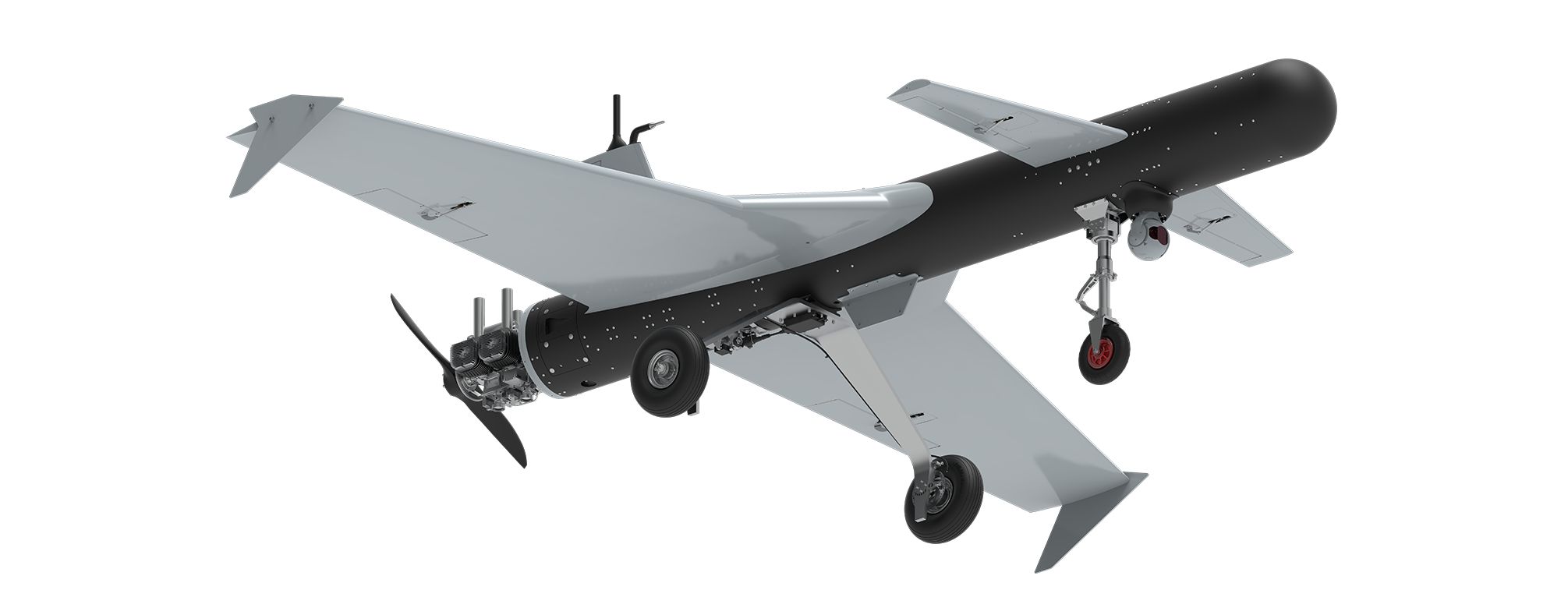
Baykar MIZRAK is a Turkish intelligent loitering munition developed for long-range strike, reconnaissance, and surveillance missions. The fixed-wing system combines a 40 kg maximum payload with an operational range exceeding 1,000 km and endurance of more than seven hours.
MIZRAK can operate with autonomous navigation and guidance functions, including AI-assisted optical guidance, visual navigation, sensor fusion, and anti-jamming protection. Its payload options include electro-optical or infrared cameras, warheads, and an optional radio-frequency seeker.
The system supports conventional runway operations and rocket-assisted takeoff, allowing deployment from both prepared and less-developed operating locations. Digital data and video links can also connect MIZRAK with Bayraktar TB2, TB3, and AKINCI unmanned aircraft acting as communications relays.
Development and introduction
Baykar developed MIZRAK in Türkiye as part of a new family of long-range unmanned strike systems. The system was publicly revealed in April 2026 ahead of its first exhibition at SAHA 2026 in Istanbul. Live-munition firing tests had also been completed by the time of its introduction.
MIZRAK was presented publicly at SAHA 2026 in May alongside Baykar's K2 Kamikaze UAV and Sivrisinek loitering munition. Its disclosed specifications placed it between smaller tactical loitering munitions and larger unmanned strike aircraft, with a maximum takeoff weight of 200 kg and a payload capacity of 40 kg.
During ADEX 2026 in Baku, held from 30 September to 2 October 2026, Azerbaijan signed the first announced contract for MIZRAK. The agreement formed part of a group of contracts between Azerbaijan and Turkish defense companies. The quantity, delivery schedule, and configuration covered by the MIZRAK contract were not disclosed.
Design
Airframe and propulsion
MIZRAK is a fixed-wing unmanned aircraft with a wingspan of approximately 4 m. It uses an internal-combustion engine driving a pusher propeller. Maximum takeoff weight is 200 kg.
The system can take off conventionally using wheeled landing gear or employ rocket-assisted takeoff. The RATO option allows operation without requiring a fully equipped runway.
Payload and guidance
MIZRAK is offered with two principal weapon configurations. The dual-warhead configuration carries a total of 40 kg of explosives. The alternative configuration combines a 20 kg warhead with an RF seeker for target detection and terminal engagement.
The payload system can also use interchangeable electro-optical or infrared cameras. These sensors support reconnaissance, surveillance, navigation, and target engagement functions. MIZRAK incorporates an AI-assisted optical guidance set and AI-assisted autopilot, together with sensor fusion and visual navigation.
Visual navigation enables the aircraft to continue operating when satellite navigation signals are unavailable or disrupted. Anti-jamming protection is intended to improve resistance to electronic warfare interference.
Communications and autonomy
MIZRAK supports digital data and video links and has a line-of-sight communications range exceeding 70 km. Beyond-line-of-sight communication is available as an option, including satellite communications.
Bayraktar TB2, Bayraktar TB3, and Bayraktar AKINCI aircraft can serve as communications relays for MIZRAK. The system also supports sensor-fusion-assisted fully autonomous operations, allowing missions to continue with reduced dependence on continuous direct control from a ground operator.
Flight performance
MIZRAK has an operational range of more than 1,000 km and endurance exceeding seven hours. Cruise speed is 80 KIAS, while maximum speed is 100 KIAS. The specified service ceiling is 10,000 ft, with an operational altitude of 4,000 ft.
Program status
By October 2026, MIZRAK had progressed from public introduction and testing to its first announced export contract. Azerbaijan became the first disclosed customer when a contract was announced during ADEX 2026. No information was released on ordered quantities, delivery dates, or whether the contracted aircraft had entered Azerbaijani service.
Specifications (MIZRAK)
General characteristics
- Type: Intelligent loitering munition and one-way attack unmanned aerial vehicle
- Maximum takeoff weight: 200 kg
- Payload capacity: 40 kg
- Wingspan: approximately 4 m
- Powerplant: Internal-combustion engine with pusher propeller
- Takeoff: Runway or rocket-assisted takeoff
Performance
- Operational range: more than 1,000 km
- Endurance: more than 7 hours
- Cruise speed: 80 KIAS, approximately 148 km/h
- Maximum speed: 100 KIAS, approximately 185 km/h
- Service ceiling: 10,000 ft, approximately 3,050 m
- Operational altitude: 4,000 ft, approximately 1,220 m
- Line-of-sight communications range: more than 70 km
Payload and guidance
- Dual-warhead configuration: total of 40 kg of explosives
- RF-seeker configuration: 20 kg warhead with RF seeker
- Sensor payload: interchangeable electro-optical or infrared camera
- Guidance: AI-assisted optical guidance, visual navigation, and sensor-fusion-assisted autonomous operation
- Communications: digital data and video link, optional beyond-line-of-sight communications and SATCOM
- Relay compatibility: Bayraktar TB2, TB3, and AKINCI
 Argentina
 Armenia
 Australia
 Austria
 Austria-Hungary
 Belgium
 Brazil
 United Kingdom
 United States
 Brunei
 Bulgaria
 Canada
 Chile
Chile China
China Colonial America
 Colombia
 Confederate States
 Croatia
 Czech
Czech Denmark
 Egypt
Egypt Finland
 France
 Georgia
 Germany
 German Imperial
 Greece
 Holland
 Hungary
 India
India Indonesia
 Iran
Iran Iraq
Iraq Ireland
 Israel
 Italy
Italy Japan
Japan Japan (1940)
 Jordan
 Kingdom of Italy
 Malaysia
 Mexico
 Myanmar
 Nazi Germany
 Netherlands
 New Zealand
 North Korea
 Norway
 Pakistan
 Peru
Peru Philippines
 Poland
 Portugal
 Prussia
 Romania
 Russia
 Saudi Arabia
 Serbia
 Singapore
 Slovakia
 Slovenia
 South Africa
 South Korea
 Soviet Union
 Spain
Spain Sweden
 Switzerland
 Syria
Syria Taiwan
 Thailand
 UAE
UAE Ukraine
 Vietnam
 Yugoslavia