
History
The Hypersonic Attack Cruise Missile traces its technology lineage to the Defense Advanced Research Projects Agency Hypersonic Air-breathing Weapon Concept program, which grew from the Boeing X-51 Wave Rider research vehicle. In April 2020 the U.S. Air Force issued an industry call for proposals for a scramjet-powered air-launched hypersonic missile. The program was formally established in 2022, with Raytheon selected as prime contractor and Northrop Grumman tasked with developing the scramjet engine. Raytheon received a $985 million contract in late 2021, followed by a $407 million award in 2023 for additional capability development, bringing total contract value to approximately $1.4 billion. The weapon received its official designation, AHM-4, in April 2025.
The program encountered schedule pressure when the preliminary design review, originally planned for early 2024, was postponed to September 2024 to allow additional time to finalize the hardware design. The Government Accountability Office identified the delay as having eliminated the program's schedule margin, reducing the planned flight-test campaign from seven to five events during the five-year rapid-prototyping window. In June 2025 the GAO formally assessed the HACM as behind schedule and noted that Raytheon projected it would significantly exceed its cost baseline, with cumulative development cost estimated at close to $2 billion as of January 2025.
The first flight test took place in September or October 2026, when a Royal Australian Air Force aircraft released a HACM test article over an undisclosed range in Australia. The event was conducted under the Southern Cross Integrated Flight Research Experiment (SCIFiRE), a joint U.S.–Australia hypersonics cooperation framework spanning more than 15 years of partnership. The Air Force did not confirm whether the missile transitioned to powered scramjet flight after separation from its carrier aircraft, nor did it disclose the specific aircraft type used for this release.
Design
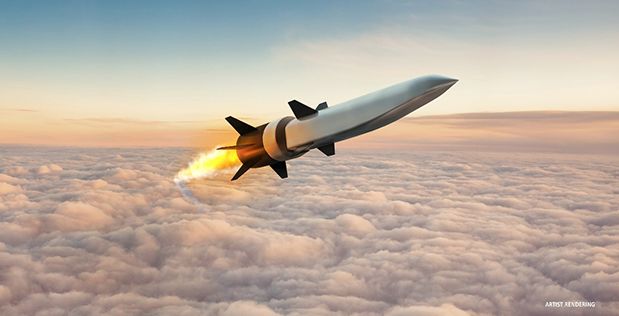
The AHM-4 HACM is a two-stage, air-breathing hypersonic cruise missile. A solid-fuel rocket booster accelerates the vehicle to hypersonic speed, after which the booster separates and a supersonic-combustion ramjet developed by Northrop Grumman takes over, using atmospheric oxygen as the oxidizer to sustain powered flight above Mach 5. This air-breathing architecture distinguishes the HACM from boost-glide hypersonic weapons such as the AGM-183 ARRW, which coasts ballistically after its rocket booster burns out. The scramjet configuration allows the missile to maintain powered, maneuverable flight along trajectories that differ substantially from a fixed ballistic or gliding path.
The missile is sized to be carried by tactical fighter aircraft rather than only by large bombers. The F-15E Strike Eagle is expected to be one of the first U.S. carrier platforms, while Australian F/A-18F Super Hornets are integrated under the SCIFiRE framework. The Air Force has described the HACM as offering tactical flexibility to employ fighters against high-value, time-sensitive targets such as air-defense systems, command facilities, and opposing strike assets, while preserving strategic bombers for other missions. Speeds above Mach 5 reduce the time available for an integrated air-defense network to detect, classify, and engage the incoming weapon, and air launch allows the firing position to be adjusted according to the operational situation without requiring the carrier aircraft to penetrate deeply into defended airspace.
Program status
As of late 2026 the HACM is in the rapid-prototyping phase. The Air Force plans to produce 13 missiles during this period, including flight-test rounds, spares, and weapons for initial operational capability. Completion of the remaining flight tests is considered essential to inform a rapid-fielding and procurement decision in fiscal year 2027. The Air Force has requested approximately $1.2 billion in its FY 2027 budget to mature and field the missile, including $404 million for the first operational production lot. Full-rate production is targeted for fiscal year 2029, following a concurrent major-capability-acquisition pathway that will incorporate design improvements learned during rapid prototyping.
The GAO warned that a major failure during the remaining flight tests could prevent completion of all five flights within the five-year rapid-prototyping window. To protect the timeline, some component-validation activities are being conducted in parallel with final system development, an approach that shortens the schedule but could require further modifications if individual elements fail during testing. Australia's role extends beyond providing a test range: the two governments confirmed during 2024 AUSMIN consultations their intention to move the SCIFiRE cooperation toward a deployable capability, with Australia considering the HACM a potential route to its first air-launched hypersonic weapon.
Specifications (AHM-4 HACM)
General characteristics
- Type: Hypersonic air-launched cruise missile
- Propulsion: Two-stage; solid-fuel rocket booster followed by Northrop Grumman supersonic-combustion ramjet (scramjet)
- Maximum speed: Above Mach 5 (exact maximum not disclosed)
- Oxygen source: Atmospheric (air-breathing)
- Carrier platforms (planned): F-15E Strike Eagle, F/A-18F Super Hornet
 Argentina
 Armenia
 Australia
 Austria
 Austria-Hungary
 Belgium
 Brazil
 United Kingdom
 Brunei
 Bulgaria
 Canada
 Chile
Chile China
China Colonial America
 Colombia
 Confederate States
 Croatia
 Czech
Czech Denmark
 Egypt
Egypt Finland
 France
 Georgia
 Germany
 German Imperial
 Greece
 Holland
 Hungary
 India
India Indonesia
 Iran
Iran Iraq
Iraq Ireland
 Israel
 Italy
Italy Japan
Japan Japan (1940)
 Jordan
 Kingdom of Italy
 Malaysia
 Mexico
 Myanmar
 Nazi Germany
 Netherlands
 New Zealand
 North Korea
 Norway
 Pakistan
 Peru
Peru Philippines
 Poland
 Portugal
 Prussia
 Romania
 Russia
 Saudi Arabia
 Serbia
 Singapore
 Slovakia
 Slovenia
 South Africa
 South Korea
 Soviet Union
 Spain
Spain Sweden
 Switzerland
 Syria
Syria Taiwan
 Thailand
 Turkey
 UAE
UAE Ukraine
 Vietnam
 Yugoslavia