

History
The Gerbera was first deployed by Russian forces in July 2024 during the Russo-Ukrainian war, initially employed as an unarmed decoy to distract and overwhelm Ukrainian air defences due to its visual similarity to the Shahed-136. By mid-2025, the drone was also being used for reconnaissance and strikes.
Initial reporting attributed development to the Russian Gastello Design Bureau, based on uncorroborated material from a Russian social media account. The Defense Intelligence of Ukraine instead identifies the Chinese company Skywalker Technology as the developer, claiming that it assembles drone kits and ships them to the Alabuga drone factory in Yelabuga, Russia, where they are finalized for operational use. The Gerbera is not listed in Skywalker Technology's public product catalog, suggesting it was developed specifically under a contract with the Russian Federation.
In July 2025, two separate incidents involved Gerbera drones entering Lithuanian NATO airspace; one was confirmed and one suspected. During the night of 9–10 September 2025, Gerbera drones entered Polish airspace as part of a large-scale Russian attack on Ukraine. Polish military recorded the first incursion at approximately 23:14 and the last at around 06:30. Polish Prime Minister Donald Tusk stated that Polish airspace was violated 19 times and at least three drones were shot down, while the presidential chancellery reported that 21 drones crossed the border. Debris was recovered in the Lublin, Masovian, and Łódzkie voivodeships and elsewhere; one object damaged a residential building in Wyryki without causing casualties. Polish investigators subsequently found SIM cards from Polish operators in some of the recovered Gerbera UAVs. The Polish prosecution concluded its investigation without identifying a direct culprit for the airspace violation and did not disclose whether the SIM cards had been stolen or acquired through other means; that portion of the investigation remains classified.
Design
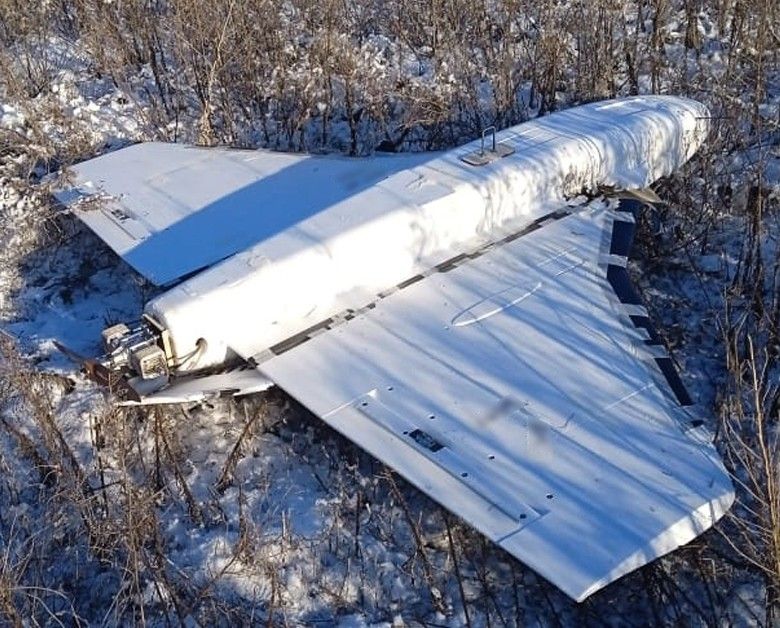
The Gerbera has a cropped delta-wing airframe, somewhat smaller than the Shahed-136, built from an internal plywood frame covered by a polystyrene foam body. Power is provided by a pusher propeller driven by an internal combustion engine, typically a 60 cc DLE60 produced by Mile Hao Xiang Technology (priced at $430–$550 on Chinese marketplaces) or a 70 cc Stinger from RCGF Stinger.
Observed components include a stabilized camera from Topotek (model KHY10S90) and a Mesh Network XK-F358 modem from Xingkay Tech, the two costing approximately $8,500 together. The mesh network allows interconnected drones to share data and relay operator signals, functioning as repeaters to increase resistance to electronic warfare. Additional components identified in recovered units include chips from Analog Devices and Texas Instruments (United States), NXP Semiconductors (Netherlands), STMicroelectronics and U-Blox (Switzerland), and XLSEMI (China).
Ukrainian officials estimate the production cost at approximately $10,000 per unit, a fraction of the Shahed-136's cost. Some but not all Gerberas carry an explosive charge; Ukrainian forces have observed units equipped with small warheads containing up to 5 kg (11 lb) of explosives, significantly less than the Shahed-136's standard 50 kg or newer 90 kg warhead.
Specifications
The following declared characteristics are listed in the sanctions database of the Defense Intelligence of Ukraine:
- Wingspan: 2.5 m
- Length: 2 m
- Maximum take-off weight: 18 kg
- Maximum speed: 160 km/h
- Flight range: 600 km
- Useful ceiling: up to 3,000 m
- Take-off method: elastic catapult or pneumatic catapult
Other sources indicate a range of roughly 300 km when not equipped with a combat payload, and a shorter range when so equipped, while the sanctions database of the Defense Intelligence of Ukraine lists a flight range of 600 km.
Variants
The Gerbera can be configured in three roles:
- Kamikaze — equipped with a small explosive warhead for direct-impact strike missions.
- Reconnaissance — outfitted with a stabilized camera and network modem for intelligence-gathering and surveillance.
- Decoy — an unarmed configuration designed to mimic the radar and visual signature of the Shahed-136 to exhaust air-defence resources.
 Argentina
 Armenia
 Australia
 Austria
 Austria-Hungary
 Belgium
 Brazil
 United Kingdom
 United States
 Brunei
 Bulgaria
 Canada
 Chile
Chile China
China Colonial America
 Colombia
 Confederate States
 Croatia
 Czech
Czech Denmark
 Egypt
Egypt Finland
 France
 Georgia
 Germany
 German Imperial
 Greece
 Holland
 Hungary
 India
India Indonesia
 Iran
Iran Iraq
Iraq Ireland
 Israel
 Italy
Italy Japan
Japan Japan (1940)
 Jordan
 Kingdom of Italy
 Malaysia
 Mexico
 Myanmar
 Nazi Germany
 Netherlands
 New Zealand
 North Korea
 Norway
 Pakistan
 Peru
Peru Philippines
 Poland
 Portugal
 Prussia
 Romania
 Saudi Arabia
 Serbia
 Singapore
 Slovakia
 Slovenia
 South Africa
 South Korea
 Soviet Union
 Spain
Spain Sweden
 Switzerland
 Syria
Syria Taiwan
 Thailand
 Turkey
 UAE
UAE Ukraine
 Vietnam
 Yugoslavia