

History
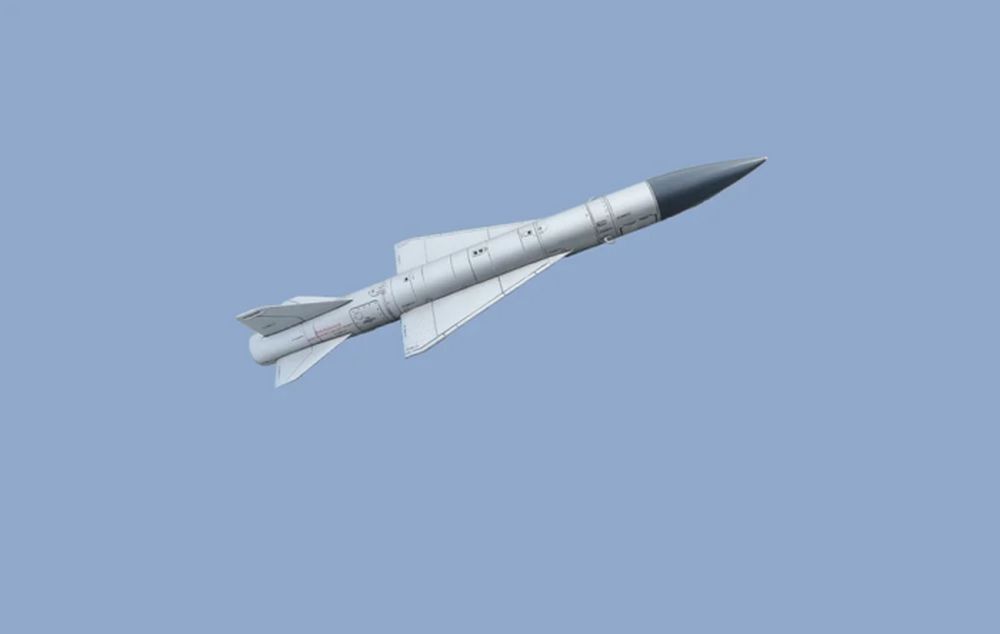
The Kh-22 "Storm" (NATO reporting name: AS-4 Kitchen) is a large, long-range supersonic anti-ship cruise missile developed by MKB Raduga in the Soviet Union. It was designed for use against aircraft carriers and carrier battle groups, with either a conventional or nuclear warhead. Following analysis of World War II naval engagements in the late 1940s and early 1950s, Soviet military planners concluded that stand-off attacks using cruise missiles launched from heavy bombers would be the most effective way to neutralize large carrier battle groups. The Kh-22 was developed as the core weapon for converting heavy bombers into missile carriers (raketonosets).
Development began at OKB-155-1 (now the Raduga Design Bureau) in the late 1950s. The first Kh-22PG missile was fired in 1963, and the Kh-22 entered service in 1968 with the Tu-22K bomber. The full K-22 missile complex was placed into service in 1971. By the mid-1970s, Tu-22M missile carriers equipped with the K-22 complex entered combat units, and the system was also received by a number of Tu-95K-22 long-range bombers. Up to three missiles can be carried under the wing and fuselage of a Tu-22M3.
The Kh-32 was developed by the Raduga design bureau as a deep modernization of the Kh-22. Work began in the late 1980s when it became evident that the Kh-22's guidance radar, operating at fixed frequencies, had very low resistance to radio-electronic countermeasures. A state contract (No. 01133) for development was signed on 19 June 1990. Due to the economic crisis and insufficient financing, work was suspended several times; the first missile tests were conducted in 1998 before being halted due to lack of funding. Development resumed on 7 March 2008 under contract No. 83042, with OJSC Tupolev tasked to re-equip one Tu-22M3 for testing. In 2010, the Council of Ministers of Russia ordered pilot production as part of the modernization of the Tu-22M3 fleet. Flight tests with missile launches were conducted at the end of July 2013. The Kh-32 was officially accepted into service in 2016 as armament for the Tu-22M3M bomber. Russia planned to modernize 30 Tu-22M3 aircraft into the Tu-22M3M version, and 32 Kh-22 missiles were to be upgraded to the Kh-32 standard during 2018–2020.
Specifications
The Kh-22 and Kh-32 share a common airframe family but differ in several key performance parameters. Where sources give different values, both are presented with their stated context.
Kh-22. Range of up to 600 km (370 mi); one source gives 350–400 km for the main modifications. Maximum speed of Mach 4.6 (approximately 5,680 km/h) in the high-altitude terminal dive; one source gives a general figure of up to 4,000 km/h. In high-altitude mode the missile climbs to 27,000 m before a steep terminal dive; in low-altitude mode it climbs to 12,000 m and executes a shallower dive at approximately Mach 3.5. Warhead: 1,000 kg shaped charge per Soviet test data (producing a hole 5 m in diameter and 12 m deep), or 960 kg high-explosive-cumulative penetrating warhead. Dimensions: length 11.6 m, body diameter 900 mm, wingspan 3 m; launch weight 5.9 t. Propulsion: Tumansky liquid-fuel rocket engine using TG-02 (Tonka-250) and IRFNA; fuel and oxidizer mass up to 3 t. Guidance: gyroscope-stabilized autopilot with radio altimeter, and a terminal-phase active radar homing head.
Kh-32. Range of up to 1,000 km (620 mi); one source gives 800–1,000 km, another gives 600–1,000 km. Speed: Mach 3.5–4.6 per one source; Mach 4.8 (5,880 km/h) per another; at least Mach 4.1 (5,000 km/h) per a third. The missile climbs to 40 km altitude in the stratosphere, transitions to level flight, then performs a steep dive at the target, combining features of cruise and ballistic weapons and making it difficult for air-defense systems to intercept. Warhead: 500 kg per two sources; up to 700 kg (lightened 9A22 M/MK) per another. Weight: 5,820 kg. Dimensions: 11.65 m × 0.92 m. Guidance: inertial navigation system with a terminal radar homing head activated approximately 200 km from the target, operating independently of GPS/GLONASS satellites.
Variants
- Kh-22 — original conventional anti-ship missile with a large shaped-charge warhead.
- Kh-22N — nuclear-armed variant with a 350–1,000 kt thermonuclear warhead.
- Kh-22P — anti-radiation missile introduced in the mid-1970s for the destruction of radar installations.
- Kh-22M / Kh-22MA — upgraded variants with Mach 3.3 speed, 600 km range, 5,780 kg weight, 960 kg RDX warhead, new attack profiles, and a datalink allowing mid-course updates.
- Kh-32 — updated conventional variant with an improved rocket motor, new anti-jam radar seeker, modern control system, and a reduced warhead; designed for the Tu-22M3M.
Operational history
The Kh-22/32 family saw its first confirmed combat use during the Russian invasion of Ukraine in 2022, when Tu-22M3 bombers employed the missiles against ground targets including industrial sites, hydraulic structures in Kryvyi Rih, and urban infrastructure in Odesa, Dnipro, and Kremenchuk. The missiles have been used against "radio-contrast" targets such as military bases, power plants, and bridges. Interception rates remained low owing to the missile's high speed until 2024, when Ukrainian forces claimed the first successful engagement of Kh-22/32 variants. On 19 April 2024, Ukraine claimed to have shot down two Kh-22/32 missiles; images released afterward showed a Kh-32 manufactured in 2023 that had been damaged by an anti-aircraft missile.
In January, Ukrainian air defense attempted to intercept a Kh-22 over Dnepropetrovsk; the missile was damaged and subsequently struck a residential building. The incident prompted a marked shift in Ukrainian public statements about the missile's vulnerability to air defense.
Russian forces used Kh-22/32 missiles to strike Ukrainian territory for the first time since July, according to the Ukrainian Air Command. The launches were carried out on the night of 17 October from aircraft positioned over temporarily occupied Crimea. The previous confirmed use of Kh-22/32 from the Black Sea area was on 16 July; a further report on 19 July mentioned Kh-22 launches toward the Odesa region, though the next morning's report did not confirm their use. During the same period, Ukrainian air defense intercepted or suppressed 293 targets, including 4 Kalibr cruise missiles and 289 UAVs.
Many older missiles in the inventory are believed to have self-destructed during flight due to their age.
Operators
- Current: Russia
- Former: Belarus, Kazakhstan, Ukraine (inventory decommissioned and scrapped following the dissolution of the Soviet Union)
 Argentina
 Armenia
 Australia
 Austria
 Austria-Hungary
 Belgium
 Brazil
 United Kingdom
 United States
 Brunei
 Bulgaria
 Canada
 Chile
 China
 Colonial America
 Colombia
 Confederate States
 Croatia
 Czech
 Denmark
 Egypt
 Finland
 France
 Georgia
 Germany
 German Imperial
 Greece
 Holland
 Hungary
 India
 Indonesia
 Iran
 Iraq
 Ireland
 Israel
 Italy
 Japan
 Japan (1940)
 Jordan
 Kingdom of Italy
 Malaysia
 Mexico
 Myanmar
 Nazi Germany
 Netherlands
 New Zealand
 North Korea
 Norway
 Pakistan
 Peru
 Philippines
 Poland
 Portugal
 Prussia
 Romania
 Saudi Arabia
 Serbia
 Singapore
 Slovakia
 Slovenia
 South Africa
 South Korea
 Soviet Union
 Spain
 Sweden
 Switzerland
 Syria
 Taiwan
 Thailand
 Turkey
 UAE
 Ukraine
 Vietnam
 Yugoslavia