
History
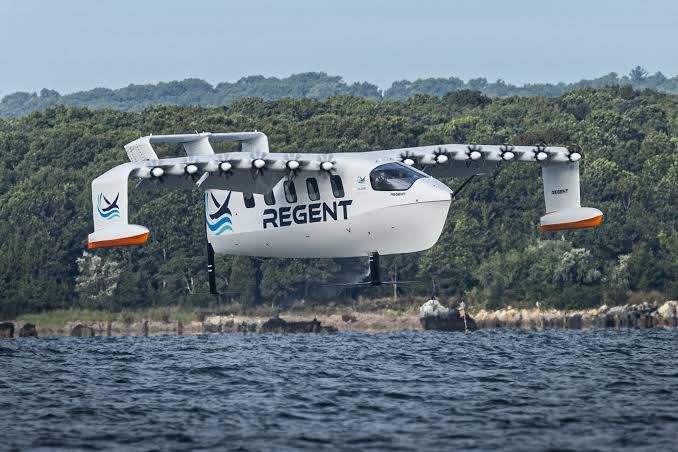
The REGENT Viceroy is a proposed electric-powered wing-in-ground-effect (WIG) craft under development by REGENT Craft Inc. of Rhode Island. REGENT is an acronym for Regional Electric Ground Effect Nautical Transport. A one-quarter-scale model was demonstrated in Narragansett Bay in 2022.
In October 2023, REGENT signed its first agreement with the U.S. Marine Corps Warfighting Lab (MCWL), worth $4.75 million, to prove the craft in hull, foil, and wing-borne modes and to inform risk reduction and certification requirements. REGENT co-founder and CEO Billy Thalheimer stated at the time that the service was not purchasing any craft and that the funding would mature the technology and validate the concept. Lockheed Martin invested in REGENT in 2023 and offered access to its facilities and expertise for military applications.
In August 2024, REGENT received U.S. Coast Guard approval to begin testing prototypes in Narragansett Bay and Rhode Island Sound. In March 2025, REGENT reported completion of the first contract and signed a second phase; REGENT estimated this phase at $10 million while other reporting placed it at $9.5 million for full-scale prototype demonstrations. That month, REGENT unveiled the full-scale Viceroy prototype and began crewed sea trials in Narragansett Bay. In August 2025, REGENT hosted MCWL staff on the water to observe testing. In November 2025, REGENT conducted three rescue drills for the Marine partnership: a dockside litter boarding of a non-ambulatory patient, a simulated beach extraction, and an open-water life raft rescue. REGENT Defense general manager Tom Huntley stated the agreement focuses on medical and casualty evacuation, contested logistics, and intelligence, surveillance, and reconnaissance, and that lessons would help the Corps build tactics as the program moves toward a Program of Record.
On September 2, 2026, the prototype made its first crewed flight over Narragansett Bay. Two captains flew the craft 596 m (1,956 ft) at an altitude of 10 m (33 ft) above the water for 30 seconds. Four weeks later, on September 30, REGENT announced a $5 million extension bringing the total MCWL partnership to $19.25 million, a figure the company rounds to $20 million in its headline. The new funding supports a fourth phase of demonstrations and command-and-control work with six planned deliverables.
Design
The Viceroy is a wing-in-ground-effect craft that flies within one wingspan of the water surface, where ground effect reduces drag and improves efficiency. For the Viceroy, this means flying approximately 9 m (30 ft) above the surface, according to REGENT. The craft operates in three modes: it floats on its hull at low speed near docks, rises onto hydrofoils once it clears the dock, and then transitions into ground-effect flight over open water. The hydrofoils retract into the vessel's deep-V hull in WIG mode.
Under U.S. federal law, the Viceroy is classified as a Type A WIG craft and regulated as a Coast Guard small passenger vessel rather than an FAA aircraft. It is designed to be operated by certified mariners holding a type rating obtained through a training course. REGENT co-founder Billy Thalheimer described this as a manpower advantage, noting that enlisted service members could operate the craft as they would a boat while accessing the capabilities of an aircraft.
The Viceroy is commanded using a single-lever thrust control and a fly-by-wire system with digital interfaces displaying maps, radar, and traffic advisories. Stability and certain maneuvers, including landing, are augmented by a proprietary autonomous digital control system. REGENT claims the system offers a level of safety and control no prior WIG craft has achieved. Propulsion is provided by propellers driven by redundant electric motors.
REGENT states the Viceroy can take off and land in waves up to 1.5 m (5 ft) and fly over waves up to 4 m (13 ft), a ceiling set by an emergency landing scenario. Regarding power, REGENT's defense materials indicate a 60-kW tactical generator would require approximately 17 hours to fully charge one Viceroy, sufficient for two supply runs. The company also proposes ship power and barge-mounted battery packs as faster options, stating one 1-MWh pack could charge two Viceroys in an hour. On signature, REGENT claims that flying at such low altitude keeps the craft below radar and above high-range sonar, and that electric propulsion reduces heat and infrared signature; these are company claims, not Marine Corps findings.
Specifications
The following figures are REGENT design targets. The prototype's first crewed flight covered 596 m for 30 seconds.
Maximum speed: up to 290 km/h (180 mph). REGENT's spec sheet lists this as 156 kn; other published data cites 160 kn.
Range (battery): up to 290 km (180 mi) per REGENT; other published data gives 160 nmi. REGENT states a hybrid-electric version could extend range to up to 2,600 km (1,400 nmi).
Payload: 12 passengers and 2 crew, or 1,600 kg (3,500 lb) of cargo, with up to 21 m³ (750 cu ft) of cargo space.
Length: 17 m (55 ft) per REGENT's spec sheet; 17.5 m (57.5 ft) in other published data.
Wingspan: 20 m (65 ft).
Height: 4.7 m (15.5 ft).
Maximum takeoff weight: 6,804 kg (15,000 lb) per REGENT's spec sheet; 6,985 kg (15,400 lb) in other published data.
Program Status
The MCWL partnership has reached $19.25 million across four phases. The fourth phase, announced in September 2026, focuses on putting the technology in the hands of the warfighter, including testing in conditions relevant to military missions and integration with defense command-and-control systems. REGENT expects its first customer deliveries in 2027. The 2024 FAA reauthorization gave the FAA and the Coast Guard until May 2026 to sign an agreement dividing oversight of WIG craft from design approval through crew certification and inspection.
In June 2025, REGENT completed a 23,700 m² (255,000 sq ft) production facility in Rhode Island, which it describes as the world's first production hub for WIG craft and which is set to come online in 2026. In August 2026, REGENT raised $240 million to execute certification milestones and scale manufacturing. The company is working with Lloyd's Register and other partners to enable operations outside the United States, including in Japan.
Announced commercial customers include The Twenty Five (REGENT's first U.S. launch customer, with routes including Boston to Nantucket in one hour and Palm Beach to Miami in 40 minutes), New Zealand's Ocean Flyer, Brittany Ferries, Mesa Airlines, Mokulele Airlines, Southern Airways Express, UrbanLink, UME Shipping, and Croatian ferry operator Split Express. A feasibility study for use in the Scottish islands is also planned. REGENT claims a $10 billion commercial backlog across the Viceroy and Monarch platforms, comprising deposit-backed orders and provisional sales agreements. As battery capacity improves, REGENT projects Viceroy range could rise to 926 km (500 sm / 436 nmi).
Variants
REGENT Defense plans to produce both crewed and fully autonomous military variants of the all-electric Viceroy, followed by a hybrid-electric option with increased range. The company also developed the Squire, a one-quarter-scale uncrewed autonomous WIG craft with a payload of 23 kg (50 lb), a speed of up to 37 km/h (20 kn) [note: source states up to 70 knots], and a range exceeding 185 km (100 nmi). The Squire made its first ground-effect flight in April 2025. REGENT is additionally developing the Monarch, a 50- to 100-passenger seaglider with delivery targeted before the end of the decade.
 Argentina
 Armenia
 Australia
 Austria
 Austria-Hungary
 Belgium
 Brazil
 United Kingdom
 Brunei
 Bulgaria
 Canada
 Chile
 China
 Colonial America
 Colombia
 Confederate States
 Croatia
 Czech
 Denmark
 Egypt
 Finland
 France
 Georgia
 Germany
 German Imperial
 Greece
 Holland
 Hungary
 India
 Indonesia
 Iran
 Iraq
 Ireland
 Israel
 Italy
 Japan
 Japan (1940)
 Jordan
 Kingdom of Italy
 Malaysia
 Mexico
 Myanmar
 Nazi Germany
 Netherlands
 New Zealand
 North Korea
 Norway
 Pakistan
 Peru
 Philippines
 Poland
 Portugal
 Prussia
 Romania

 Russia
 Saudi Arabia
 Serbia
 Singapore
 Slovakia
 Slovenia
 South Africa
 South Korea
 Soviet Union
 Spain
 Sweden
 Switzerland
 Syria
 Taiwan
 Thailand
 Turkey
 UAE
 Ukraine
 Vietnam
 Yugoslavia