
History
In September 2023, the U.S. Marine Corps issued a requirement for a long-range precision attack missile, designated LRAM (Long Range Attack Missile), to be launched from helicopters and VTOL aircraft. The AH-1Z was the baseline platform, with a required sea-level range of at least 280 km (150 nm). The program was later renamed the Precision Attack Strike Munition (PASM) program, and the L3Harris Red Wolf was among the competitors.
Test firings from AH-1Z helicopters began in 2024. In September 2025, the U.S. Marine Corps conducted a live-fire test of the Red Wolf from an AH-1Z Viper attack helicopter over the Atlantic Test Range, successfully engaging a maritime target and incorporating the missile into the targeting network used during the operation.
In January 2026, the U.S. Naval Air Systems Command selected L3Harris to develop, test, and produce the Red Wolf under the Marine Corps' PASM program. In February 2026, it was announced that L3Harris had won a production contract for an undisclosed number of missiles, with delivery planned by the end of September 2027. The selection was influenced by the success of 52 launched-effects vehicle flights, including a recent low-altitude test from an AH-1Z helicopter.
In October 2026, the Systems Integration Management Office of the U.S. Army Special Operations Aviation Command conducted the first flight of the Red Wolf from an MH-60 helicopter, validating compatibility between the missile's launch system and the aircraft and assessing flight characteristics under operational conditions. The test provides an initial technical basis for extending integration to other H-60 variants. L3Harris stated that the Wolf Pack portfolio, encompassing both Red Wolf and Green Wolf, has completed 60 flight demonstrations involving fixed-wing aircraft, helicopters, and ground-based launch systems. The demonstration does not yet establish a timeline for operational deployment.
Specifications
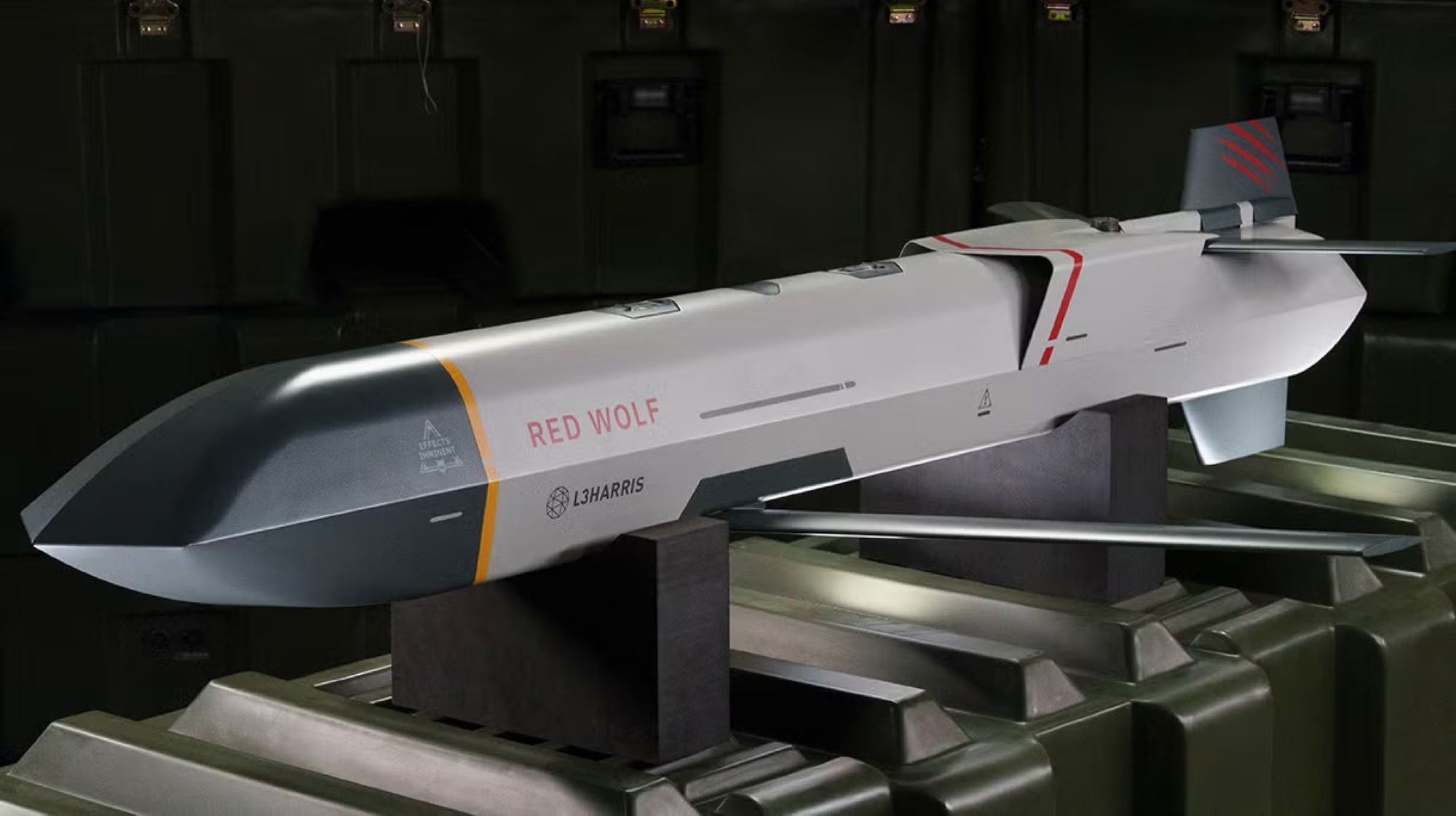
The Red Wolf is in the 115 kg (250 lb) class and measures approximately 1.8 m (6 ft) in length. It is powered by a small jet engine fed by a dorsal intake and features flip-out swept wings and tail surfaces that deploy after launch. L3Harris states a range of 370 km (200 nautical miles) when launched from VTOL platforms. The missile can reach high-subsonic speeds and has a flight endurance exceeding 60 minutes. Navigation combines GPS with a seeker designed to engage both stationary and moving targets. The system supports beyond-line-of-sight communications and autonomous over-the-horizon engagements, and can use external targeting data to strike objectives outside the launching aircraft's direct field of view. Its modular architecture allows different payloads and software configurations to be integrated into a common air vehicle.
Variants
The Red Wolf is the kinetic precision-strike variant of the Wolf Pack family developed by L3Harris. Its counterpart, the Green Wolf, is a recoverable variant designed for electronic warfare missions, including electronic attack and the detection, identification, and geolocation of hostile electromagnetic emissions. Both variants support in-flight mission adjustments and coordination with other unmanned systems, allowing employment to be adapted after launch.
 Argentina
 Armenia
 Australia
 Austria
 Austria-Hungary
 Belgium
 Brazil
 United Kingdom
 Brunei
 Bulgaria
 Canada
 Chile
 China
 Colonial America
 Colombia
 Confederate States
 Croatia
 Czech
 Denmark
 Egypt
 Finland
 France
 Georgia
 Germany
 German Imperial
 Greece
 Holland
 Hungary
 India
 Indonesia
 Iran
 Iraq
 Ireland
 Israel
 Italy
 Japan
 Japan (1940)
 Jordan
 Kingdom of Italy
 Malaysia
 Mexico
 Myanmar
 Nazi Germany
 Netherlands
 New Zealand
 North Korea
 Norway
 Pakistan
 Peru
 Philippines
 Poland
 Portugal
 Prussia
 Romania

 Russia
 Saudi Arabia
 Serbia
 Singapore
 Slovakia
 Slovenia
 South Africa
 South Korea
 Soviet Union
 Spain
 Sweden
 Switzerland
 Syria
 Taiwan
 Thailand
 Turkey
 UAE
 Ukraine
 Vietnam
 Yugoslavia