
History
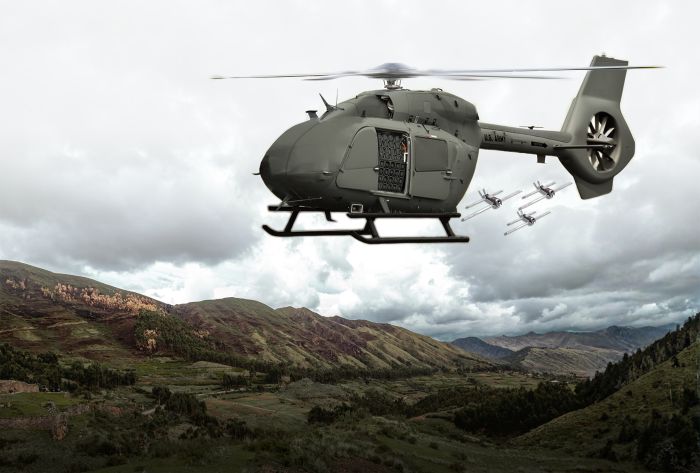
The MQ-72C Lakota Connector is an unmanned cargo helicopter developed by Airbus U.S. Space & Defense as a variant of the UH-72B Lakota, itself derived from the H145 twin-engine light helicopter. In May 2024, the Naval Air Systems Command awarded Airbus a Phase I Other Transaction Agreement through the Naval Aviation Systems Consortium for the U.S. Marine Corps Aerial Logistics Connector program, a Middle Tier of Acquisition rapid prototyping effort aimed at producing aircraft prototypes for operational demonstrations in distributed operating environments. The first program demonstration was completed in October 2024 at Marine Corps Air Station New River and Marine Corps Base Camp Lejeune, assessing the UH-72B Lakota's performance and suitability for transporting mission-specific loads. A second demonstration followed in May 2025.
In April 2025, Airbus announced a partnership with Shield AI to integrate its Hivemind autonomy software into the MQ-72C. L3Harris Technologies joined the team in May 2025 to provide digital backbone and mission systems integration, and Parry Labs joined in June 2025 to supply mission software, edge computing hardware, and a ground control station. The team achieved its first autonomous flight in August 2025 at Airbus Helicopters' facility in Grand Prairie, Texas, using an H145 as the test vehicle. The aircraft flew under the direct control of Hivemind in collaboration with Airbus' Helionix avionics, performing automatic takeoff, landing, and additional manoeuvres without pilot input. A further autonomous test in September 2025 focused on waypoint-based navigation.
By June 2026, Team Lakota Connector had accumulated over 70 autonomous flight hours. In October 2026, Airbus conducted a self-funded demonstration for the U.S. Army at Huntsville Executive Airport in Alabama, conducting five flights that included autonomous hovering in complex patterns, normal traffic patterns, and autonomous routing around no-fly zones. A pilot remained on board as a safety margin throughout but did not take control of the aircraft during any of the autonomous phases.
Specifications
The MQ-72C has a length of 13.5 m (44.42 ft) and a height of 4 m (13.04 ft). Its maximum take-off weight is 3,800 kg (8,378 lb). The cruise speed is 135 knots (250 km/h), with a design range of more than 350 nautical miles (650 km) and a maximum operating altitude of 20,000 ft (6,100 m). Engine power ratings are 894 shaft horsepower for take-off, 771 shp for maximum continuous power, and 951 shp for one-engine-inoperative maximum continuous power. The aircraft is designed to carry Joint Modular Intermodal Containers and ordnance containers.
Program status
The MQ-72C is being developed under a five-year program expected to conclude in 2029, at which point Airbus aims to transition to production at its facility in Columbus, Mississippi. The current demonstrator is not in a fully uncrewed configuration; a pilot remains on board during autonomous flights as a safety margin. The final design intends to replace the cockpit with an open pass-through cargo bay accessed by clamshell nose doors, which have been designed and 3D-rendered but not yet flight-tested and are planned for integration in the 2029–2030 timeframe. The Marine Corps is targeting an operationally relevant demonstration in 2027, and Near Earth Autonomy and Honeywell are developing a competing AW139-based design for the same program. The U.S. Army has not formalised a requirement for a cargo-carrying drone helicopter, but expressed interest in the capability demonstrated at Huntsville, particularly to support long-range air assault operations.
 Argentina
 Armenia
 Australia
 Austria
 Austria-Hungary
 Belgium
 Brazil
 United Kingdom
 Brunei
 Bulgaria
 Canada
 Chile
 China
 Colonial America
 Colombia
 Confederate States
 Croatia
 Czech
 Denmark
 Egypt
 Finland
 France
 Georgia
 Germany
 German Imperial
 Greece
 Holland
 Hungary
 India
 Indonesia
 Iran
 Iraq
 Ireland
 Israel
 Italy
 Japan
 Japan (1940)
 Jordan
 Kingdom of Italy
 Malaysia
 Mexico
 Myanmar
 Nazi Germany
 Netherlands
 New Zealand
 North Korea
 Norway
 Pakistan
 Peru
 Philippines
 Poland
 Portugal
 Prussia
 Romania

 Russia
 Saudi Arabia
 Serbia
 Singapore
 Slovakia
 Slovenia
 South Africa
 South Korea
 Soviet Union
 Spain
 Sweden
 Switzerland
 Syria
 Taiwan
 Thailand
 Turkey
 UAE
 Ukraine
 Vietnam
 Yugoslavia