

History
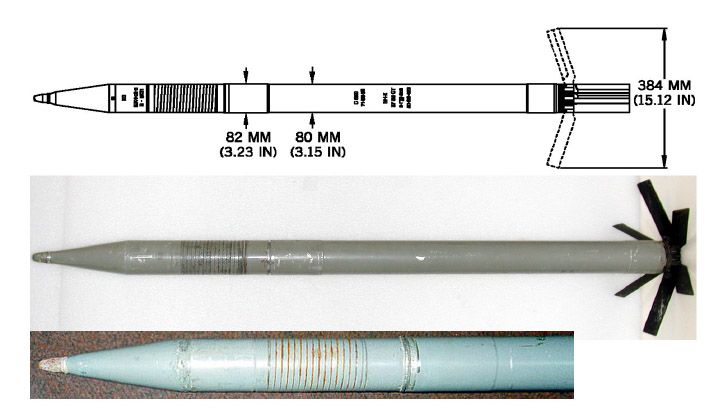
The S-8VC is a modified version of the Soviet S-8 family of 80 mm unguided aerial rockets, specifically adapted for intercepting aerial targets including unmanned aerial vehicles. The base S-8 family was developed by OKB-16 in the Soviet Union in the late 1960s to replace the obsolete 57 mm S-5 rockets and entered service with Soviet aviation in the 1970s for engaging ground targets. Video of the S-8VC being employed was published on the Smotrim platform, marking its first publicized use.
Design
The defining feature of the S-8VC modification is a proximity (non-contact) fuze, which detonates the warhead in the vicinity of the target without requiring a direct hit, creating a cloud of warhead elements along the flight path of the target UAV. The rockets are launched from Ka-52M attack helicopters fitted with dedicated B8V10-UV launch modules. Target acquisition for the unguided rockets is provided by an optoelectronic station equipped with day and night channels.
Operational use
The S-8VC has been employed in the Russia-Ukraine war for the interception of aerial targets. In February, Russian propagandist sources claimed that 25 Ukrainian long-range kamikaze drones were shot down during two sorties of a Ka-52M helicopter. Prior to the introduction of the S-8VC, Ka-52 crews had relied on the helicopter's onboard cannon and modified 9K121 Vikhr rockets for engaging aerial targets.
 Argentina
 Armenia
 Australia
 Austria
 Austria-Hungary
 Belgium
 Brazil
 United Kingdom
 United States
 Brunei
 Bulgaria
 Canada
 Chile
 China
 Colonial America
 Colombia
 Confederate States
 Croatia
 Czech
 Denmark
 Egypt
 Finland
 France
 Georgia
 Germany
 German Imperial
 Greece
 Holland
 Hungary
 India
 Indonesia
 Iran
 Iraq
 Ireland
 Israel
 Italy
 Japan
 Japan (1940)
 Jordan
 Kingdom of Italy
 Malaysia
 Mexico
 Myanmar
 Nazi Germany
 Netherlands
 New Zealand
 North Korea
 Norway
 Pakistan
 Peru
 Philippines
 Poland
 Portugal
 Prussia
 Romania
 Saudi Arabia
 Serbia
 Singapore
 Slovakia
 Slovenia
 South Africa
 South Korea
 Soviet Union
 Spain
 Sweden
 Switzerland
 Syria
 Taiwan
 Thailand
 Turkey
 UAE
 Ukraine
 Vietnam
 Yugoslavia