
History
The AIM-120 Advanced Medium-Range Air-to-Air Missile (AMRAAM) was developed under a Family of Weapons Memorandum of Agreement among the United States and several NATO nations, under which the US was to develop the next-generation medium-range air-to-air missile while Europe developed the next-generation short-range missile. AMRAAM largely replaced the AIM-7 Sparrow as the principal beyond-visual-range air-to-air missile in US inventory. Deployment of the AIM-120A began in September 1991 in US Air Force F-15 Eagle fighter squadrons, with the US Navy following in 1993 in F/A-18 Hornet squadrons. As of 2008, more than 14,000 missiles had been produced for the US Air Force, the US Navy, and 33 international customers.
Design
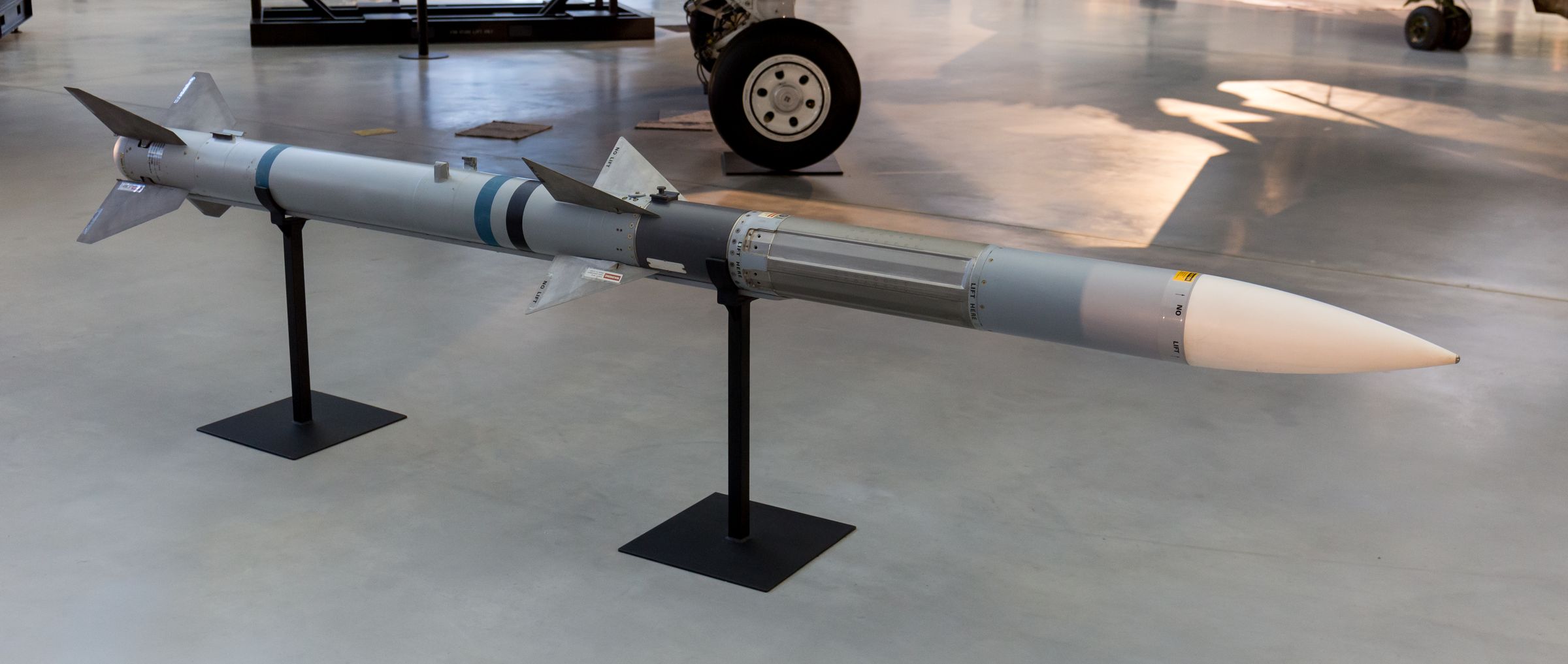
AMRAAM is an all-weather, beyond-visual-range air-to-air missile capable of day-and-night operations. It uses active transmit-receive radar guidance rather than the semi-active receive-only radar of the AIM-7 Sparrow, providing a "fire-and-forget" capability that frees the aircrew to engage multiple targets simultaneously. The missile combines inertial guidance, midcourse datalink updates, and an on-board active radar for terminal intercept. It incorporates a "Home on Jamming" capability, allowing it to switch from active radar homing to passive homing on jamming signals from the target. An inertial reference unit and micro-computer system reduce the missile's dependence on the aircraft's fire-control system. NATO pilots use the brevity code "Fox Three" when firing the AIM-120. Raytheon states that the missile's capabilities have been demonstrated in over 6,000 test shots.
Operational history
AMRAAM has been used in several engagements, achieving 16 air-to-air kills in conflicts over Iraq, Bosnia, Kosovo, India, and Syria. Its operational kill probability is 0.59. In more recent conflicts, AMRAAMs have been used extensively in the US and allied campaign against Houthi drones, in engagements over Syria and Iraq during efforts to defend Israel against Iranian attacks, and in Ukraine to counter Russian drones and cruise missiles through NASAMS air defense systems and F-16 fighters. These munitions have been supplied by the United States and NATO allies.
Variants
AMRAAM has been produced in multiple variants from the original AIM-120A through the AIM-120B, AIM-120C-5, AIM-120C-7, AIM-120C-8, AIM-120D, and AIM-120D-3. The AIM-120D-3 features modernized processors and software-based electronic-warfare countermeasures. The AIM-120C-8 is a version of the AIM-120C-7 that replaced some discontinued parts with equivalent commercial parts, with capabilities identical to the C-7. The AMRAAM-Extended Range (AMRAAM-ER) is a ground-launched variant with a larger rocket motor and optimized flight control algorithms, integrated with NASAMS for medium-range air defense. An AIM-120E variant was hinted at in a March 2025 Air Force contract, though an Air Force spokesperson stated no details could be provided. In September 2024, Raytheon suggested that the AIM-120D-3 may serve as a complement to the AIM-260 JATM rather than be fully replaced by it, with the JATM as a "kick-the-door-down" weapon and AMRAAM as the "affordable" capacity missile.
Program status
In September 2026, RTX subsidiary Raytheon was awarded a five-year AMRAAM production contract with options for two additional years, valued at up to $20.7 billion, covering Lots 41 through 47. Under a framework agreement announced in February 2026, Raytheon is working toward annual production of at least 1,900 missiles. The company has invested in manufacturing equipment, workforce expansion, and supplier capacity, and identified new US solid-rocket-motor production lines expected to come online in 2027. AIM-120s can cost over $1 million per unit, depending on variant.
On 28 October 2026, Japanese Defence Minister Shinjirō Koizumi and US Secretary of War Pete Hegseth agreed to establish a final assembly and checkout facility for AMRAAMs in Japan, on the sidelines of the ASEAN Defence Ministers' Meeting Plus in Cebu, Philippines. The facility operates under Operation Supercharge, a US-Japan initiative to strengthen cooperation on defence equipment and technology. Koizumi described the missiles as "essential for the F-35" and said the agreement would ensure acquisition of equipment needed by both countries while strengthening Japan's defence industry base. The facility's location, construction timeline, and production capacity had not been disclosed. A feasibility study supported by Mitsubishi Electric and Raytheon preceded the agreement, and discussions in April 2026 expanded the scope to include Japanese production of circuit card assemblies. The plan to co-produce AMRAAMs in Japan was first discussed in 2024. The final assembly and inspection model allows Japan to complete and check missiles using components produced through an industrial arrangement, rather than manufacturing the entire missile domestically.
Platforms and operators
Raytheon states that AMRAAM is fielded by 44 countries and operates across 14 platforms. In the air-to-air role it is integrated on the F-15 Eagle, F-16 Fighting Falcon, F/A-18 Hornet and Super Hornet, F-22 Raptor, F-35 (the only radar-guided air-to-air missile cleared for the F-35), Eurofighter Typhoon, JAS-39 Gripen, Tornado, and Harrier. In the surface-launch role, AMRAAM is the baseline weapon on the NASAMS air defense system, which protects the US National Capital Region and is used by 14 international partners. AMRAAM has been procured by numerous countries including Canada, South Korea, Poland, Pakistan, Taiwan, Singapore, Finland, Morocco, Switzerland, Malaysia, Indonesia, Australia, Saudi Arabia, Norway, Germany, Sweden, Turkey, Argentina, Japan, the Netherlands, the UAE, Spain, and Egypt. In Japan, AMRAAM is a primary weapon on F-15 variants operated by both the US Air Force and the Japan Air Self-Defense Force, as well as on F-35s operated by US and Japanese units.
 Argentina
 Armenia
 Australia
 Austria
 Austria-Hungary
 Belgium
 Brazil
 United Kingdom
 Brunei
 Bulgaria
 Canada
 Chile
 China
 Colonial America
 Colombia
 Confederate States
 Croatia
 Czech
 Denmark
 Egypt
 Finland
 France
 Georgia
 Germany
 German Imperial
 Greece
 Holland
 Hungary
 India
 Indonesia
 Iran
 Iraq
 Ireland
 Israel
 Italy
 Japan
 Japan (1940)
 Jordan
 Kingdom of Italy
 Malaysia
 Mexico
 Myanmar
 Nazi Germany
 Netherlands
 New Zealand
 North Korea
 Norway
 Pakistan
 Peru
 Philippines
 Poland
 Portugal
 Prussia
 Romania

 Russia
 Saudi Arabia
 Serbia
 Singapore
 Slovakia
 Slovenia
 South Africa
 South Korea
 Soviet Union
 Spain
 Sweden
 Switzerland
 Syria
 Taiwan
 Thailand
 Turkey
 UAE
 Ukraine
 Vietnam
 Yugoslavia