
History
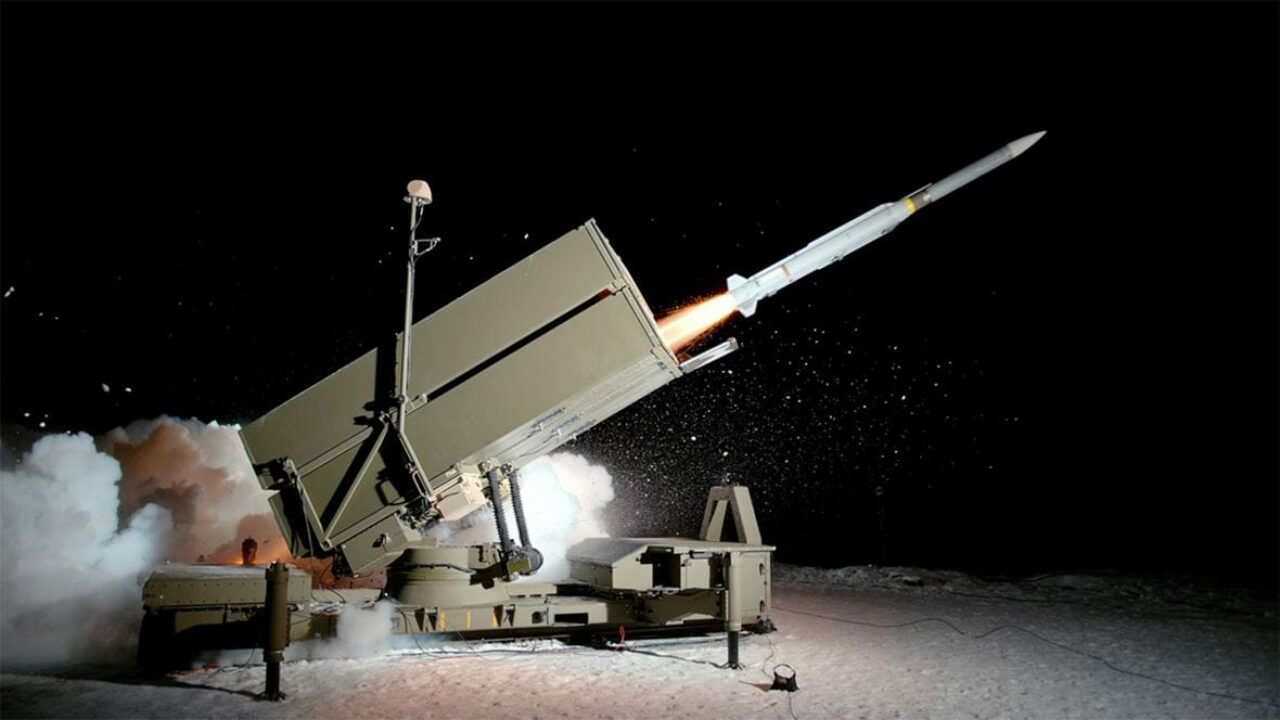
The Raytheon AIM-120 Advanced Medium-Range Air-to-Air Missile Extended Range, commonly called AMRAAM-ER, is a ground-launched surface-to-air missile developed for integration with the National Advanced Surface-to-Air Missile System (NASAMS). It combines AMRAAM-derived guidance with a larger propulsion and control section to engage airborne targets at greater ranges and altitudes than a standard surface-launched AMRAAM.
AMRAAM-ER is intended for medium-range ground-based air defence. Raytheon has described the missile as an interceptor for threats including aircraft, cruise missiles, and unmanned aerial vehicles when employed through NASAMS.
The program has progressed through flight testing, an updated propulsion configuration, and a transition toward full-rate production. In September 2026 Raytheon also publicly identified AMRAAM-ER as compatible with the Australian NASAMS configuration.
Development and testing
Published accounts give differing dates for the earliest AMRAAM-ER flight activity. A secondary equipment database lists a first flight on 4 October 2016, while a later account quoting Raytheon states that the first AMRAAM-ER missile flight test was successfully completed in the second quarter of 2021. The Raytheon-attributed 2021 milestone is the more directly supported program statement.
Development subsequently produced an updated AMRAAM-ER configuration using the guidance section of the AIM-120C-8 AMRAAM together with a new propulsion and flight-control package. Raytheon, Kongsberg Defence & Aerospace, the Norwegian Ministry of Defence, and Norwegian armed forces participated in testing of this configuration.
In November 2023 the updated missile was flight tested from NASAMS at Andøya, Norway. The firing used a preprogrammed flight path to verify safe departure from the launcher and missile performance. Raytheon publicly announced the test in February 2024.
The updated missile incorporates what was described as the Norwegian Propulsion Stack. This consists of a more robust 10-inch rocket motor supplied by Nammo and a 10-inch control actuator system from Kongsberg Defence & Aerospace. The Norwegian Ministry of Defence participated as a collaborative partner in this development.
Production transition
In April 2026 the United States Air Force awarded Raytheon a contract valued at up to $234.8 million to transition AMRAAM-ER into full-rate production. Raytheon described the award as a significant step toward sustainable large-scale production. Work associated with the contract was expected to continue through 13 April 2030.
The 2026 production-transition contract also included foreign military sales associated with Hungary, Kuwait, Lithuania, the Netherlands, Norway, and Taiwan. The cited contract information establishes participation in the procurement program but does not by itself demonstrate that every listed country had placed AMRAAM-ER into operational service.
Australian NASAMS compatibility
On 16 September 2026 Raytheon Australia identified AMRAAM-ER as compatible with Australia's NASAMS configuration and included it in the system's described effector suite alongside the AIM-9X Sidewinder and standard AIM-120 AMRAAM. This was the first public identification of AMRAAM-ER as part of the Australian configuration's effector suite.
The Australian NASAMS configuration also incorporates locally developed CEA Technologies radars, Kongsberg's Fire Distribution Centre, a Raytheon High Mobility Launcher mounted on the Hawkei vehicle, and a Raytheon Australia multispectral ground system. The Australian Department of Defence announced on 9 September 2026 that NASAMS had achieved final operational capability and met the requirements for operational service. The available evidence establishes AMRAAM-ER compatibility and its inclusion in the described effector suite, but does not document an Australian live firing of AMRAAM-ER itself.
Design
AMRAAM-ER adapts technology from the AIM-120 missile family for ground-based air defence. Its defining feature is the combination of AMRAAM guidance with a larger rocket motor and control section intended to increase engagement range and altitude when launched from NASAMS.
Guidance and control
The updated configuration flight tested in 2023 incorporates the guidance section of the AIM-120C-8 AMRAAM. It uses a 10-inch control actuator system supplied by Kongsberg Defence & Aerospace. The control system forms part of the Norwegian Propulsion Stack developed for the latest tested AMRAAM-ER configuration.
Propulsion
The updated AMRAAM-ER uses a 10-inch rocket motor manufactured by Nammo. Raytheon has described the extended-range configuration as receiving its additional performance from the more powerful rocket motor and associated flight-control section.
NASAMS integration
AMRAAM-ER is designed specifically for ground-based air defence and integration with the NASAMS launcher. NASAMS provides the launcher and wider command-and-control architecture through which the missile is employed. The missile complements other NASAMS-compatible effectors rather than replacing all existing AMRAAM configurations.
Program status
By 2026 AMRAAM-ER had completed multiple flight-test milestones and had entered a transition to full-rate production under a United States Air Force contract. Raytheon stated that the missile was integrated with NASAMS for medium-range air-defence missions.
In Australia, Raytheon publicly identified AMRAAM-ER in September 2026 as compatible with the Australian NASAMS configuration. Australia's NASAMS system had reached final operational capability by that time, although the cited material does not confirm an Australian AMRAAM-ER live firing or provide the number of AMRAAM-ER missiles delivered.
Variants
- AMRAAM-ER: Extended-range, ground-launched AMRAAM derivative developed for NASAMS, combining AMRAAM guidance with a larger propulsion and control section.
- Updated AMRAAM-ER configuration: Flight-tested in November 2023 with the AIM-120C-8 guidance section, a 10-inch Nammo rocket motor, and a 10-inch Kongsberg control actuator system collectively associated with the Norwegian Propulsion Stack.
Specifications (updated AMRAAM-ER configuration)
General characteristics
- Type: Ground-launched surface-to-air missile for medium-range air defence.
- Launch system: NASAMS launcher.
- Guidance section: AIM-120C-8 AMRAAM guidance section in the updated flight-tested configuration.
- Rocket motor: 10-inch Nammo rocket motor.
- Control actuator system: 10-inch Kongsberg Defence & Aerospace control actuator system.
Performance
- Range improvement: Raytheon stated that the extended-range configuration increases range by approximately 50 percent compared with the baseline AMRAAM configuration used for comparison.
- Altitude improvement: Raytheon stated that the extended-range configuration increases engagement altitude by approximately 70 percent compared with the baseline AMRAAM configuration used for comparison.
- Target types: Aircraft, cruise missiles, and unmanned aerial vehicles are among the airborne threats identified for NASAMS employment of the interceptor.
Related equipment
- AIM-120 AMRAAM: Missile family providing the guidance technology from which AMRAAM-ER is derived.
- AIM-120C-8 AMRAAM: Provides the guidance section used by the updated AMRAAM-ER configuration tested in 2023.
- NASAMS: Ground-based air-defence system with which AMRAAM-ER is designed to integrate.
- AIM-9X Sidewinder: Another interceptor identified alongside AMRAAM and AMRAAM-ER in the Australian NASAMS effector suite.
 Argentina
 Armenia
 Australia
 Austria
 Austria-Hungary
 Belgium
 Brazil
 United Kingdom
 Brunei
 Bulgaria
 Canada
 Chile
Chile China
China Colonial America
 Colombia
 Confederate States
 Croatia
 Czech
Czech Denmark
 Egypt
Egypt Finland
 France
 Georgia
 Germany
 German Imperial
 Greece
 Holland
 Hungary
 India
India Indonesia
 Iran
Iran Iraq
Iraq Ireland
 Israel
 Italy
Italy Japan
Japan Japan (1940)
 Jordan
 Kingdom of Italy
 Malaysia
 Mexico
 Myanmar
 Nazi Germany
 Netherlands
 New Zealand
 North Korea
 Norway
 Pakistan
 Peru
Peru Philippines
 Poland
 Portugal
 Prussia
 Romania
 Russia
 Saudi Arabia
 Serbia
 Singapore
 Slovakia
 Slovenia
 South Africa
 South Korea
 Soviet Union
 Spain
Spain Sweden
 Switzerland
 Syria
Syria Taiwan
 Thailand
 Turkey
 UAE
UAE Ukraine
 Vietnam
 Yugoslavia