
History
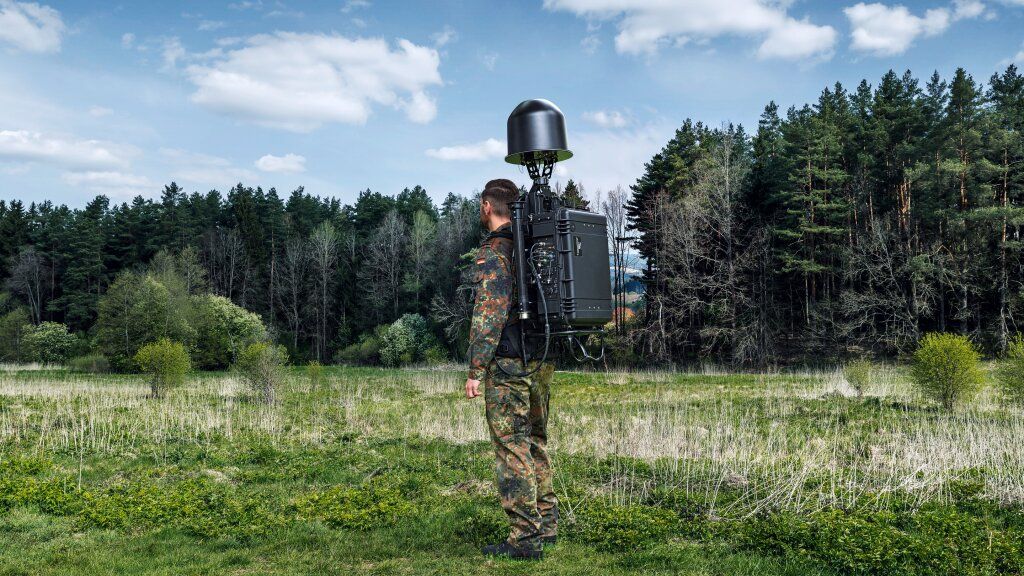
The Rohde & Schwarz R&S MP007 is a man-portable tactical direction-finding system for detecting, analyzing, and locating radio-frequency emissions. It covers frequencies from 9 MHz to 8 GHz.
The system combines an R&S PR200 portable monitoring receiver with an R&S ADD507 direction-finding antenna. Its portable, modular configuration supports field deployment, vehicle installation, and connection to wider radiolocation networks.
Rohde & Schwarz announced the MP007 on 5 August 2026. The company developed it for spectrum awareness, emissions control, interference localization, area and personnel protection, search and rescue, and early anomaly detection.
According to the manufacturer announcement, the complete system can be assembled without tools. Its components are arranged for rapid transport and deployment by tactical teams.
Design
System components
The MP007 uses an R&S PR200 portable monitoring receiver installed in an impact-resistant transport case. An R&S ADD507 compact VHF/UHF direction-finding antenna provides the primary direction-finding capability. The complete field kit also includes cables, two mast extensions, two batteries, and a laptop for control and signal presentation.
The assembled system weighs approximately 27 kg. Backpack-oriented configurations include a mast and adapter. Vehicle-mounted configurations use longer radio-frequency cables and a magnetic antenna mount. An optional R&S HE400 handheld antenna supports near-field homing.
Direction finding and signal analysis
In direction-finding mode, the MP007 covers the frequency range from 9 MHz to 8 GHz, although performance is reduced below 20 MHz. Its typical direction-finding accuracy is approximately 2 degrees root mean square when measured in a reflection-free environment.
The system uses the Watson-Watt direction-finding method at frequencies up to and including 300 MHz. Above 300 MHz, it uses correlative interferometry. The receiver provides a selectable intermediate-frequency spectrum display with a range of up to 40 MHz. With the optional CS-PS panorama-scan function, the scan rate reaches up to 60 GHz per second.
Power and environmental protection
Two lithium-ion batteries with integrated charging electronics provide up to eight hours of operation. The batteries are hot-swappable, allowing an operator to replace one during use without interrupting the system.
Rohde & Schwarz states that the MP007 complies with MIL-STD-810H requirements for climatic and mechanical stress and MIL-STD-461G requirements for electromagnetic compatibility. The system has an IP43 protection rating.
Networking and applications
Multiple MP007 units can be connected to form a radiolocation network. Within the Rohde & Schwarz software environment, networked units can support automatic triangulation, display signals on maps, generate configured alerts, and automate task sequences.
The system has two Ethernet interfaces. One provides direct control, while the second supports integration with customer-provided IP communications infrastructure, including tactical radio links.
The MP007 is intended for spectrum monitoring and emissions control tasks, locating interference sources, protecting areas and personnel, supporting search-and-rescue operations, and detecting unusual radio-frequency activity. The Janes report also identifies it as the latest Rohde & Schwarz man-portable direction-finding system announced in August 2026.
Configurations
- Field configuration: Portable system using the PR200 receiver, ADD507 antenna, transport case, mast extensions, batteries, cables, and control laptop.
- Backpack configuration: Portable arrangement supplied with a mast and adapter for deployment by a field team.
- Vehicle-mounted configuration: Installation using longer radio-frequency cables and a magnetic antenna mount.
- Near-field homing configuration: Optional arrangement using the R&S HE400 handheld antenna to locate a nearby emitter.
Specifications (R&S MP007)
General characteristics
- Type: Man-portable tactical direction-finding system
- Primary receiver: R&S PR200 portable monitoring receiver
- Primary antenna: R&S ADD507 direction-finding antenna
- Total weight: Approximately 27 kg, including cables, two mast extensions, and two batteries
- Power supply: Two hot-swappable lithium-ion batteries with integrated charging electronics
- Operating time: Up to eight hours
- Protection rating: IP43
- Environmental standards: MIL-STD-810H and MIL-STD-461G
Direction-finding performance
- Frequency range: 9 MHz to 8 GHz, with reduced performance below 20 MHz
- Typical accuracy: Approximately 2 degrees RMS in a reflection-free environment
- Method at 300 MHz and below: Watson-Watt
- Method above 300 MHz: Correlative interferometry
- Real-time bandwidth: Up to 40 MHz
- Panorama scan rate: Up to 60 GHz/s with the optional CS-PS function
Connectivity
- Ethernet interfaces: Two
- Network capability: Connection of multiple systems for radiolocation and automatic triangulation
 Argentina
 Armenia
 Australia
 Austria
 Austria-Hungary
 Belgium
 Brazil
 United Kingdom
 United States
 Brunei
 Bulgaria
 Canada
 Chile
Chile China
China Colonial America
 Colombia
 Confederate States
 Croatia
 Czech
Czech Denmark
 Egypt
Egypt Finland
 France
 Georgia
 German Imperial
 Greece
 Holland
 Hungary
 India
India Indonesia
 Iran
Iran Iraq
Iraq Ireland
 Israel
 Italy
Italy Japan
Japan Japan (1940)
 Jordan
 Kingdom of Italy
 Malaysia
 Mexico
 Myanmar
 Nazi Germany
 Netherlands
 New Zealand
 North Korea
 Norway
 Pakistan
 Peru
Peru Philippines
 Poland
 Portugal
 Prussia
 Romania
 Russia
 Saudi Arabia
 Serbia
 Singapore
 Slovakia
 Slovenia
 South Africa
 South Korea
 Soviet Union
 Spain
Spain Sweden
 Switzerland
 Syria
Syria Taiwan
 Thailand
 Turkey
 UAE
UAE Ukraine
 Vietnam
 Yugoslavia