
History
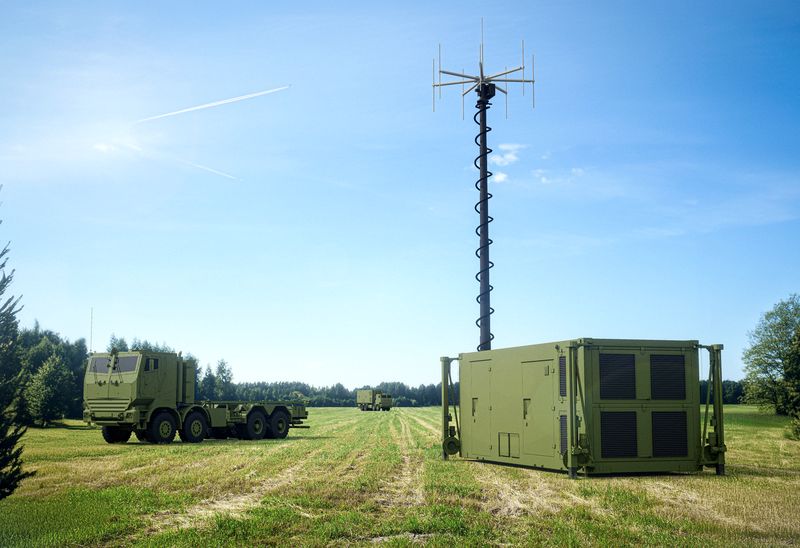
Hensoldt Twinvis is a German passive radar system developed for wide-area airspace surveillance without transmitting radar energy of its own. It detects and tracks targets by analysing reflections of existing radio and television broadcast signals.
The system is intended for military air surveillance and civil air traffic applications. Its passive operating principle allows it to contribute sensor data without adding a distinctive radar transmission to the electromagnetic environment.
Twinvis has been demonstrated in NATO-related trials and integrated with air-defence command-and-control systems. In 2026, its air picture was incorporated into Rheinmetall's Skymaster system during the German Air Force exercise Timber Express 2026.
Development and demonstrations
Development work on passive radar technology associated with Twinvis began in 2006. Hensoldt publicly presented the Twinvis system at ILA Berlin in 2018, where military and civilian configurations were shown. Background information on the system and its development is summarized in the Twinvis overview.
Hensoldt stated in 2019 that Twinvis had detected two F-35 aircraft departing Berlin after ILA 2018. The claim was disputed in its implications for stealth detection because Lockheed Martin said the aircraft were flying with radar reflectors and active transponders, which made them easier to detect. The available evidence therefore supports the reported detection but does not establish that the event demonstrated detection of F-35 aircraft in a low-observable combat configuration.
In 2019, a two-sensor Twinvis cluster was deployed on the Polish Baltic coast during a NATO Science and Technology Organization measurement campaign. Reported targets included ships, ultralight aircraft, combat aircraft, ballistic missiles and surface-to-air missiles. Surveillance ranges of up to 300 km were reported during the campaign, and live Twinvis data were supplied to the Polish MilRad network for analysis.
In February 2022, plans were reported to add Twinvis passive detection capability to the IRIS-T SLM surface-to-air missile system. This represented an integration proposal rather than evidence that Twinvis had become a standard operational component of every IRIS-T SLM system.
Timber Express 2026
During the German Air Force exercise Timber Express 2026, the air picture generated by Twinvis was successfully integrated into Rheinmetall's Skymaster command and weapon engagement system. Skymaster directed the Skynex air-defence battery used in the exercise scenario. Hensoldt described the event in an official announcement, while Janes independently reported the integration.
The systems operated under NATO networking conditions. Sensor data were fused and correlated through the Link 16 network to produce a common air picture. The exercise demonstrated that passive radar data could be incorporated into a network also combining active radar and electro-optical sensors.
Rheinmetall and Hensoldt said the results provide a basis for future integration of passive sensing with stationary Skynex systems, mobile Skyranger systems and counter-UAS systems such as Skyspotter. These were presented as future integration opportunities rather than confirmed standard Twinvis configurations. Contemporary coverage by Militär Aktuell also described the Timber Express demonstration.
Design
Twinvis is a passive radar receiver rather than a conventional transmitting radar. It uses electromagnetic signals already emitted by external transmitters and analyses signals reflected from aircraft or other objects. Because Twinvis does not require its own radar transmitter for target illumination, its operation does not create the normal emission signature associated with an active surveillance radar.
Signal processing
According to Hensoldt information cited in the available sources, Twinvis can process signals from up to 16 FM radio transmitters and five single-frequency networks using digital audio broadcasting and digital terrestrial television signals. Other published technical descriptions also list DAB+, DVB-T and DVB-T2 among supported broadcast sources.
The system compares direct signals from known transmitters with signals reflected from targets. Multiple geographically separated transmission sources can be used to calculate target positions and generate a three-dimensional air picture.
Sensor networking
A single Twinvis sensor is stated to track up to 200 aircraft in three dimensions within a radius of up to 250 km under suitable conditions. Up to 15 Twinvis sensors can also be connected as a sensor cluster. Published descriptions indicate that individual sensors in such a network may be separated by distances ranging from several kilometres to more than 100 km.
Detection range and accuracy depend on the illumination source and operational environment. Published figures associate FM signals with longer-range surveillance, while DAB and DVB-T signals provide shorter-range coverage with higher stated positional accuracy.
Air-defence integration
Twinvis can supply its air picture to external command-and-control networks rather than operating only as a stand-alone sensor. During Timber Express 2026, its tracks were incorporated into Rheinmetall Skymaster and correlated with other sensor data through Link 16. This demonstrated a practical networked role for Twinvis in an air-defence architecture.
Hensoldt is a German sensor company whose radar portfolio includes active and passive air-surveillance systems. A general company profile and radar overview are available in the Hensoldt reference article.
Program status
Twinvis has been used in demonstrations, trials and integration activities since its public presentation in 2018. Published reporting also states that two demonstration systems were delivered to Germany's Federal Office of Bundeswehr Equipment, Information Technology and In-Service Support. The supplied sources do not establish large-scale production or broad operational deployment.
The 2026 Timber Express trial demonstrated interoperability with an operational-style air-defence command network, but it did not by itself establish Twinvis as a standard fielded sensor for Skynex, Skyranger or Skyspotter. Rheinmetall and Hensoldt described those integrations as future possibilities supported by the exercise results.
Variants
- Military Twinvis: Passive surveillance configuration intended for military airspace monitoring and integration with defence networks.
- Civil Twinvis: Civilian configuration presented for applications including air traffic surveillance and supplementary airport coverage.
Specifications (Hensoldt Twinvis)
General characteristics
- Type: Passive three-dimensional air-surveillance radar
- Operating principle: Detection through reflections of emissions from external broadcast transmitters
- Azimuth coverage: 360 degrees
- FM transmitter inputs: Up to 16
- Single-frequency networks: Up to 5 using DAB and DVB-T broadcast sources
- Maximum reported simultaneous aircraft tracks: Up to 200
- Maximum reported sensors in a cluster: Up to 15
- Antenna-to-track delay: Less than 1.5 seconds
Performance
- Reported surveillance radius: Up to 250 km for a single sensor under suitable conditions
- FM-based detection range: About 250 km
- FM-based stated accuracy: About 300-500 m
- DAB/DVB-T-based detection range: About 100 km
- DAB/DVB-T-based stated accuracy: About 50-100 m
- Reported trial range: Up to 300 km during the 2019 NATO measurement campaign in Poland
 Argentina
 Armenia
 Australia
 Austria
 Austria-Hungary
 Belgium
 Brazil
 United Kingdom
 United States
 Brunei
 Bulgaria
 Canada
 Chile
Chile China
China Colonial America
 Colombia
 Confederate States
 Croatia
 Czech
Czech Denmark
 Egypt
Egypt Finland
 France
 Georgia
 German Imperial
 Greece
 Holland
 Hungary
 India
India Indonesia
 Iran
Iran Iraq
Iraq Ireland
 Israel
 Italy
Italy Japan
Japan Japan (1940)
 Jordan
 Kingdom of Italy
 Malaysia
 Mexico
 Myanmar
 Nazi Germany
 Netherlands
 New Zealand
 North Korea
 Norway
 Pakistan
 Peru
Peru Philippines
 Poland
 Portugal
 Prussia
 Romania
 Russia
 Saudi Arabia
 Serbia
 Singapore
 Slovakia
 Slovenia
 South Africa
 South Korea
 Soviet Union
 Spain
Spain Sweden
 Switzerland
 Syria
Syria Taiwan
 Thailand
 Turkey
 UAE
UAE Ukraine
 Vietnam
 Yugoslavia