

History
NPO Splav ISDM Zemledeliye is a Russian engineering system for remotely creating minefields. It uses 122 mm rockets carrying scatterable mines and can deploy them at ranges of 5 to 15 km.
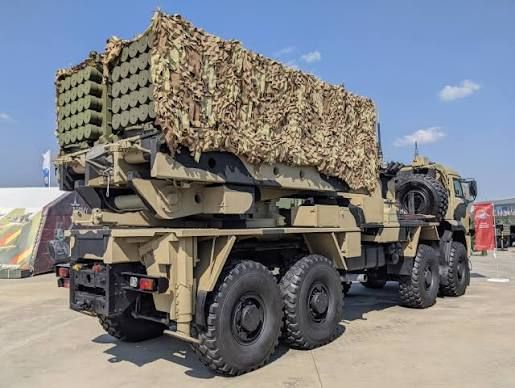
The system was developed for the Russian Armed Forces' Engineer Troops under the Zemledeliye-I research and development program. Its launcher carries 50 rockets in two 25-round containers on an armored KamAZ-6560 8x8 chassis.
Zemledeliye entered Russian service around 2020 and has subsequently been used in the Russia-Ukraine war. Ukrainian forces have reported destroying several systems with unmanned aircraft and FPV drones.
Development
The Zemledeliye-I program was associated with a December 2013 contract between the Russian Ministry of Defence and NPO Splav of Tula. According to Janes, the system was specifically developed for the Engineer Troops, and a preliminary batch was thought to have been delivered during 2020.
Zemledeliye was publicly displayed in Moscow in 2020. Russian military testing was reported to have concluded later that year during the Caucasus 2020 exercises. The system subsequently appeared during the Zapad-2021 strategic exercise. A general technical overview published by Wikipedia describes it as being in service from 2020.
Design
The complete Zemledeliye system includes a launcher vehicle, a transport-loading vehicle and containerized engineering ammunition. Both primary vehicles are based on the KamAZ-6560 8x8 truck and use armored cabins. The transport-loading vehicle has a rear-mounted crane for handling the ammunition containers.
Launcher and ammunition
The launcher carries two racks, each containing 25 preloaded 122 mm rockets, for a total of 50 rounds. The rockets use solid-fuel propulsion and carry scatterable mines. When fired, they release their mine payload over a designated area rather than functioning as conventional high-explosive artillery rockets.
The system can create minefields at distances between 5 and 15 km. The operator can define parameters including the shape, dimensions, density and mine type of the intended field. Course-corrected rockets and computerized fire control allow mines to be dispersed within the planned area. Reported compatible mines include the POM-3 Medallion anti-personnel mine and the PTM-4 anti-tank mine.
Programmable mine settings can include self-destruction or automatic deactivation after a selected period. This allows the duration of a remotely created minefield to be controlled rather than leaving every deployed mine permanently active.
Fire control and vehicle equipment
The launcher is equipped with satellite navigation, an onboard computer and meteorological equipment. These systems provide data for calculating the firing solution and compensating for conditions that can affect rocket flight. The vehicle also carries communications and fire-control equipment. Janes reports a self-defence system with six smoke grenade launchers, three mounted on each side of the vehicle.
Operational history
Russian forces employed Zemledeliye during the Russia-Ukraine war. Janes reported its combat debut in March 2022 after footage showed two launchers firing full 50-round salvos in what was reported to be Kharkiv Oblast.
The system was also used during later phases of the war, including Russian efforts to create mine barriers against Ukrainian ground operations. Open-source reporting has particularly associated Zemledeliye with extensive remote mining during the 2023 Ukrainian counteroffensive.
Ukrainian units have subsequently targeted Zemledeliye launchers with unmanned aircraft. In July 2025, Ukraine's Special Operations Forces reported destroying one system with FPV drones after locating it near the front line. Militarnyi reported that the vehicle was immobilized and then set on fire by additional drone strikes.
Another destroyed Zemledeliye was reported near Panteleymonivka south of Horlivka in November 2025. UNITED24 Media described the loss and noted the system's use of computerized controls for precise remote minefield creation.
In July 2026, the 412th Nemesis Brigade reported destroying a Zemledeliye system on the Zaporizhzhia front with FPV drones. Euromaidan Press reported the strike and described the system's role in remotely mining routes used by Ukrainian forces.
On 19 August 2026, the Dovbush Hornets unmanned-systems battalion of Ukraine's 68th Jaeger Brigade reported another strike on a Russian Zemledeliye. According to the unit's published imagery and video, the vehicle caught fire after being hit and was destroyed. The event provided further evidence that the system remained in Russian frontline use in 2026.
Operators
- Russian Armed Forces: Operated by the Engineer Troops and used during the Russia-Ukraine war.
Specifications (ISDM Zemledeliye launcher)
General characteristics
- Crew: 3
- Length: 10.3 m
- Width: 2.5 m
- Chassis: KamAZ-6560 8x8 armored truck
Launcher
- Caliber: 122 mm
- Launch capacity: 50 rockets in two 25-round containers
- Ammunition: Rockets carrying scatterable anti-personnel or anti-tank mines
- Maximum firing range: 15 km
- Reported operating range for mine deployment: 5 to 15 km
 Argentina
 Armenia
 Australia
 Austria
 Austria-Hungary
 Belgium
 Brazil
 United Kingdom
 United States
 Brunei
 Bulgaria
 Canada
 Chile
Chile China
China Colonial America
 Colombia
 Confederate States
 Croatia
 Czech
Czech Denmark
 Egypt
Egypt Finland
 France
 Georgia
 Germany
 German Imperial
 Greece
 Holland
 Hungary
 India
India Indonesia
 Iran
Iran Iraq
Iraq Ireland
 Israel
 Italy
Italy Japan
Japan Japan (1940)
 Jordan
 Kingdom of Italy
 Malaysia
 Mexico
 Myanmar
 Nazi Germany
 Netherlands
 New Zealand
 North Korea
 Norway
 Pakistan
 Peru
Peru Philippines
 Poland
 Portugal
 Prussia
 Romania
 Saudi Arabia
 Serbia
 Singapore
 Slovakia
 Slovenia
 South Africa
 South Korea
 Soviet Union
 Spain
Spain Sweden
 Switzerland
 Syria
Syria Taiwan
 Thailand
 Turkey
 UAE
UAE Ukraine
 Vietnam
 Yugoslavia