

History
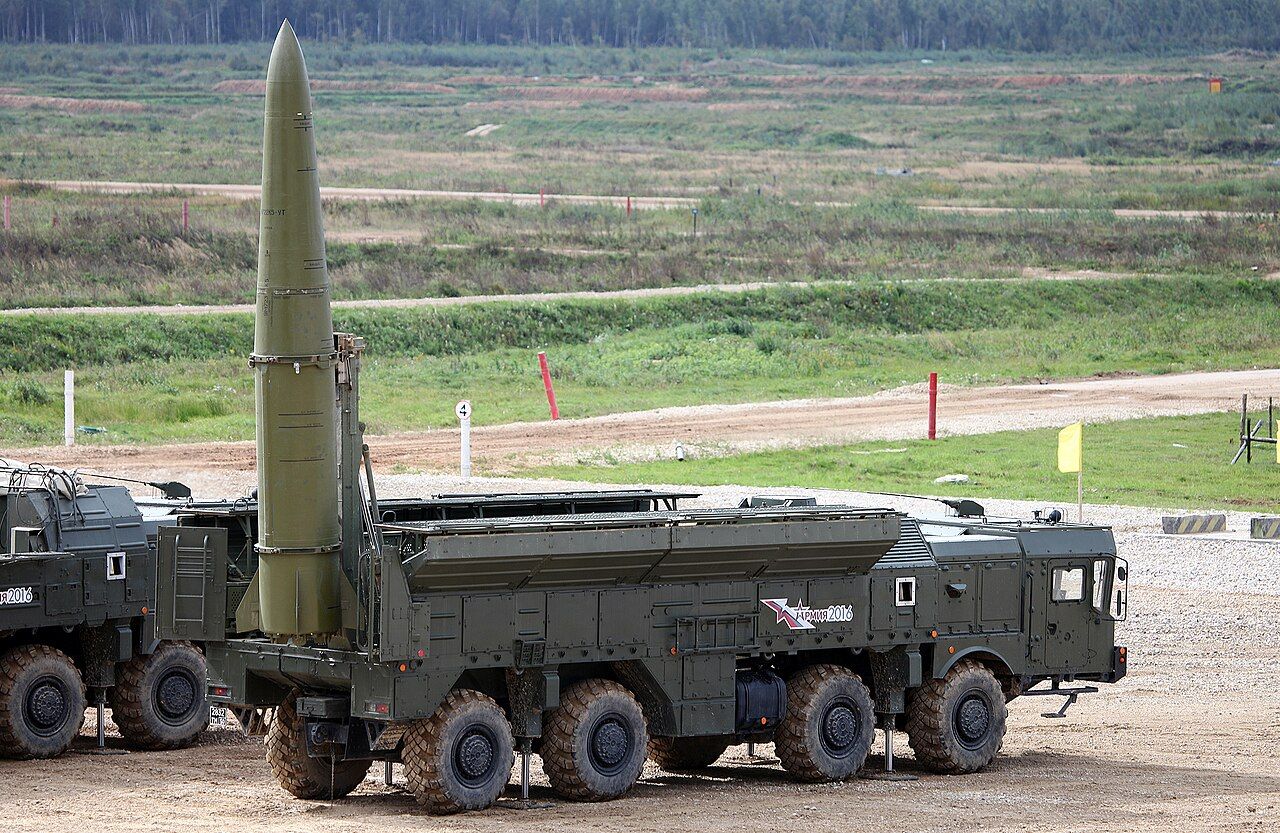
The 9P78-1 is the road-mobile transporter-erector-launcher associated with Russia's Iskander-M operational-tactical missile system. It carries two missiles and provides their transport, launch preparation, elevation and firing from dispersed positions.
The launcher forms one element of the wider Iskander complex, which also includes transporter-loader, command, information-processing, maintenance and support vehicles. Detailed technical profiles describe the 9P78-1 as an 8×8 vehicle based on the Belarusian MZKT-7930 all-terrain chassis.
The Iskander program was developed as a successor to earlier Soviet operational-tactical missile systems. The Iskander-M entered Russian service in 2006, providing missile brigades with a mobile launcher capable of rapidly firing two missiles before relocating.
Development and introduction
Work on the Iskander family began during the late Soviet period. The wider program is described as having started in 1988, with the Kolomna Machine-Building Design Bureau responsible for development of the missile system. Ground equipment was produced by organizations including Production Association Barricades in Volgograd, while another technical account identifies the Central Design Bureau Titan as the launcher designer. The first successful Iskander missile launch was reported in 1996.
Serial production of the Iskander-M system began in 2006, when the system was also adopted by the Russian Army. Because the available sources do not provide a separate completion date for the first 9P78-1 launcher, 2006 is used here as the earliest supported production and service milestone for the Iskander-M launcher configuration.
Russian missile brigades subsequently converted to the Iskander-M. A detailed RUSI technical profile states that an Iskander-M brigade has three battalions, each with four 9P78-1 launchers, giving a total of 12 TELs per brigade.
Design
Chassis and mobility
The 9P78-1 is built on an 8×8 MZKT-7930 high-mobility chassis. RUSI gives the gross vehicle weight as 42.3 tonnes and a maximum road speed of 70 km/h. The launcher is intended to leave paved roads and use dispersed firing positions, reducing the time it must remain exposed at a launch site.
The chassis identification is inconsistent in some secondary descriptions. Army Recognition refers in one passage to a BAZ6909-based launcher but elsewhere identifies the Iskander-M vehicle as MZKT-7930. More detailed technical profiles from RUSI and Missilery.info, as well as the system description summarized by Wikipedia, identify the operational launcher chassis as the MZKT-7930 or closely related MZKT-79306 designation.
Launcher arrangement
The launcher carries two missiles horizontally during movement and preparation. Before firing, a selected missile is raised into the vertical launch position. The vehicle incorporates equipment for determining its position, receiving target and mission data, programming the missile and conducting the launch sequence.
RUSI reports that the 9P78-1 has a gas-turbine generator that supplies power for missile elevation and programming. Target coordinates can be entered through a computer in the cab, while a datalink in the rear of the launcher transfers the engagement data to the missile.
The launcher is operated by a crew of three. The vehicle can prepare a missile for launch within about 16 minutes after movement, with the time reduced to about five minutes when already stationary. Other published system specifications give up to four minutes from the highest state of readiness and up to 16 minutes from march. Both carried missiles can be fired with an interval of no more than approximately one minute.
Missile carriage
The Iskander-M launcher is primarily associated with the 9M723 family of quasi-ballistic missiles. Each 9P78-1 carries two missiles. The broader launcher architecture is also associated with cruise-missile configurations of the Iskander family, including the 9M728. RUSI notes that a launcher may be capable of carrying different missile types at the same time, although this is described as a possibility rather than a confirmed standard loading practice.
The missile rather than the launcher provides the propulsion, guidance and warhead capability. The launcher therefore should not be confused with the complete 9K720 Iskander-M weapon system or with the 9M723 missile itself.
Supporting vehicles
The 9P78-1 operates as part of a larger vehicle group. The 9T250-series transporter-loader carries replacement missiles and uses a crane to transfer them to the launcher. RUSI reports a two-person crew for the transporter-loader and an understood reload time of approximately 16 minutes.
Other supporting elements include command and staff vehicles and an information-processing station. These vehicles receive and process targeting information before transmitting engagement data to the launcher. A Missile Defense Advocacy Alliance profile likewise describes the Iskander as using a road-mobile TEL carrying up to two missiles alongside loader, command, information, maintenance and support vehicles.
Operational history
Iskander systems have been operational with Russian forces since 2006. The first documented combat use of the wider Iskander system was reported during the 2008 Russo-Georgian War. Russian missile brigades subsequently received additional Iskander-M sets as the type replaced older operational-tactical missile systems.
During the Russia-Ukraine war, Russia deployed Iskander-M systems close to the Ukrainian border and used Iskander missiles extensively against targets in Ukraine. The mobility of the launcher allows firing units to operate from dispersed locations and relocate after launch.
Launchers have also become targets for Ukrainian long-range strikes. On 5 June 2025, the Ukrainian military said a strike on a missile base at Klintsy in Russia's Bryansk region destroyed one Iskander launcher and damaged two others. On 14 March 2026, Ukrainian forces reported destroying an Iskander ballistic-missile launcher near Vyshneve in Crimea.
In August 2026, Ukrainian President Volodymyr Zelensky stated that Ukrainian forces had struck an Iskander launcher on Russian territory near Ukraine's border. He described attacks on launch positions close to Ukraine as one method of reducing Russian ballistic-missile attacks, while withholding operational details because of the sensitivity of the mission.
Operators
- Russia: The 9P78-1 launcher is fielded as part of Russian Iskander-M missile brigades. The system has been in Russian service since 2006.
Export users of the wider Iskander family include Armenia and Algeria with the Iskander-E configuration, while Belarus received Iskander systems beginning in 2022. The supplied evidence does not establish that all export launchers are identical to the Russian 9P78-1 Iskander-M configuration, so they are not listed here as confirmed operators of this exact launcher variant.
Specifications (9P78-1 Iskander-M launcher)
General characteristics
- Type: Self-propelled transporter-erector-launcher
- Chassis: MZKT-7930 8×8 all-terrain wheeled chassis
- Crew: 3
- Missiles carried: 2
- Gross vehicle weight: 42.3 tonnes
- Maximum road speed: 70 km/h
Launch preparation
- Preparation from movement: approximately 16 minutes
- Preparation when stationary: approximately 5 minutes according to the RUSI technical profile
- Launch interval: no more than approximately 1 minute between the two carried missiles
Equipment
- Auxiliary power: Gas-turbine generator for missile elevation and programming
- Mission preparation: Computerized target-coordinate entry and missile programming
- Launch arrangement: Missiles carried horizontally and elevated to the vertical position before launch
Related equipment
- 9T250 transporter-loader: Companion vehicle that carries replacement missiles and uses a crane to reload the launcher.
- 9M723: Quasi-ballistic missile family primarily associated with the Iskander-M launcher.
- 9M728: Cruise missile associated with the Iskander family and capable of being launched from compatible Iskander TEL configurations.
- OTR-23 Oka: Earlier Soviet operational-tactical missile system that influenced the development path leading to Iskander.
 Argentina
 Armenia
 Australia
 Austria
 Austria-Hungary
 Belgium
 Brazil
 United Kingdom
 United States
 Brunei
 Bulgaria
 Canada
 Chile
Chile China
China Colonial America
 Colombia
 Confederate States
 Croatia
 Czech
Czech Denmark
 Egypt
Egypt Finland
 France
 Georgia
 Germany
 German Imperial
 Greece
 Holland
 Hungary
 India
India Indonesia
 Iran
Iran Iraq
Iraq Ireland
 Israel
 Italy
Italy Japan
Japan Japan (1940)
 Jordan
 Kingdom of Italy
 Malaysia
 Mexico
 Myanmar
 Nazi Germany
 Netherlands
 New Zealand
 North Korea
 Norway
 Pakistan
 Peru
Peru Philippines
 Poland
 Portugal
 Prussia
 Romania
 Saudi Arabia
 Serbia
 Singapore
 Slovakia
 Slovenia
 South Africa
 South Korea
 Soviet Union
 Spain
Spain Sweden
 Switzerland
 Syria
Syria Taiwan
 Thailand
 Turkey
 UAE
UAE Ukraine
 Vietnam
 Yugoslavia