
History
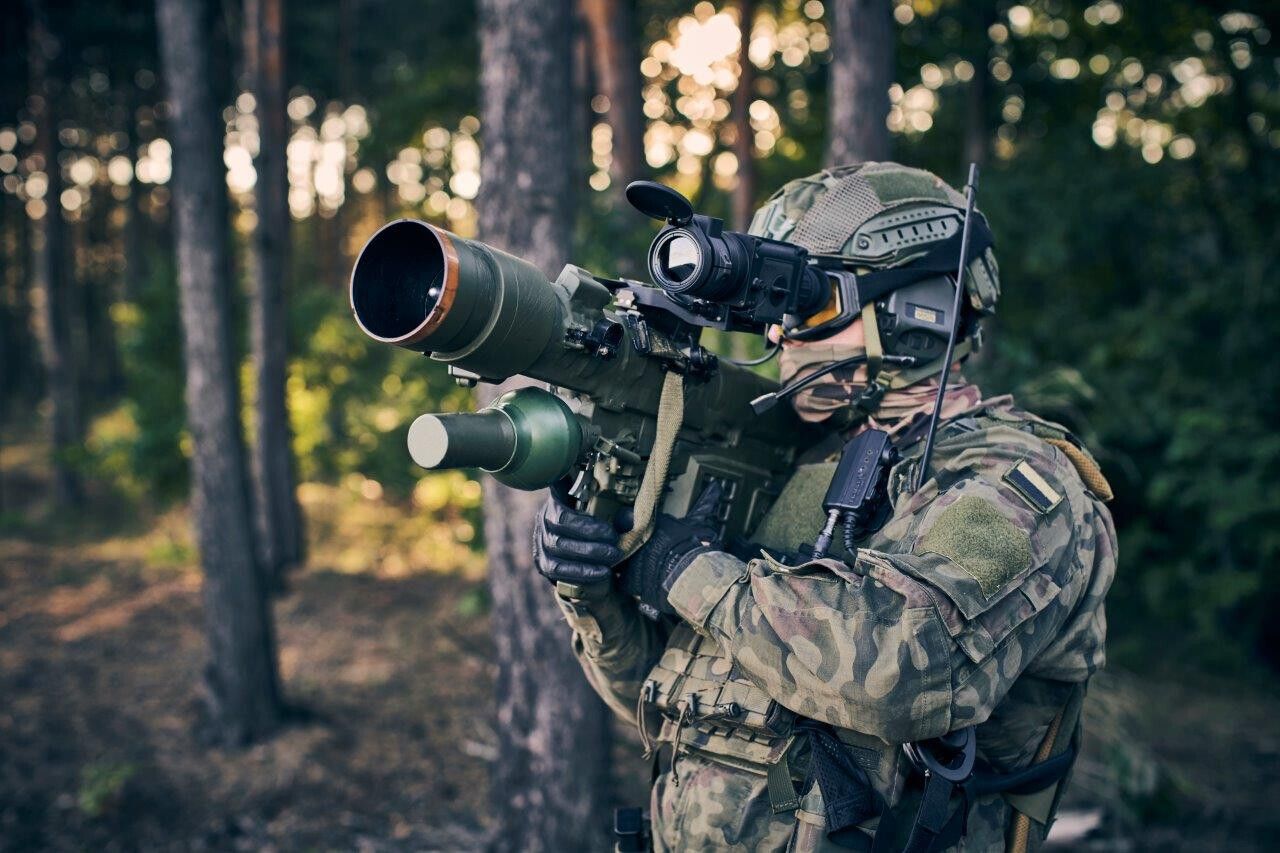
The MESKO Piorun is a Polish man-portable air-defense system designed to engage low-flying aerial targets. It is a modernization of the earlier Grom system and is also known as Grom-M.
Piorun development focused on improving target detection, resistance to countermeasures, guidance accuracy and effectiveness against small aerial targets. The system entered production in Poland and has subsequently been ordered by several NATO countries and other international customers.
The system has been used by Ukrainian forces since 2022, while growing international demand has led Poland's defense industry to expand Piorun missile production capacity.
Development and production
The modernization program that produced Piorun was carried out during 2010–2015. Piorun was publicly presented at the MSPO defense exhibition in 2015. In December 2016, the Polish Ministry of National Defence signed a contract with MESKO for 1,300 missiles and 420 launch mechanisms.
Technical problems with the propulsion system delayed deliveries, which began in 2019 after successful testing. Piorun missiles were subsequently integrated with Polish ground-based air-defense systems including Poprad and PSR-A Pilica.
MESKO manufactures Piorun at its plant in Skarżysko-Kamienna, Poland. PGZ reported that dedicated production capacity had increased from about 300 missiles per year to approximately 1,500, with plans to exceed 2,000 missiles annually.
In August 2026, Poland, Norway, Lithuania and Latvia established a joint procurement arrangement covering several thousand Piorun missiles and several hundred launch units. The contract was valued at more than 8 billion Polish zlotys, and deliveries were scheduled to continue through 2030. More than 80 percent of the equipment was intended for the Polish Armed Forces, while the remainder was to be supplied to the other participating countries. The contract also included simulators, training and logistics packages.
Design
Piorun is a portable surface-to-air missile system intended for short-range defense against low-flying aircraft, helicopters, unmanned aerial vehicles and other small aerial targets. It uses an infrared homing system derived from the Grom family.
The modernization introduced more sensitive detection systems intended to increase target acquisition range. CRW Telesystem-Mesko developed key optoelectronic and electronic assemblies for the system, including components of the seeker, programmable electronics and the digital starting mechanism.
The seeker incorporates indium antimonide and lead sulfide photodetectors. New processing algorithms, spectral ranges and target-selection methods were introduced to increase resistance to thermal interference. Changes to missile control characteristics were intended to improve accuracy in both the distant and terminal portions of flight.
Piorun also introduced a proximity fuze to increase effectiveness against small targets. Optical and optoelectronic aiming devices support target engagement, including operation under night conditions. A programmable grip stock assembly provides digital control functions and allows Piorun missiles to be integrated with different launching platforms.
Operational history
Ukraine received Piorun systems before and during the Russian invasion that began in 2022. Ukrainian forces have credited Piorun missiles with engagements against Russian aircraft and helicopters, including Su-34 and Su-25 aircraft and Mi-24 and Ka-52 helicopters. Independent attribution of individual losses is not established by the available sources.
Operational use in Ukraine contributed to increased international interest in the system. PGZ has reported sales to customers including the United States, Japan and Indonesia, while additional European states have placed orders or joined procurement programs.
Variants
- Piorun: Production modernization of the Grom man-portable air-defense system with improved detection, guidance electronics, resistance to thermal interference, a proximity fuze and day and night aiming capability.
- Piorun New Generation: Planned further development announced by PGZ. The company states that it is intended to provide longer range, additional features and improved portability.
Operators
- Poland: Primary user and customer. Poland has ordered thousands of missiles and hundreds of launch mechanisms.
- Ukraine: Uses Piorun systems supplied by Poland and has employed them during the war with Russia since 2022.
- Latvia: Reported as an operator and participant in the 2026 multinational procurement program.
- Norway: Reported as an operator and participant in the 2026 multinational procurement program.
- Sweden: Reported as an operator, with an additional order placed for delivery in 2027.
- Belgium: Reported as an operator.
- Estonia: Reported as an operator.
- North Macedonia: Reported as an operator.
Lithuania joined the 2026 four-country procurement program. Available reporting described this as its first Piorun order, so Lithuania is treated as a future operator rather than an established operator.
Specifications (Piorun)
General characteristics
- Type: Man-portable surface-to-air missile system
- Guidance: Infrared homing
- Target types: Low-flying aircraft, helicopters, unmanned aerial vehicles and small aerial targets
Performance
- Maximum engagement range: Up to 6.5 km (4.0 mi), according to producer data cited in the available source
- Maximum engagement altitude: Up to 4 km (2.5 mi)
- Missile speed: Approximately 660 m/s
Warhead and guidance features
- Fuzing: Proximity fuze
- Seeker features: Improved sensitivity and resistance to thermal interference compared with the earlier Grom system
- Sighting: Optical and optoelectronic aiming equipment with day and night capability
 Argentina
 Armenia
 Australia
 Austria
 Austria-Hungary
 Belgium
 Brazil
 United Kingdom
 United States
 Brunei
 Bulgaria
 Canada
 Chile
Chile China
China Colonial America
 Colombia
 Confederate States
 Croatia
 Czech
Czech Denmark
 Egypt
Egypt Finland
 France
 Georgia
 Germany
 German Imperial
 Greece
 Holland
 Hungary
 India
India Indonesia
 Iran
Iran Iraq
Iraq Ireland
 Israel
 Italy
Italy Japan
Japan Japan (1940)
 Jordan
 Kingdom of Italy
 Malaysia
 Mexico
 Myanmar
 Nazi Germany
 Netherlands
 New Zealand
 North Korea
 Norway
 Pakistan
 Peru
Peru Philippines
 Portugal
 Prussia
 Romania
 Russia
 Saudi Arabia
 Serbia
 Singapore
 Slovakia
 Slovenia
 South Africa
 South Korea
 Soviet Union
 Spain
Spain Sweden
 Switzerland
 Syria
Syria Taiwan
 Thailand
 Turkey
 UAE
UAE Ukraine
 Vietnam
 Yugoslavia